Potatoes are one of the most common foods in kitchens around the world. They are inexpensive, versatile, easy to prepare, and can be transformed into countless dishes, from crispy roasted potatoes and creamy mashed potatoes to fries, soups, stews, gratins, and casseroles.
But every once in a while, you reach into the pantry and discover something strange.
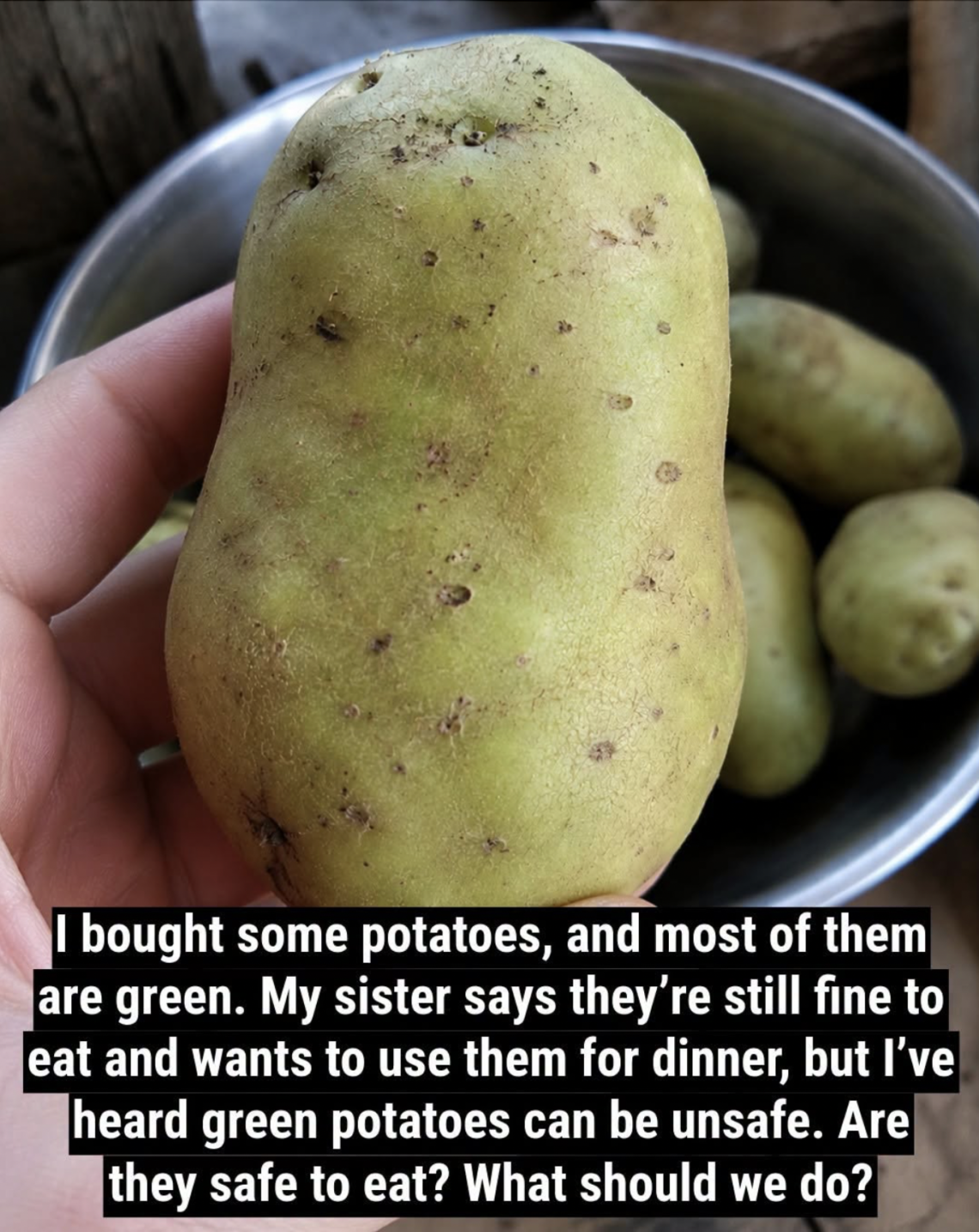
A potato that was once completely yellow, brown, red, or white now has a green patch on its skin.
Sometimes the entire potato has developed a greenish color. Sometimes only a small section is green. In other cases, the potato looks perfectly normal from the outside, but after cutting it open, you notice a green area just underneath the skin.
This naturally leads to an important question:
Why do potatoes turn green, and are green potatoes actually safe to eat?
The answer is more complicated than simply saying, “Green potatoes are poisonous,” or “Just cut off the green part.”
The green color itself is not what makes the potato potentially harmful. The green color is mainly a sign that the potato has been exposed to light and has begun producing chlorophyll. However, exposure to light can also be associated with increased levels of naturally occurring glycoalkaloids, particularly solanine and related compounds, which can cause illness if consumed in sufficiently high amounts.
That means the green color is an important warning sign.
Understanding what it means, how green potatoes develop, how to store potatoes correctly, and when a potato should simply be thrown away can help you make safer decisions in the kitchen.
What Does It Mean When a Potato Turns Green?
The first thing to understand is that potatoes do not normally turn green because they are becoming poisonous in the same way that spoiled meat or moldy food becomes unsafe.
The green color is primarily caused by chlorophyll.
Chlorophyll is the pigment responsible for the green color in plants.
When a potato grows underground, it is protected from sunlight. Because it develops in darkness, the potato’s skin usually remains its normal color.
But once the potato is exposed to light, something changes.
The cells in the potato begin responding to that light exposure, and chlorophyll can develop in the skin and sometimes in the flesh immediately underneath it.
This is why green potatoes are often found in situations where they have been exposed to light for an extended period.
For example, a potato may turn green when it is:
- sitting on a kitchen counter near a sunny window
- stored in a transparent bag
- exposed to bright artificial lighting
- left uncovered in a grocery store
- stored in a pantry with too much light
- partially exposed after being dug from the soil
- kept in a container that allows light to enter
The green color itself is therefore primarily a plant response to light.
But there is an important connection between light exposure and naturally occurring potato toxins.
The Real Concern Is Not Chlorophyll
This is one of the most important points to remember.
Chlorophyll is not the main reason green potatoes can be dangerous.
Eating chlorophyll does not normally cause the kind of poisoning associated with heavily green potatoes.
The concern is the presence of glycoalkaloids.
Potatoes naturally contain glycoalkaloids as part of their natural defense system.
The two compounds most commonly discussed are:
- solanine
- chaconine
These compounds help protect the potato plant against certain insects, animals, and other threats.
They are naturally occurring chemicals.
They are not something manufacturers add to potatoes.
Under normal circumstances, potatoes contain relatively low levels of these compounds.
However, levels can increase under certain conditions, particularly when potatoes are exposed to light, damaged, sprouting, or otherwise stressed.
This is why a green potato deserves attention.
Why Would a Potato Produce These Compounds?
From the potato’s perspective, these compounds are useful.
A potato is not simply a piece of food sitting in your kitchen.
Biologically, it is part of a living plant.
The tuber is a storage organ.
Its purpose is to store energy and nutrients that can eventually support the development of a new potato plant.
The potato plant has natural defense mechanisms to protect itself.
Glycoalkaloids are part of that defense system.
They can make the plant less attractive to insects and animals.
So when a potato experiences certain environmental conditions, the plant can respond by increasing the concentration of these defensive compounds.
Light exposure is one of the factors associated with this process.
That is why the green color should not simply be dismissed as a cosmetic change.
Does Every Green Potato Contain Dangerous Levels of Solanine?
No.
This is another important distinction.
The presence of green color does not automatically mean that the potato contains a dangerous amount of glycoalkaloids.
The concentration can vary considerably.
A potato might have a small green patch with relatively limited accumulation.
Another potato could be extensively green and have a much higher concentration.
Other factors also matter, including:
- potato variety
- growing conditions
- storage conditions
- temperature
- light exposure
- physical damage
- sprouting
- age
- location of the green tissue
- preparation
This makes it difficult to judge safety using color alone.
Nevertheless, significant greening is a reason to be cautious.
Can You Eat a Potato With a Small Green Spot?
This is where the answer becomes more practical.
If a potato has only a small localized green area, some food-safety guidance allows the green portion and surrounding tissue to be removed generously, followed by careful inspection of the remaining potato.
The important point is that you should not simply shave off the thinnest possible layer.
The potentially elevated glycoalkaloids can be concentrated near the skin and green areas.
A generous amount should therefore be removed.
After cutting away the green portion, examine the rest of the potato.
If the potato looks normal, smells normal, has a firm texture, and the remaining flesh is not bitter or otherwise unusual, the situation is different from a potato that is extensively green, severely sprouted, shriveled, or bitter.
However, if a large portion of the potato is green, throwing it away is the safer choice.
When in doubt, don’t take unnecessary chances with food that is inexpensive and easily replaced.
What If the Whole Potato Is Green?
A potato that is extensively green should generally be discarded.
There is little reason to try to rescue a potato when a substantial portion of it has developed green coloration.
Removing the skin may reduce some exposure, but it does not guarantee that all elevated glycoalkaloids have been eliminated.
This is particularly important if the flesh itself has become greenish rather than merely having a small green patch on the surface.
The more extensive the greening, the less attractive the potato becomes as a food choice.
When a potato is heavily green, bitter, or significantly sprouted, the safest and simplest decision is usually to throw it away.
What About Potato Sprouts?
Sprouting is another important warning sign.
Potatoes naturally contain buds, often called “eyes,” from which new shoots can develop.
Under suitable storage conditions, these eyes can remain dormant for a long time.
But when potatoes are exposed to warmth, light, moisture, or prolonged storage, the eyes can begin producing sprouts.
A small sprout does not necessarily mean the entire potato must automatically be discarded.
If the potato remains firm and otherwise looks healthy, some guidance allows small sprouts to be removed along with the surrounding area.
However, heavily sprouted potatoes should be discarded.
This is especially true when the potato is also:
- green
- soft
- shriveled
- bitter
- strongly discolored
Sprouting and greening can both be associated with increased glycoalkaloid concentrations.
Are Potato Sprouts Poisonous?
Potato sprouts can contain higher levels of glycoalkaloids than ordinary potato flesh.
That is why you should not intentionally eat potato sprouts.
If you find a few small sprouts on an otherwise healthy potato, remove the sprouts and their immediate surrounding tissue before cooking.
But if the potato is covered with many long sprouts, has become very soft, or has significant green coloration, it is better to discard it.
The older and more deteriorated the potato becomes, the less worthwhile it is to try to save it.
What Happens If You Eat Too Much Solanine?
High exposure to potato glycoalkaloids can cause gastrointestinal and neurological symptoms.
Possible symptoms can include:
- nausea
- vomiting
- abdominal pain
- diarrhea
- headache
- dizziness
- weakness
- confusion
- burning or irritation in the mouth or throat
More severe poisoning is possible with sufficiently high exposure, although serious cases are uncommon.
The exact severity depends on the amount consumed, the concentration of glycoalkaloids, and individual factors.
This is why you should not deliberately eat strongly green or bitter potatoes simply to avoid wasting food.
Why Do Green Potatoes Sometimes Taste Bitter?
Bitterness can be an important warning sign.
Glycoalkaloids can contribute to a bitter taste and unpleasant mouth sensations.
If you cook a potato and it tastes unusually bitter, particularly if it was green or heavily sprouted, do not continue eating it.
You should not try to disguise the bitterness with:
- butter
- cheese
- sauces
- spices
- salt
- gravy
A strong bitter taste is not something to “cook away.”
It is better to discard the potato.
Can Cooking Remove Solanine?
This is a common misconception.
People often assume that because cooking destroys many harmful microorganisms, it must also eliminate every natural toxin.
That is not necessarily true.
Glycoalkaloids are relatively heat-stable compared with many ordinary foodborne microorganisms.
Normal cooking methods do not guarantee their complete destruction.
Therefore, you should not rely on boiling, baking, frying, roasting, or microwaving to make a heavily green potato safe.
Cooking can change the concentration in some circumstances, but it should not be viewed as a reliable way to rescue a potato with substantial glycoalkaloid accumulation.
The safest strategy is to start with potatoes that have been properly stored and show no significant greening.
Does Boiling Help?
Boiling can cause some water-soluble compounds to move into the cooking water.
But that does not mean boiling a heavily green potato makes it safe.
The degree of reduction depends on many factors.
If a potato is substantially green or otherwise concerning, don’t use boiling as a safety strategy.
Food safety begins before the potato reaches the cooking pot.
What About Frying?
Frying uses high temperatures, but again, that does not mean you can take a heavily green potato and simply fry it until it becomes safe.
In fact, frying can sometimes make it harder to recognize the original condition of the potato because the exterior changes color during cooking.
A crispy surface does not automatically mean a questionable potato has become safe.
Start with good-quality potatoes.
Does Peeling Remove the Problem?
Peeling can remove a substantial portion of the compounds because glycoalkaloids can be concentrated near the skin, particularly in green areas.
This is one reason peeling and removing green portions can reduce exposure.
However, peeling is not a guarantee that a heavily green potato is safe.
If the potato is extensively green, it is better to discard it rather than relying on peeling alone.
For a small green spot on an otherwise normal potato, removing the skin and a generous amount of the underlying flesh around the green area can reduce the affected tissue.
Why Are Glycoalkaloids Concentrated Near the Skin?
The potato’s outer tissues are particularly important from a defense perspective.
The skin and immediately underlying tissue are exposed to environmental stress.
The plant’s defense compounds can therefore be more concentrated in these areas.
When the potato turns green, the green tissue and surrounding area can have elevated glycoalkaloid concentrations.
This is why simply cutting away a paper-thin green layer is not necessarily sufficient.
Why Do Potatoes Turn Green at the Grocery Store?
Sometimes potatoes begin turning green before you even bring them home.
This can happen because of the way they are displayed.
If potatoes are exposed to strong store lighting for long periods, light can reach the tubers.
Even relatively moderate exposure can contribute to greening over time.
This is one reason potatoes are often sold in opaque or semi-opaque packaging rather than transparent plastic.
When shopping, inspect the potatoes before buying them.
Look for:
- excessive green areas
- severe sprouting
- deep cuts
- mold
- soft spots
- major bruising
- shriveling
A small blemish is not necessarily a problem, but potatoes that are extensively green are best avoided.
How Should You Store Potatoes?
Proper storage is one of the easiest ways to prevent potatoes from turning green.
The ideal environment is generally:
cool, dark, dry, and well ventilated.
The exact ideal temperature depends on the purpose and variety, but ordinary household storage should avoid both excessive warmth and refrigeration unless you have a specific reason and understand the consequences.
The key principle for preventing greening is simple:
Keep potatoes away from light.
A dark pantry, cupboard, or suitable storage area is much better than a sunny countertop.
Why Should Potatoes Be Kept in the Dark?
Because light encourages chlorophyll production.
Remember that the green color is primarily a response to light.
If you leave potatoes sitting beside a window, you may eventually notice green patches developing.
The same can happen under bright kitchen lights if potatoes remain exposed for long periods.
A dark storage container can significantly reduce this problem.
Should Potatoes Be Stored in the Refrigerator?
This is more complicated than it might seem.
Refrigerator temperatures are generally colder than ideal for many raw potatoes intended for ordinary cooking.
Very cold storage can cause starch to convert into sugars.
This can affect:
- flavor
- color
- cooking behavior
- browning during frying
For that reason, many recommendations favor storing potatoes in a cool, dark, well-ventilated place rather than a standard refrigerator.
However, storage recommendations can vary depending on the potato type and intended preparation.
The most important thing for preventing greening is avoiding light.
Why Should You Avoid Plastic Bags?
Plastic bags can trap moisture.
Excess moisture can encourage deterioration and mold.
Potatoes generally benefit from airflow.
Paper bags, breathable sacks, baskets, or other ventilated storage arrangements are often more suitable.
However, the exact container matters less than the overall environment.
The goal is:
dark + cool + dry + ventilated.
Don’t Store Potatoes Next to Onions
You may have heard this recommendation before.
Potatoes and onions have different storage needs and can release gases that may influence each other’s shelf life.
Keeping them separated is a simple practical habit.
Store potatoes in their own ventilated container and keep onions elsewhere.
This can help reduce premature deterioration.
Why Do Potatoes Turn Green Even in Your Pantry?
Sometimes people store potatoes in a pantry and still discover green patches.
This can happen because the pantry isn’t actually dark enough.
For example, potatoes may sit on an open shelf where daylight enters through a nearby window.
Even indirect light can contribute to greening over time.
Another possibility is that potatoes were already partially green when purchased.
Inspect them carefully when bringing them home.
Does Washing a Potato Remove the Green Color?
No.
Washing does not remove chlorophyll from the potato’s tissues.
If the potato is green because of light exposure, the green pigment is inside the affected tissue.
You need to remove the affected area rather than simply washing the surface.
What If the Potato Has a Green Skin but White Flesh?
This is relatively common.
You may peel the potato and find that the interior looks normal.
That is better than having green coloration deep into the flesh, but it does not automatically mean you should ignore the greening.
Remove the green skin and a generous amount of the flesh immediately underneath it.
Then inspect the remaining potato.
If there is extensive greening, bitterness, or other signs of deterioration, discard it.
What If Only One Side Is Green?
A localized green area often indicates that only part of the potato was exposed to light.
For example, a potato may have been lying on a shelf with one side exposed.
The exposed side turns green while the covered side remains normal.
In such a case, the green area should be removed generously.
The rest of the potato may still be usable if it is otherwise sound.
But again, if you are uncomfortable with the potato’s condition, throwing it away is the safest option.
What If the Potato Is Slightly Green but Very Firm?
Firmness is a positive sign regarding general freshness, but it doesn’t eliminate the issue of glycoalkaloids.
A firm green potato can still contain elevated levels of these compounds.
Therefore, don’t use firmness as the only safety test.
Evaluate the extent of greening.
A small area can potentially be removed.
A heavily green potato should generally be discarded.
What If the Potato Is Green and Soft?
That’s a much stronger reason to throw it away.
Greening plus softness suggests the potato has experienced significant deterioration.
If it is also:
- wrinkled
- sprouting heavily
- leaking
- moldy
- foul-smelling
- bitter
there is little reason to attempt to salvage it.
A potato is inexpensive compared with the consequences of eating food that has clearly deteriorated.
What If There Is Mold?
Mold is a separate issue from greening.
A small superficial blemish on a firm vegetable can sometimes be handled differently depending on the food, but potatoes that are significantly moldy, soft, or deteriorated should be discarded.
Don’t simply cut away a large moldy section and assume the rest is always safe.
When spoilage is extensive, the safest choice is disposal.
Can Green Potatoes Make Children Sick?
Children can be more vulnerable to foodborne hazards because of their smaller body size.
If a child accidentally eats a small amount of potato that had a small green patch removed, serious poisoning is unlikely.
But deliberately serving heavily green or bitter potatoes to children is not advisable.
If someone has eaten a significant quantity of strongly green or bitter potato and develops concerning symptoms, seek medical advice promptly.
What About Pets?
Potatoes can also pose concerns for animals.
Raw, green, or sprouted potato material should not be intentionally fed to pets.
Dogs and other animals can be affected by various compounds found in plants, and individual sensitivity varies.
If a pet has consumed a substantial amount of green or sprouted potato, especially if symptoms develop, contact a veterinarian.
Can You Eat Green Potato Chips?
This is an interesting question because potato chips are made from potatoes.
Commercial food production involves sorting and processing controls, but green coloration in a raw potato remains a sign that deserves attention.
If you are making chips at home and discover that the potato is significantly green, don’t assume frying will make the issue disappear.
Start with fresh, properly stored potatoes.
What About Green Fries?
The same principle applies.
A green potato should not be considered safe simply because it will become French fries.
If you cut a potato and discover a small green area, remove it thoroughly.
If the potato is heavily green, discard it.
High-temperature cooking does not give you a reliable guarantee that problematic glycoalkaloids have been eliminated.
Why Do Potatoes Become Bitter After Cooking?
Bitterness can sometimes be a warning sign of elevated glycoalkaloids.
If you notice an unusually bitter flavor, especially in a potato that was green or sprouted before cooking, stop eating it.
Don’t assume that every bitter potato is dangerous, because other factors can affect flavor.
But when bitterness occurs alongside greening or sprouting, it is a strong reason to be cautious.
Can You Prevent Potatoes From Turning Green?
Yes.
Prevention is much easier than trying to rescue a heavily green potato.
Follow a few simple habits.
Keep potatoes in darkness
Avoid sunlight and bright kitchen lighting.
Keep them cool
Avoid hot areas near ovens, radiators, or appliances that generate heat.
Keep them dry
Moisture encourages deterioration.
Give them ventilation
Don’t seal them in a damp plastic container.
Buy only what you can use
Long storage increases the chance of sprouting and deterioration.
Inspect them regularly
Remove deteriorating potatoes before they affect the others.
Don’t Wash Potatoes Before Storage
If you buy potatoes with some dirt on the surface, that does not necessarily mean they should be washed immediately.
Washing adds moisture.
It is generally better to keep potatoes dry during storage and wash them shortly before preparation.
Of course, if a potato is visibly contaminated or dirty, clean it appropriately before use.
The general principle is to avoid unnecessary moisture during long-term storage.
Should You Keep Potatoes in a Plastic Drawer?
A plastic drawer can work if it provides darkness and adequate ventilation.
But a completely sealed container may trap moisture.
If the drawer becomes humid, potatoes can deteriorate faster.
The storage environment matters more than the material of the container.
Why Some Potatoes Green Faster Than Others
Different potato varieties can respond differently to environmental conditions.
Some varieties may develop visible greening relatively quickly.
Others may be less visually dramatic.
The absence of green color does not necessarily mean there are zero glycoalkaloids.
Remember, potatoes naturally contain small amounts of these compounds.
The concern is excessive levels.
Are All Parts of the Potato Equally Safe?
No.
The distribution of glycoalkaloids is not perfectly uniform.
The skin, eyes, sprouts, and green areas can contain higher concentrations.
This is one reason peeling and removing damaged sections can reduce exposure in mildly affected potatoes.
However, heavily green potatoes should not be considered safe simply because some parts appear normal.
What Does “Natural Toxin” Mean?
The phrase can sound frightening.
But “natural” does not mean dangerous in every quantity.
Many plants contain defensive compounds.
Humans consume numerous plant foods that naturally contain chemicals that would be harmful at sufficiently high concentrations.
The important question is dose.
Potatoes are normally safe to eat because their glycoalkaloid concentrations are generally low.
The problem arises when concentrations become unusually high.
Why Don’t Normal Potatoes Poison Us?
Because ordinary potatoes generally contain glycoalkaloids at levels that are not expected to cause harm when eaten as part of a normal diet.
Food safety standards and agricultural practices also take these compounds into account.
The problem is associated particularly with potatoes that have been exposed to unfavorable storage conditions or that have become strongly green, sprouted, or bitter.
This is why proper storage matters.
Is the Green Color Always Visible?
Not necessarily.
The relationship between visible greening and glycoalkaloid levels is not perfectly straightforward.
Some potatoes can have elevated glycoalkaloids without dramatic visible greening.
This is another reason not to intentionally consume bitter or heavily sprouted potatoes even if they don’t look extremely green.
At home, however, visible greening remains a useful warning sign.
What Should You Do When You Find Green Potatoes?
Don’t panic.
First, inspect the potato.
Ask:
How much of it is green?
If only a small localized section is green and the potato otherwise appears healthy, remove the green section generously along with the surrounding tissue.
Then inspect the remaining potato.
If it is extensively green, heavily sprouted, soft, bitter, or otherwise deteriorated, throw it away.
The goal is not to waste food unnecessarily, but food safety should come first.
The Most Important Rule: When in Doubt, Throw It Out
Potatoes are inexpensive.
If you have a potato that looks significantly green, feels soft, smells unusual, and is covered in sprouts, there is no reason to take a risk.
Throw it away.
You don’t need to find a complicated way to rescue every potato.
Food waste is unfortunate, but consuming questionable food is not a good solution.
Instead, focus on preventing the problem next time by storing potatoes correctly.
A Simple Potato Storage Routine
When you bring potatoes home, don’t immediately leave them on the kitchen counter.
Instead:
Step 1: Inspect them.
Look for green areas, excessive sprouts, cuts, mold, or soft spots.
Step 2: Don’t wash them unnecessarily.
Keep them dry during storage.
Step 3: Move them into a dark storage area.
A cool pantry or suitable cupboard is often appropriate.
Step 4: Allow ventilation.
Avoid completely sealed containers if moisture accumulates.
Step 5: Keep them away from direct sunlight.
Even a small amount of light over a long period can contribute to greening.
Step 6: Check them periodically.
Use the oldest potatoes first.
Remove any that are deteriorating badly.
What About Potatoes With Just a Tiny Green Edge?
Suppose you cut into a potato and see a very small green crescent near the skin.
This is different from finding a potato that is green all over.
Cut away the green area generously.
Don’t just scrape the surface.
Then inspect the rest.
If the remaining flesh is normal and the potato is firm and fresh, it may still be suitable for cooking.
If the potato is bitter, extensively green, or otherwise questionable, discard it.
Why You Shouldn’t Taste Raw Green Potato to “Test” It
Some people recommend tasting a small piece to see whether it is bitter.
That is not a good safety strategy.
You don’t need to deliberately consume questionable food to evaluate it.
Visual inspection, smell, texture, and the degree of greening provide enough information for a practical household decision.
If the potato looks seriously questionable, throw it away.
What If You Already Ate a Green Potato?
Don’t automatically panic.
Eating a small amount of potato with a minor green area does not necessarily mean you will become ill.
The risk depends on the amount consumed and the concentration of glycoalkaloids.
If you ate a small quantity and feel completely fine, there may be no problem.
However, if you consumed a substantial amount of strongly green or bitter potato and develop symptoms such as vomiting, diarrhea, severe abdominal discomfort, dizziness, confusion, or significant weakness, seek medical advice promptly.
How Quickly Can Symptoms Appear?
Symptoms from significant glycoalkaloid exposure can develop after ingestion, often within hours, although timing can vary.
The important thing is not to ignore significant symptoms after consuming heavily green or bitter potatoes.
If you’re concerned about a possible poisoning, contact your local poison-information or medical service rather than relying on internet advice.
Can Green Potatoes Be Used for Planting?
A green potato is not necessarily useless.
Potatoes can be used as planting material under suitable conditions.
However, potatoes intended for planting should come from appropriate certified seed stock when possible rather than relying on kitchen potatoes.
If you are growing potatoes, remember that the plant itself and its green parts can contain glycoalkaloids.
Never assume that because something grew in your garden it is automatically safe to eat.
What About Green Potato Leaves?
Potato leaves and stems are not considered ordinary edible vegetables.
They can contain significant levels of glycoalkaloids.
Do not treat potato leaves like spinach or other leafy greens.
The edible part of the potato plant is the properly matured tuber prepared appropriately.
Why Potatoes Should Be Stored Differently From Tomatoes
Potatoes and tomatoes are both members of the nightshade family, but they have very different storage needs.
Tomatoes are generally kept at room temperature until ripe, whereas potatoes prefer a cool, dark environment.
Understanding these differences helps prevent accidental spoilage.
Green Potatoes Are a Storage Warning
One of the most useful ways to think about green potatoes is this:
Greening is a message from the potato.
It tells you that the potato has experienced enough light exposure to trigger chlorophyll production.
And because light exposure can be associated with increased glycoalkaloid production, the green color should not simply be ignored.
You don’t have to fear every green spot.
But you should pay attention.
The Myth That Green Potatoes Are “Always Poisonous”
This statement is too simplistic.
A green potato is not automatically a lethal food.
Likewise, saying that all green potatoes are perfectly safe is also incorrect.
The reality lies between these extremes.
The amount of glycoalkaloids varies.
A small green area on an otherwise healthy potato can often be removed.
A potato that is extensively green, bitter, and heavily sprouted is a different situation.
Good food safety advice recognizes this distinction.
The Myth That Cooking Makes Green Potatoes Safe
This is another misconception.
Cooking is excellent for destroying many microorganisms and making foods digestible.
But not every naturally occurring chemical is destroyed by ordinary cooking.
Glycoalkaloids are relatively resistant to normal cooking temperatures.
Therefore, don’t use cooking as an excuse to consume potatoes that are clearly questionable.
The Myth That Peeling Always Solves Everything
Peeling can remove a substantial portion of glycoalkaloids because concentrations are often higher near the surface.
But if a potato is heavily green, peeling alone is not enough reason to assume it is safe.
A heavily affected potato should be discarded.
The Myth That All Sprouted Potatoes Must Be Thrown Away Immediately
This is also somewhat simplistic.
A small sprout on a firm, otherwise healthy potato can sometimes be removed along with the surrounding tissue.
But if the potato is heavily sprouted, green, soft, shriveled, or bitter, discard it.
The condition of the entire potato matters.
The Best Way to Think About Potato Safety
Instead of memorizing one sentence such as:
“Green potatoes are poisonous.”
remember a more useful principle:
Green coloration is a warning sign associated with light exposure and potentially increased glycoalkaloids.
Then evaluate the potato as a whole.
Is the greening minor or extensive?
Is the potato firm or soft?
Are there a few small sprouts or dozens of long sprouts?
Does it smell normal?
Does the flesh look normal after removing the affected area?
Is there mold?
Is it bitter?
These observations help you make a more sensible decision.
Why Good Storage Can Make Such a Big Difference
The easiest way to deal with green potatoes is not to create them in the first place.
A dark pantry can make a huge difference.
Imagine two bags of potatoes.
The first bag sits on an open counter near a window.
Every day, sunlight reaches the potatoes.
After some time, green patches begin appearing.
The second bag is stored in a dark, cool, ventilated cupboard.
The potatoes remain protected from light.
The difference is not a special chemical.
It is simply storage.
Don’t Let Potatoes Sit in Sunlight
This is especially important after purchasing potatoes.
You may come home from the grocery store, put the bag on the kitchen counter, and forget about it.
A few days later, you notice green patches.
The potato did not suddenly become green for no reason.
It responded to its environment.
Move potatoes into a suitable storage location as soon as practical.

Welcome to my kitchen!
I’m a passionate home cook and recipe creator who loves turning simple ingredients into delicious, comforting meals that everyone can enjoy. Through this website, I share carefully prepared recipes, practical cooking tips, and easy-to-understand food education to help you feel more confident in the kitchen.
My goal is to make cooking simple, enjoyable, and accessible. Whether you are looking for a quick family dinner, a delicious dessert, healthy meal ideas, or traditional recipes with a modern touch, you’ll find inspiration here.
More Than Just Recipes
I believe that cooking is also a way to learn. That’s why this website is not only about recipes. I also create educational articles about ingredients, cooking techniques, kitchen tips, food preparation, and the stories behind different dishes.
Each article is designed to give you useful knowledge that you can apply in your own kitchen. From understanding how ingredients work together to learning better cooking methods, my aim is to help you become a more confident and creative cook.
My Philosophy
Good food doesn’t always require complicated ingredients or professional equipment. With a little knowledge, patience, and creativity, simple ingredients can become something truly special.
I believe in sharing recipes that are practical, clearly explained, and enjoyable to make. I also love exploring new flavors while appreciating traditional cooking and the recipes passed down through generations.
Thank you for visiting my kitchen and being part of this food-loving community. I hope my recipes and articles inspire you to cook, learn, experiment, and most importantly, enjoy every bite!
Happy cooking!