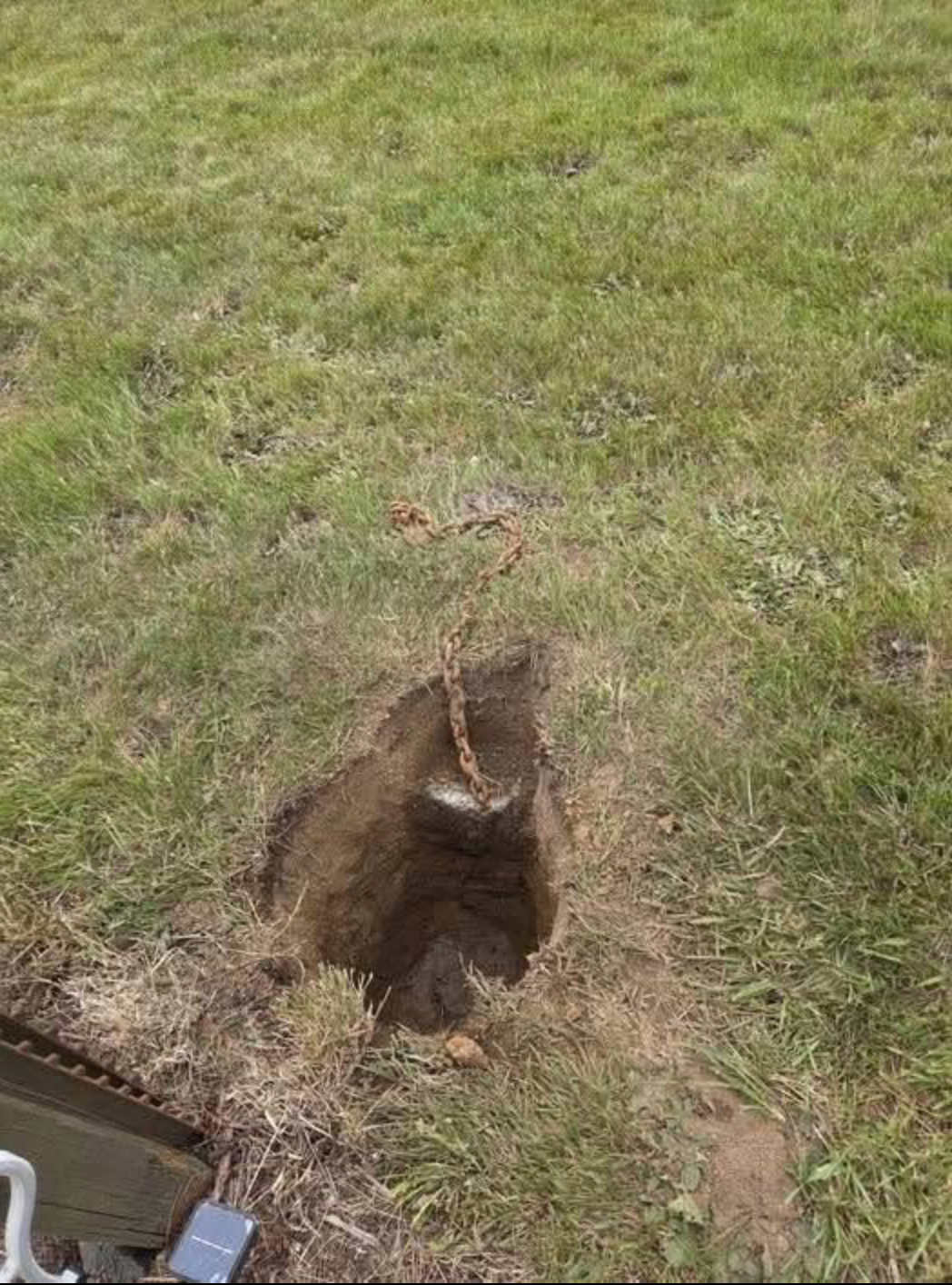
There is something undeniably exciting about uncovering a mysterious object while digging in your yard. What starts as an ordinary home improvement project—replacing an old mailbox, installing a fence post, planting a tree, or building a garden bed—can suddenly turn into a fascinating mystery when your shovel strikes something unexpected beneath the soil.
Imagine carefully digging a new hole for your mailbox when you hear the unmistakable clink of metal. Curious, you brush away the dirt and discover a partially buried object. It’s made of metal, sits about eight inches below the surface, appears larger than you expected, and even has a chain attached. Naturally, questions begin racing through your mind.
Is it an old utility marker? A forgotten piece of farm equipment? A buried anchor? Something historical?
Discoveries like this happen more often than many people realize. Homes and neighborhoods often sit on land that has been used for decades—or even centuries—for farming, construction, transportation, military activity, or previous residential developments. Over time, equipment breaks, property lines change, utilities are upgraded, and objects become buried beneath layers of soil.
While it’s fun to speculate, it’s also important to approach unidentified buried objects carefully. Some are completely harmless, while others may be connected to underground utilities or infrastructure that should not be disturbed.
Let’s explore some of the most common possibilities.
1. An Old Property Survey Marker
One possibility is that you’ve uncovered an old survey monument.
Surveyors often install permanent markers to identify:
- property corners
- boundary lines
- easements
- reference points
Some older markers include:
- metal rods
- steel stakes
- iron pipes
- chains
- identification caps
If the object is located close to a property line or near the edge of your yard, this is certainly a possibility.
2. An Anchor for an Old Utility Pole or Mailbox
Older mailboxes, signposts, and utility poles sometimes used buried metal anchors for stability.
These anchors could include:
- steel rods
- chains
- eye bolts
- metal plates
If your neighborhood has existed for many decades, remnants of previous installations may still remain underground.
3. A Fence Anchor or Gate Hardware
Many older fences used buried anchors to support:
- corner posts
- tension wires
- gates
- braces
Even if no fence exists today, previous property owners may have removed the visible portions while leaving underground hardware behind.
4. Part of an Agricultural Tool
If the property was once farmland, the object could be part of older farming equipment such as:
- plows
- cultivators
- harrows
- wagon hardware
- hitch components
- chain assemblies
Farm equipment often broke during use, and damaged pieces were sometimes buried or simply left in the field.
5. A Guy Wire Anchor
Utility poles and communication towers frequently use guy wires for support.
These wires connect to buried anchors that help stabilize tall structures against wind and tension.
Older anchors may include:
- large steel rods
- anchor plates
- eye bolts
- heavy chains
If there are utility poles nearby, this possibility should be considered.
6. An Old Well or Cistern Component
Older properties sometimes contained:
- hand-dug wells
- cisterns
- water pumps
Chains and metal hardware may have been attached to:
- well buckets
- lifting mechanisms
- pump systems
- protective covers
If your home is historic, this may warrant further investigation.
7. A Buried Foundation Tie or Construction Hardware
Construction projects often leave behind:
- reinforcing steel
- foundation anchors
- tie rods
- lifting hardware
These pieces may remain underground long after buildings have been demolished.
8. A Historical Artifact
Occasionally, buried metal objects have historical significance.
Examples include:
- horse tack
- wagon chains
- railroad hardware
- military equipment
- industrial machinery
- antique tools
The age and history of your property may influence this possibility.
9. An Underground Utility Component
One of the more important possibilities is that the object is connected to underground infrastructure.
It could be associated with:
- telephone lines
- electrical grounding
- water service
- gas service
- cable systems
For this reason, avoid pulling or cutting attached chains until the object has been identified.
Why Is There a Chain Attached?
The chain provides an important clue.
Chains may have been used for:
- lifting
- securing equipment
- attaching anchors
- tension systems
- operating underground mechanisms
- connecting gates or barriers
Its purpose depends entirely on the object it is attached to.
Should You Keep Digging?
Proceed carefully.
If the object appears to be:
- unusually large
- firmly anchored
- connected to cables
- attached to pipes
- near utility services
it’s wise to stop digging until you better understand what you’ve found.
If you’re unsure whether underground utilities may be present, contact your local utility locating service before continuing excavation. In many areas, utility companies can mark underground lines before further digging.
Can Metal Detectors Help?
Yes.
A metal detector may help estimate:
- the object’s overall size
- its approximate shape
- whether additional metal is buried nearby
However, it cannot identify the object with certainty.
How Old Could It Be?
Without examining it directly, it’s impossible to determine its age.
Buried metal objects may range from:
- only a few years old
- several decades old
- more than a century old
The surrounding soil, corrosion, construction style, and nearby historical records can sometimes provide clues.
Should You Clean It?
If you suspect the object could be historically significant, avoid aggressive cleaning.
Heavy scrubbing or chemical cleaning may remove valuable surface details or markings.
Instead:
- gently brush away loose soil
- photograph it from multiple angles
- note its location
- document the depth
Frequently Asked Questions
Could it be buried treasure?
Although it’s always fun to imagine, most buried metal objects found during routine yard work turn out to be old hardware, construction materials, agricultural equipment, or utility components rather than valuable treasure.
Is it dangerous?
Most buried metal objects are harmless. However, if the object appears connected to cables, pipes, or utility systems, avoid disturbing it until it has been identified.
Why would someone bury metal?
Many objects were never intentionally buried. Over years or decades, soil naturally accumulates through landscaping, erosion, construction, and organic matter, gradually covering items that were once at the surface.
Should I remove it?
Only after you’re reasonably confident it isn’t connected to utilities or other infrastructure. If there is any uncertainty, consult the appropriate utility service or local authority before attempting removal.
Could it increase my property’s historical value?
Probably not by itself, but if the object appears to be an unusual historical artifact, local historical societies or archaeologists may be able to provide additional information about its origin.
Tips for Investigating a Mystery Find
If you discover an unknown buried object:
- Take clear photographs before moving it.
- Measure its approximate depth and location.
- Avoid cutting or pulling attached chains.
- Inspect for identifying marks or stamped numbers.
- Use caution if utilities may be nearby.
- Research your property’s history to see how the land was used in the past.

Welcome to my kitchen!
I’m a passionate home cook and recipe creator who loves turning simple ingredients into delicious, comforting meals that everyone can enjoy. Through this website, I share carefully prepared recipes, practical cooking tips, and easy-to-understand food education to help you feel more confident in the kitchen.
My goal is to make cooking simple, enjoyable, and accessible. Whether you are looking for a quick family dinner, a delicious dessert, healthy meal ideas, or traditional recipes with a modern touch, you’ll find inspiration here.
More Than Just Recipes
I believe that cooking is also a way to learn. That’s why this website is not only about recipes. I also create educational articles about ingredients, cooking techniques, kitchen tips, food preparation, and the stories behind different dishes.
Each article is designed to give you useful knowledge that you can apply in your own kitchen. From understanding how ingredients work together to learning better cooking methods, my aim is to help you become a more confident and creative cook.
My Philosophy
Good food doesn’t always require complicated ingredients or professional equipment. With a little knowledge, patience, and creativity, simple ingredients can become something truly special.
I believe in sharing recipes that are practical, clearly explained, and enjoyable to make. I also love exploring new flavors while appreciating traditional cooking and the recipes passed down through generations.
Thank you for visiting my kitchen and being part of this food-loving community. I hope my recipes and articles inspire you to cook, learn, experiment, and most importantly, enjoy every bite!
Happy cooking!