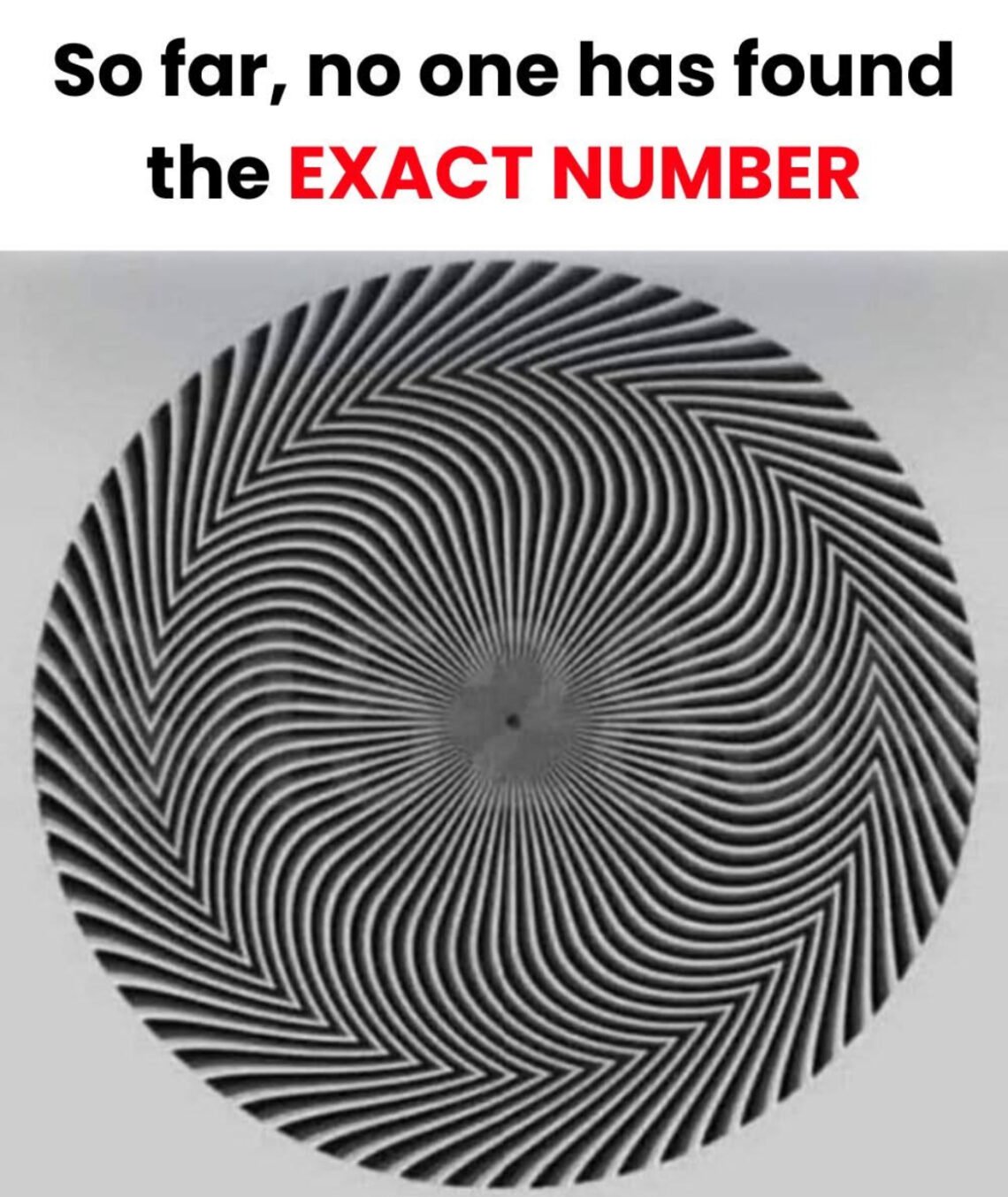
Optical illusions have a fascinating way of making us question something we normally take for granted: what we see.
We tend to assume that our eyes simply record the world around us and send an accurate picture to the brain. But vision is much more complicated than that. Your eyes collect light, color, contrast, edges, shapes, and movement, while your brain rapidly interprets all of that information and turns it into something meaningful.
Most of the time, this process works so well that we never think about it.
But optical illusions expose the process.
They create situations in which the information reaching our eyes can be interpreted in more than one way. A shape may suddenly appear to change. A color may look different depending on its surroundings. A picture may contain a hidden object that becomes obvious only after someone points it out.
And then there are those particularly frustrating illusions in which a number is hiding somewhere in the image.
One person looks at the picture and immediately says, “I see it.”
Another person stares at exactly the same image and says:
“Where? I don’t see anything.”
Then someone gives them a clue.
Suddenly, the hidden number seems incredibly obvious.
That strange experience is not necessarily because one person has better eyesight than another. It has much more to do with how the brain processes visual information.
Why Can a Number Be Hidden in Plain Sight?
A hidden-number optical illusion usually works by making the number blend into its surroundings.
Instead of drawing a large number in a clearly different color, the designer may construct the number from subtle changes in:
- brightness
- color
- texture
- spacing
- orientation
- contrast
- shape
- pattern
- shadows
The result is an image in which the number technically exists, but your brain doesn’t immediately separate it from the background.
It’s similar to camouflage in nature.
A stick insect doesn’t disappear physically.
It’s still there.
But its shape and color resemble its environment so closely that a predator can look directly at it without recognizing it as an animal.
A hidden number works according to a similar principle.
The number is present.
Your eyes receive information from it.
But your brain initially treats the number as part of the background.
Your Eyes Don’t “Understand” the Picture
This is one of the most important things to understand about optical illusions.
Your eyes don’t understand what they’re seeing.
Your eyes detect light.
The retina contains specialized cells that respond to different properties of light, including brightness and color. That information is converted into neural signals and transmitted through the visual system.
The brain then begins organizing those signals.
It looks for patterns.
It identifies edges.
It separates objects from backgrounds.
It detects changes in brightness.
It compares nearby colors.
It tries to determine what belongs together.
Eventually, the brain produces your conscious visual experience.
So when you say:
“I see a number,”
what you’re really describing is the result of an enormous amount of processing happening inside your visual system.
The Brain Is Constantly Looking for Patterns
Humans are extremely good at recognizing patterns.
This ability is useful every day.
Imagine walking through a forest.
You see leaves, branches, shadows, rocks, sunlight and hundreds of overlapping shapes.
Your brain doesn’t treat every tiny detail as equally important.
Instead, it searches for meaningful structures.
A face.
An animal.
A person.
A path.
A vehicle.
A familiar object.
This ability helps us navigate the world efficiently.
But it can also create interesting mistakes.
If a hidden number is designed carefully, the brain may initially categorize its edges and patterns as meaningless background information.
Why Some People See the Number Immediately
Suppose you look at the illusion and immediately recognize the hidden number.
That doesn’t necessarily mean your eyes are dramatically better than someone else’s.
You may simply be noticing the relevant visual cue more quickly.
Perhaps the number has a slightly different brightness from its surroundings.
Perhaps the shapes forming the number have a particular orientation.
Perhaps the pattern becomes clearer when you slightly move the image farther away.
Or perhaps you already know what kind of illusion you’re looking at.
Once your brain knows that there is a number somewhere, it becomes easier to search for one.
Expectations Can Change What You Notice
This is a fascinating part of visual perception.
If someone tells you:
“There is a number hidden in this picture.”
your brain immediately changes its search strategy.
Instead of simply looking at the image as a collection of colors and shapes, you begin looking for:
- curves
- straight lines
- loops
- diagonal strokes
- repeated shapes
- unusual gaps
- areas of contrasting brightness
You are essentially telling your visual system:
“Find something that resembles a number.”
That instruction can make previously unnoticed information suddenly become meaningful.
The “Aha!” Moment
That’s why hidden-image illusions often produce such a satisfying moment.
At first:
Nothing.
You stare.
You move the image closer.
You move it farther away.
You squint.
Still nothing.
Then suddenly:
There it is!
Once the number becomes visible, it may be almost impossible to ignore.
This is sometimes called a perceptual “aha” experience.
The image itself hasn’t necessarily changed.
Your interpretation of the image has changed.
Why Looking From Farther Away Can Help
One of the simplest tricks for hidden-number illusions is to move the image farther away.
This may sound strange.
If you want to see something, wouldn’t you normally move closer?
Not always.
When you move farther away, tiny details become less individually noticeable.
The brain begins integrating information over a larger area.
A pattern that looks like random dots up close may combine into a larger shape from a distance.
This is similar to how pointillist paintings work.
Up close, you see individual dots.
From farther away, your brain combines those dots into recognizable forms.
Try Squinting
Another classic technique is gently squinting.
Don’t strain your eyes.
Simply narrow them slightly.
This reduces the amount of fine detail reaching your conscious perception and can make large-scale patterns more noticeable.
Sometimes the hidden number becomes easier to detect because the distracting details become less prominent.
You might suddenly notice a large outline that was previously buried beneath dozens of tiny shapes.
Try Tilting Your Phone
Sometimes the number is easier to detect when you slightly change the angle of the screen.
This can alter:
- reflections
- apparent contrast
- brightness
- viewing angle
- color perception
The illusion may be designed around subtle differences that become more noticeable under different viewing conditions.
Don’t Stare at One Tiny Spot
Another common mistake is staring directly at the center.
Instead, let your eyes move slowly across the entire image.
Look at the:
- top
- bottom
- left side
- right side
- corners
- center
Try not to consciously search for a specific number at first.
Instead, look for anything that appears slightly unusual.
You may notice a curve or line before recognizing the complete number.
Use Peripheral Vision
Sometimes the hidden shape is easier to detect when you aren’t staring directly at it.
Look slightly beside the suspected area.
Your peripheral vision can be surprisingly useful for noticing broad differences in brightness and shape.
Once you notice something unusual, move your gaze toward it.
This technique is particularly interesting because it demonstrates that seeing isn’t simply about focusing directly on an object.
Different parts of the visual system contribute different kinds of information.
Why Contrast Matters So Much
Contrast is one of the fundamental ingredients of visual perception.
If a black object is placed on a white background, it is immediately obvious.
But if a dark-gray object is placed against a slightly lighter gray background, the difference becomes much harder to detect.
A hidden-number illusion often uses this principle.
The number might be only slightly different from the surrounding pattern.
Your brain may therefore initially treat the entire region as one continuous texture.
Increase the effective contrast—by changing the viewing distance, lighting, or angle—and suddenly the number emerges.
The Number May Be Defined by Absence
Here’s another clever technique.
The hidden number doesn’t necessarily have to be made from darker shapes.
Sometimes the number is formed by spaces between objects.
Imagine dozens of small circles.
Individually, they look random.
But the arrangement of the empty spaces between them forms a large number.
This is an example of how our brains can perceive structure even when the important shape isn’t explicitly drawn as a solid object.
Figure and Ground
One of the central concepts in visual perception is the distinction between figure and ground.
The figure is the object we perceive as being in front.
The ground is the background surrounding it.
Normally, the distinction is easy.
A black letter on white paper is the figure.
The white paper is the ground.
Optical illusions can deliberately make this distinction ambiguous.
The hidden number may have nearly the same visual properties as the background.
Your brain therefore doesn’t immediately decide:
“This is the object.”
Instead, everything looks like one pattern.
Once your brain identifies the number as the figure, the image suddenly makes sense.
Why the Same Image Can Look Different to Different People
This is perhaps the most interesting part.
Two people can look at the same image under the same conditions and report different experiences.
Why?
Because perception is not determined only by the physical image.
It is influenced by the observer.
Factors can include:
- attention
- expectations
- viewing distance
- lighting
- display quality
- visual experience
- familiarity with similar patterns
- individual differences in color perception
- fatigue
- concentration
This doesn’t mean that perception is completely subjective.
There is still a physical image producing visual information.
But the brain has to interpret that information.
And interpretation can vary.
What If You See a Completely Different Number?
Some optical illusions are deliberately designed so that people report different numbers.
For example, a low-contrast pattern might allow different observers to pick up different shapes.
One person might see:
12
Another might see:
17
Someone else might see:
74
And another person might insist that there is nothing there at all.
Before assuming that someone is “wrong,” remember that the visual system is dealing with ambiguous information.
If the image doesn’t contain enough clear information, the brain may make different interpretations.
Your Brain Uses Previous Experience
Imagine you see a blurry shape in the distance.
You may interpret it differently depending on what you expect to find.
If you’re at the beach, you might interpret a distant shape as an umbrella.
If you’re in a forest, you might interpret a similar shape as a tree branch.
If you’re in a parking lot, you might think it is a person.
The physical information is incomplete.
Your brain uses context to fill in the gaps.
Hidden-number illusions take advantage of this same ability.
Why Once You See It, You Can’t “Unsee” It
This is one of the funniest characteristics of optical illusions.
Before someone reveals the hidden number, you may stare at the image for minutes.
After they point it out, you can suddenly see it immediately.
Why?
Because your brain has learned the relevant pattern.
The next time you look at the image, you already know what structure to search for.
It’s similar to reading a difficult word.
At first, you may struggle.
Once you figure it out, the same word becomes instantly recognizable.
Don’t Assume It Means Something Is Wrong With Your Eyes
Failing to see a hidden number doesn’t automatically indicate poor eyesight.
Optical illusions are specifically designed to challenge perception.
Even people with excellent vision can struggle with them.
However, if someone experiences persistent difficulty seeing ordinary objects, significant changes in vision, double vision, flashing lights, sudden vision loss, or other unusual visual symptoms outside an optical-illusion context, that’s a different situation and should be evaluated medically.
A puzzle shouldn’t be used as a test of eye health.
The Science Behind the Illusion
The visual system processes information at multiple stages.
Light enters the eye.
The lens focuses it onto the retina.
Photoreceptors respond to light.
Neural signals travel through the optic nerve.
Information reaches visual processing areas of the brain.
Different parts of the visual system are particularly sensitive to features such as:
- edges
- orientation
- movement
- contrast
- color
- spatial patterns
The brain then combines these signals to construct a meaningful representation.
A hidden-number illusion manipulates these features so that the intended pattern isn’t immediately obvious.
Your Brain Loves Efficiency
The brain processes an enormous amount of sensory information every second.
It cannot consciously analyze every detail.
Instead, it uses shortcuts.
These shortcuts are usually helpful.
If you see four legs, fur, a tail and a familiar shape, you don’t need to analyze every pixel before deciding:
“That’s probably a dog.”
Your brain recognizes the overall pattern.
But shortcuts can occasionally lead to illusions.
The same system that helps you recognize objects quickly can also cause you to miss something deliberately camouflaged.
Why Patterned Backgrounds Are So Effective
A completely plain background would make a hidden number easy to detect.
So illusion designers introduce visual noise.
They might use:
- dots
- stripes
- waves
- circles
- lines
- repeated colors
- irregular shapes
These elements create distractions.
The number becomes part of the visual noise.
Your brain must separate meaningful structure from irrelevant information.
Think of It Like a Puzzle
You can approach the image like a detective.
Don’t simply ask:
“Where is the number?”
Instead, ask:
“What doesn’t look quite right?”
Look for:
- repeated curves
- lines that seem slightly organized
- shapes that form larger groups
- differences in brightness
- areas where the pattern suddenly changes
- unusually symmetrical regions
You’re looking for clues.
Step-by-Step Method to Decode the Number
If you want to solve a hidden-number illusion, try this sequence.
Step 1: Look normally
Give yourself a few seconds.
Don’t overthink it.
Step 2: Move the image farther away
Try viewing it from a greater distance.
Step 3: Slightly squint
Reduce the fine details.
Step 4: Move your eyes slowly
Scan from left to right and top to bottom.
Step 5: Look for broad shapes
Don’t search for individual dots.
Search for curves, lines and large structures.
Step 6: Try tilting the screen
Change the viewing angle slightly.
Step 7: Change the brightness
If you’re viewing the image digitally, a small change in screen brightness can sometimes affect contrast.
Step 8: Take a short break
Look away for several seconds.
Then look again.
A fresh visual system can sometimes detect patterns that prolonged staring missed.
Why Staring Too Long Can Make Things Worse
You might think that staring harder automatically improves your chances.
Not necessarily.
When you stare at an image for too long, your attention can become locked onto irrelevant details.
You may start thinking:
“Maybe it’s in this corner.”
Then you spend another minute staring at that corner.
If the number isn’t there, you’re simply reinforcing the wrong search strategy.
Sometimes the best approach is to look away and return.
The Power of a Hint
There’s a reason optical-illusion puzzles often provide hints.
A hint dramatically reduces the search space.
If someone says:
“Look for a two-digit number in the center.”
your brain knows what kind of structure to search for.
If they say:
“It’s slightly darker than the surrounding pattern.”
you can concentrate on contrast.
If they say:
“Move the picture farther away.”
you know to look for a large-scale pattern.
A good hint doesn’t necessarily give away the answer.
It teaches you how to look.
Optical Illusions Are More Than Internet Puzzles
Although hidden-number images are popular online, optical illusions have been studied for centuries.
Artists have deliberately used visual ambiguity to create fascinating effects.
Psychologists and neuroscientists have also studied illusions because they provide useful clues about how perception works.
An illusion can reveal what normally remains invisible:
the brain’s assumptions about the world.
Illusions Show That Seeing Is an Active Process
We often talk about vision as though it were a camera.
But the brain isn’t simply recording.
It’s interpreting.
It’s predicting.
It’s comparing.
It’s organizing.
It’s filling gaps.
It’s deciding which information is important.
That’s why illusions are so valuable.
They show us that perception isn’t merely about receiving information.
It’s about making sense of information.
The Hidden Number Is Really a Test of Attention
At first glance, the challenge appears to be:
“Can you see the number?”
But a deeper question is:
“Can you direct your attention toward the right visual information?”
Your eyes may technically receive the information immediately.
Your conscious awareness may not.
That’s an important distinction.
Something can be present in your visual field without becoming the focus of your attention.
Why These Images Are So Popular
Hidden-number illusions are perfect for social media because they create curiosity.
Someone sees the headline:
“Only a few people can see the number.”
Immediately, they want to test themselves.
They stare at the image.
They try different techniques.
Then they ask friends:
“What number do you see?”
The puzzle becomes interactive.
Instead of simply looking at an image, you’re comparing your perception with other people’s perception.
The Social Experiment
Try showing the same illusion to several people without giving them any hints.
Ask each person:
“What do you see?”
Write down their answers.
Then compare.
You may find that some people identify the number almost immediately while others struggle.
That’s part of the fun.
Just remember that different answers don’t automatically mean that someone has better or worse eyesight.
The image may simply be ambiguous enough to encourage different interpretations.
Don’t Let the Headline Fool You
Claims like:
“Only geniuses can see this.”
or
“People with perfect vision see this number.”
should be treated skeptically.
Optical illusions aren’t reliable intelligence tests.
They aren’t standardized vision examinations.
And seeing a hidden number quickly doesn’t prove that someone is smarter.
These puzzles are primarily demonstrations of perception, attention and visual processing.
A Better Way to Think About the Challenge
Instead of asking:
“Am I smart enough to see it?”
ask:
“What visual information is my brain missing?”
That turns the puzzle into a learning experience.
You’re not competing against the image.
You’re learning how your perception works.
What Makes a Good Hidden-Number Illusion?
A well-designed illusion usually balances two things.
The number needs to be:
hidden enough to be challenging
but also
visible enough to be discoverable.
If the number is too obvious, the puzzle isn’t interesting.
If it is genuinely impossible to distinguish, the puzzle becomes frustrating rather than fun.
The best illusions create that satisfying moment when you suddenly recognize the answer.
The Final Reveal
And that’s what makes the hidden-number illusion so memorable.
At first, you see chaos.
Random colors.
Random shapes.
A confusing pattern.
Nothing meaningful.
Then your brain discovers the structure.
Suddenly, the chaos becomes organized.
You don’t feel as though the number has appeared.
You feel as though you’ve unlocked it.
That’s the magic of visual perception.
Final Thoughts
A hidden number in an optical illusion isn’t really hiding from your eyes.
It’s hiding from your attention and interpretation.
Your eyes may be receiving the relevant visual information from the very beginning. But your brain has to decide which parts matter, which parts belong together and whether the pattern represents something meaningful.
That’s why one person may notice the number instantly while another person can stare at the same picture for several minutes without seeing anything.
The next time you encounter one of these illusions, don’t immediately assume that you need better eyesight.
Instead, change the way you look.
Move the image farther away.
Squint slightly.
Change the angle.
Scan the entire picture.
Look for differences in contrast.
Give your eyes a short break.
And most importantly, stop trying to force the answer.

Welcome to my kitchen!
I’m a passionate home cook and recipe creator who loves turning simple ingredients into delicious, comforting meals that everyone can enjoy. Through this website, I share carefully prepared recipes, practical cooking tips, and easy-to-understand food education to help you feel more confident in the kitchen.
My goal is to make cooking simple, enjoyable, and accessible. Whether you are looking for a quick family dinner, a delicious dessert, healthy meal ideas, or traditional recipes with a modern touch, you’ll find inspiration here.
More Than Just Recipes
I believe that cooking is also a way to learn. That’s why this website is not only about recipes. I also create educational articles about ingredients, cooking techniques, kitchen tips, food preparation, and the stories behind different dishes.
Each article is designed to give you useful knowledge that you can apply in your own kitchen. From understanding how ingredients work together to learning better cooking methods, my aim is to help you become a more confident and creative cook.
My Philosophy
Good food doesn’t always require complicated ingredients or professional equipment. With a little knowledge, patience, and creativity, simple ingredients can become something truly special.
I believe in sharing recipes that are practical, clearly explained, and enjoyable to make. I also love exploring new flavors while appreciating traditional cooking and the recipes passed down through generations.
Thank you for visiting my kitchen and being part of this food-loving community. I hope my recipes and articles inspire you to cook, learn, experiment, and most importantly, enjoy every bite!
Happy cooking!