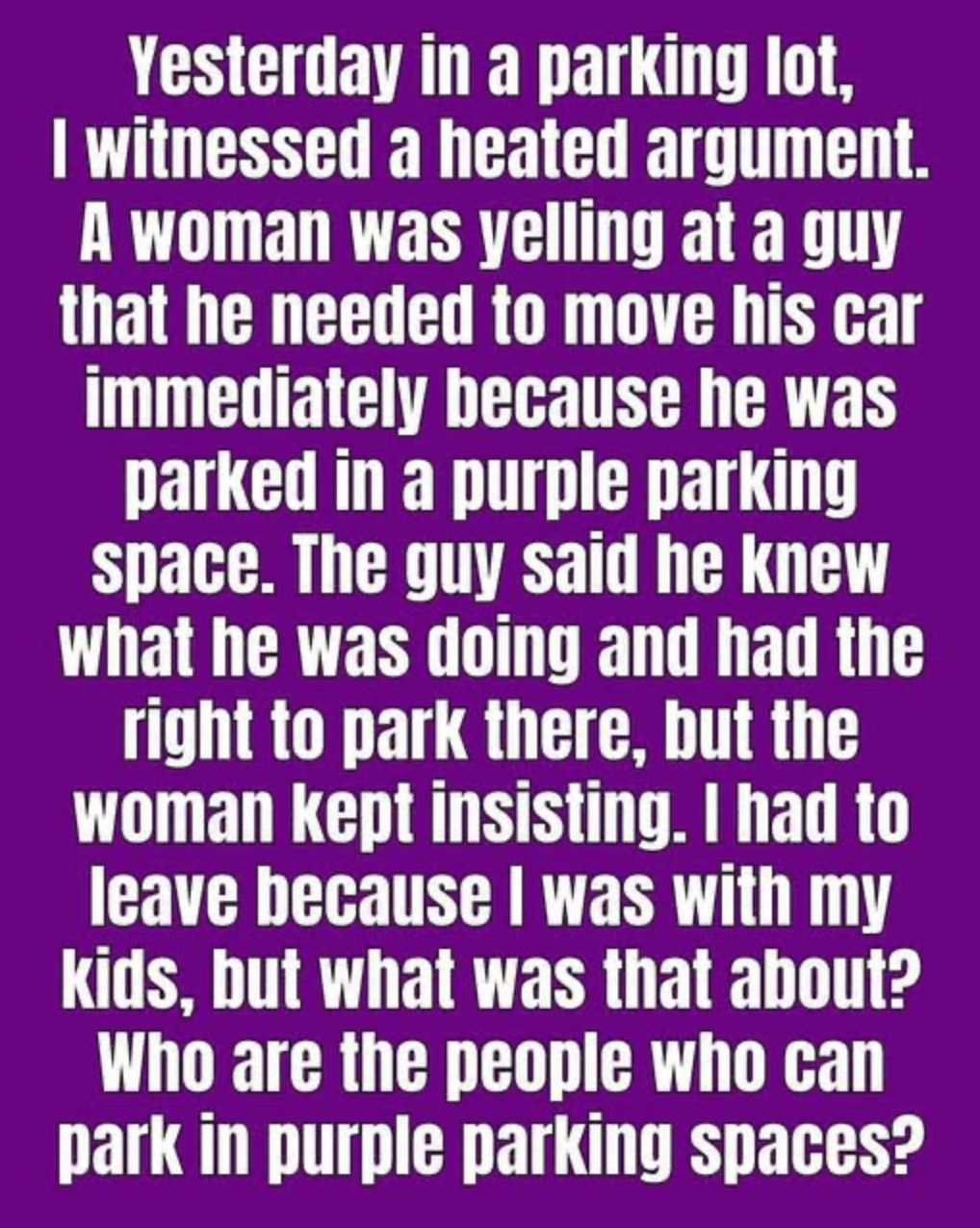
Imagine pulling into the parking lot of a shopping center, hospital, community center, or public building. As you slowly drive through the rows of parked cars looking for an available space, one spot immediately catches your attention. Unlike the familiar white, yellow, or blue parking lines, this space is painted a bold shade of purple.
At first glance, it might seem like a decorative choice or perhaps part of a colorful redesign of the parking lot. Some people assume it’s simply a reserved space for employees or an aesthetic addition meant to brighten the area.
But in many communities, a purple parking space carries a much deeper meaning.
Rather than serving as decoration, these spaces are often created to raise awareness about an important social issue and to provide support for individuals who may need quick, safe access to certain services. Understanding the purpose of these spaces helps promote respect, compassion, and awareness within the community.
What Does a Purple Parking Space Mean?
Unlike blue accessible parking spaces, which are regulated by law in many countries for people with disabilities, purple parking spaces do not have one universal meaning.
Instead, their purpose depends on the city, organization, or property where they are installed.
In many places, purple parking spaces are connected with awareness campaigns for domestic violence (also called domestic abuse or intimate partner violence). They may symbolize a community’s commitment to supporting survivors, educating the public, and encouraging people experiencing abuse to seek help.
In other locations, purple spaces may be part of local initiatives supporting different causes, such as community awareness programs or charitable campaigns. For this reason, it’s always important to read nearby signs that explain the specific purpose of the space.
Why Is Purple Associated With Domestic Violence Awareness?
Purple has long been used by many organizations as a symbol of:
- Courage
- Hope
- Strength
- Survival
- Dignity
- Healing
It is commonly featured during Domestic Violence Awareness Month in several countries and appears on awareness ribbons, educational materials, fundraising events, and community campaigns.
The color serves as a visible reminder that domestic violence affects people of all ages, backgrounds, and communities.
More Than Just a Parking Space
In some communities, a purple parking space is part of a broader awareness campaign.
Its purpose may include:
- Encouraging conversations about domestic violence.
- Promoting available support services.
- Increasing public awareness.
- Showing solidarity with survivors.
- Helping reduce stigma surrounding abuse.
Many purple spaces include signs, plaques, or QR codes directing people to local support organizations or crisis resources.
Why Awareness Matters
Domestic violence often remains hidden.
Many people experiencing abuse do not seek help immediately for a variety of reasons, including fear, financial dependence, concern for children, or uncertainty about available support.
Public awareness campaigns aim to:
- Educate communities.
- Encourage early intervention.
- Promote healthy relationships.
- Help people recognize warning signs.
- Inform individuals about available resources.
A simple parking space can become a powerful conversation starter.
Is It Illegal to Park in a Purple Space?
That depends entirely on local rules.
Unlike designated accessible parking spaces, which are often protected by law and require a valid permit, purple parking spaces may not always have legal restrictions.
Some are:
- Reserved for specific awareness events.
- Located on private property with posted rules.
- Symbolic installations intended primarily for education.
- Regular parking spaces featuring awareness artwork.
Always read any posted signs before parking.
If the space is marked as reserved or restricted, those instructions should be followed.
Could Purple Parking Spaces Have Other Meanings?
Yes.
Because there is no universal international standard for purple parking spaces, different communities may use them differently.
Examples include:
- Domestic violence awareness.
- Community health campaigns.
- Charity fundraising events.
- Temporary awareness initiatives.
- Local public art projects.
The surrounding signage usually explains the intended purpose.
Respecting Community Awareness Efforts
Even when a purple parking space functions as a regular parking spot, understanding its message demonstrates respect for the community’s efforts.
Awareness campaigns often rely on highly visible public spaces to encourage people to learn more about important issues.
Taking a moment to read the information nearby can increase understanding and empathy.
The Importance of Domestic Violence Awareness
Domestic violence can take many forms, including:
- Physical abuse
- Emotional abuse
- Psychological abuse
- Sexual abuse
- Financial abuse
- Coercive or controlling behavior
It affects people of every age, gender, income level, culture, and background.
Recognizing these realities helps communities provide better support for those affected.
How Communities Raise Awareness
Many organizations work year-round to educate the public through:
- Educational workshops.
- Public events.
- Awareness walks.
- Purple lighting displays.
- Information booths.
- School programs.
- Community partnerships.
- Social media campaigns.
Purple parking spaces are one visible part of these broader efforts.
If You See a Purple Parking Space
Instead of simply driving past, consider taking a closer look.
You may find:
- Educational information.
- Contact details for local support services.
- Community event announcements.
- Awareness campaign materials.
- Messages encouraging kindness and support.
Sometimes, a small sign can provide valuable information to someone who needs it.
Common Misconceptions
Myth: Purple parking spaces have the same legal status everywhere.
False.
Their meaning varies depending on the local organization or property owner.
Myth: They’re only decorative.
Not necessarily.
Many are part of carefully planned awareness campaigns with important educational goals.
Myth: Purple spaces always indicate domestic violence services.
Not always.
While this is a common use in many communities, purple may represent other local initiatives depending on the location.
Frequently Asked Questions
Why isn’t there one universal meaning?
Parking colors beyond standardized markings often reflect local programs, community initiatives, or property-specific designs rather than national regulations.
Should I avoid parking there?
Read the posted signs first. If the space is reserved or restricted, choose another space. If it functions as a regular parking space but carries an awareness message, you may still wish to take a moment to learn about the campaign it represents.
Who creates these spaces?
They may be established by:
- Local governments
- Community organizations
- Hospitals
- Businesses
- Advocacy groups
- Property owners working with nonprofit organizations
Interesting Facts
Colors play an important role in public communication. Around the world, different colors are used to quickly convey information, improve safety, and raise awareness. Blue often identifies accessible parking, red may indicate emergency or fire lanes, green can designate environmentally friendly vehicle spaces, and purple is increasingly used by some communities to highlight important social causes. These visual cues help communicate meaningful messages without requiring lengthy explanations.

Welcome to my kitchen!
I’m a passionate home cook and recipe creator who loves turning simple ingredients into delicious, comforting meals that everyone can enjoy. Through this website, I share carefully prepared recipes, practical cooking tips, and easy-to-understand food education to help you feel more confident in the kitchen.
My goal is to make cooking simple, enjoyable, and accessible. Whether you are looking for a quick family dinner, a delicious dessert, healthy meal ideas, or traditional recipes with a modern touch, you’ll find inspiration here.
More Than Just Recipes
I believe that cooking is also a way to learn. That’s why this website is not only about recipes. I also create educational articles about ingredients, cooking techniques, kitchen tips, food preparation, and the stories behind different dishes.
Each article is designed to give you useful knowledge that you can apply in your own kitchen. From understanding how ingredients work together to learning better cooking methods, my aim is to help you become a more confident and creative cook.
My Philosophy
Good food doesn’t always require complicated ingredients or professional equipment. With a little knowledge, patience, and creativity, simple ingredients can become something truly special.
I believe in sharing recipes that are practical, clearly explained, and enjoyable to make. I also love exploring new flavors while appreciating traditional cooking and the recipes passed down through generations.
Thank you for visiting my kitchen and being part of this food-loving community. I hope my recipes and articles inspire you to cook, learn, experiment, and most importantly, enjoy every bite!
Happy cooking!