Every few months, a seemingly straightforward math puzzle begins making the rounds on social media. It might appear in a Facebook post, an Instagram story, a WhatsApp group, or a short video asking viewers to “prove their intelligence” by solving it. Thousands of people eagerly jump into the comments, each convinced their answer is the only correct one.
Some answers receive hundreds of likes. Others spark long debates, with people insisting that calculators are wrong, teachers disagree, or “modern math” has changed the rules.
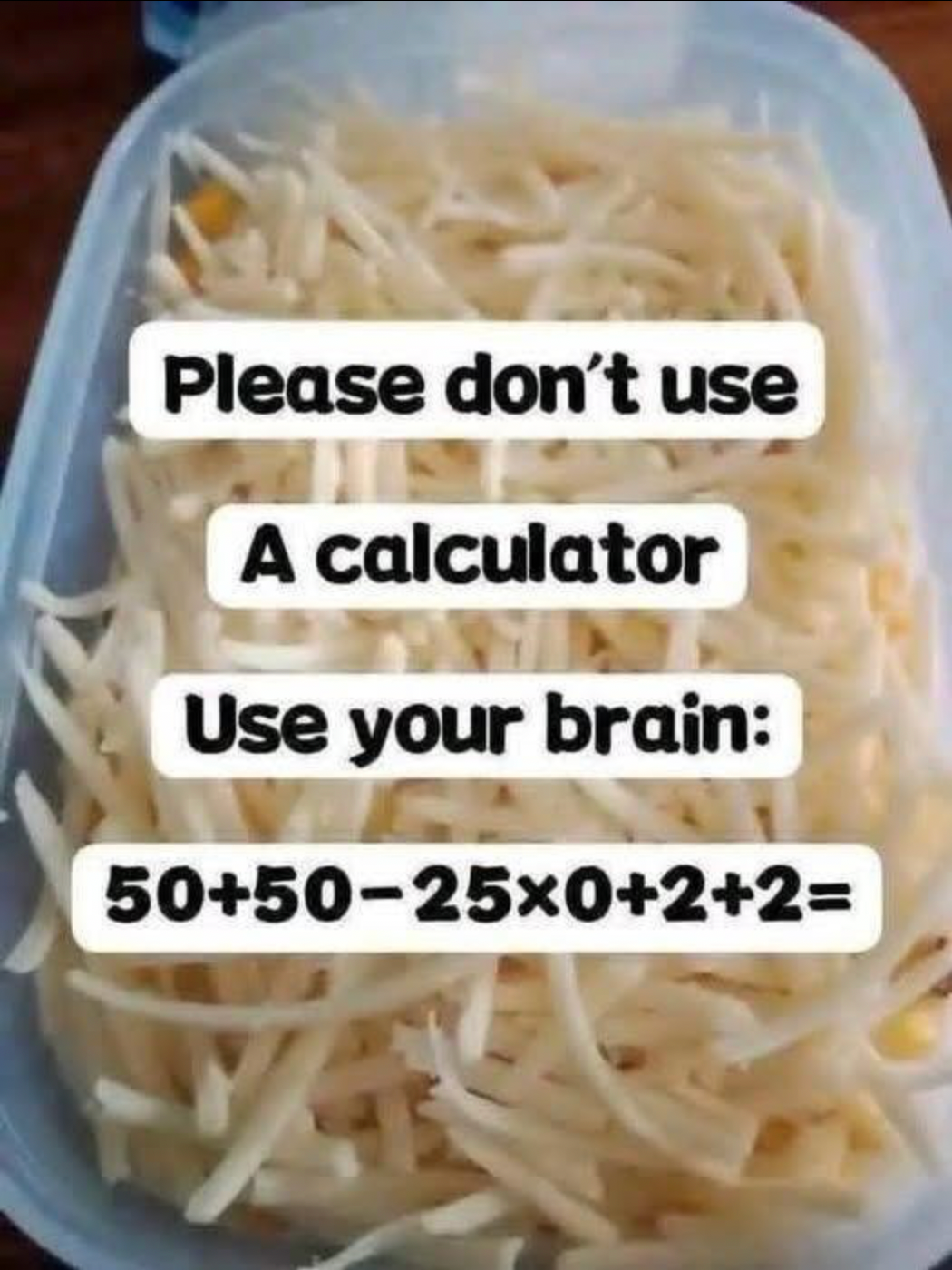
One such puzzle that has recently attracted attention is:
50 + 50 − 25 × 0 + 2 + 2 = ?
At first glance, many people instinctively begin solving the equation from left to right, adding and subtracting the numbers as they appear. Others remember learning something in school about multiplication coming before addition and subtraction, but aren’t quite sure how it applies.
The surprising part is that this puzzle isn’t really testing your ability to perform difficult calculations. Instead, it tests whether you remember one of the most fundamental principles of arithmetic: the order of operations.
Once you understand that rule, the answer becomes straightforward.
Why Do These Math Puzzles Go Viral?
Simple arithmetic puzzles are popular because they create an illusion of difficulty.
People enjoy them because they:
- Look easy at first glance.
- Can be solved quickly.
- Often produce different answers when solved incorrectly.
- Encourage discussion and friendly debate.
- Give people an opportunity to test their math skills.
The disagreement usually doesn’t come from the arithmetic itself—it comes from applying the rules in the wrong order.
The Secret: The Order of Operations
Mathematics follows internationally accepted rules that determine the order in which calculations should be performed.
Without these rules, the same equation could produce many different answers depending on where someone starts.
To avoid confusion, mathematicians use the order of operations, often remembered by the acronyms:
- PEMDAS
- BODMAS
- BIDMAS
Although the acronyms differ slightly by country, they all represent the same underlying principle.
What Does PEMDAS Mean?
PEMDAS stands for:
- P – Parentheses
- E – Exponents
- M – Multiplication
- D – Division
- A – Addition
- S – Subtraction
One important point is that multiplication and division have the same level of priority. Likewise, addition and subtraction have the same level of priority. When operations have equal priority, they are performed from left to right.
Solving the Puzzle Step by Step
Let’s examine the expression:
50 + 50 − 25 × 0 + 2 + 2
Step 1: Look for Parentheses
There are no parentheses.
So we move to the next step.
Step 2: Look for Exponents
There are no exponents.
Proceed to multiplication.
Step 3: Perform Multiplication
The only multiplication is:
25 × 0
Any number multiplied by zero equals zero.
So:
25 × 0 = 0
Now the equation becomes:
50 + 50 − 0 + 2 + 2
Step 4: Complete Addition and Subtraction
Now solve from left to right.
First:
50 + 50 = 100
Now:
100 − 0 = 100
Next:
100 + 2 = 102
Finally:
102 + 2 = 104
The Correct Answer
50 + 50 − 25 × 0 + 2 + 2 = 104
The multiplication by zero changes the subtraction into subtracting nothing, leaving the total at 104 after adding the remaining numbers.
Why Do So Many People Get It Wrong?
A common mistake is ignoring the order of operations and calculating strictly from left to right.
For example:
50 + 50 = 100
100 − 25 = 75
75 × 0 = 0
0 + 2 + 2 = 4
This method produces 4, but it is incorrect because it violates the established rules of arithmetic. Multiplication must be completed before addition and subtraction.
The Importance of Multiplying by Zero
The multiplication in this puzzle may look insignificant, but it completely changes the result.
A basic property of mathematics states:
Any number multiplied by zero equals zero.
Examples include:
- 7 × 0 = 0
- 100 × 0 = 0
- 25 × 0 = 0
- 1,000 × 0 = 0
This rule is one of the foundations of arithmetic.
Why Mathematics Needs Consistent Rules
Imagine asking ten people to solve the same equation without agreed-upon rules.
Some would start from the left.
Others might multiply first.
Some would add first.
The answers would all differ.
The order of operations provides a universal system that ensures everyone solving the same expression correctly arrives at the same answer.
This consistency is essential not only in classrooms but also in science, engineering, finance, computer programming, and countless everyday calculations.
Common Misconceptions
Myth: You always solve equations from left to right.
Not exactly.
You move left to right only among operations with the same priority. Multiplication and division come before addition and subtraction.
Myth: Zero doesn’t matter.
False.
Zero has unique mathematical properties and can dramatically affect the outcome of an equation, as this puzzle demonstrates.
Myth: Calculators sometimes ignore the rules.
Modern calculators follow the standard order of operations when expressions are entered correctly.
Fun Facts About Zero
Zero is one of the most remarkable numbers in mathematics. Although it represents the absence of quantity, it plays a crucial role in arithmetic, algebra, computing, and science. Ancient civilizations used various number systems without a true zero, but the concept was later developed and refined, revolutionizing mathematics. Today, zero is essential for everything from simple calculations to advanced computer programming and digital technology.
Why Brain Teasers Like This Are Good for You
Math puzzles aren’t just entertaining—they can also help sharpen important mental skills.
Regularly solving logic and arithmetic puzzles may improve:
- Attention to detail
- Logical reasoning
- Problem-solving ability
- Mental calculation skills
- Memory of mathematical rules
Even when you get the answer wrong initially, reviewing the correct method reinforces concepts that remain useful throughout life.

Welcome to my kitchen!
I’m a passionate home cook and recipe creator who loves turning simple ingredients into delicious, comforting meals that everyone can enjoy. Through this website, I share carefully prepared recipes, practical cooking tips, and easy-to-understand food education to help you feel more confident in the kitchen.
My goal is to make cooking simple, enjoyable, and accessible. Whether you are looking for a quick family dinner, a delicious dessert, healthy meal ideas, or traditional recipes with a modern touch, you’ll find inspiration here.
More Than Just Recipes
I believe that cooking is also a way to learn. That’s why this website is not only about recipes. I also create educational articles about ingredients, cooking techniques, kitchen tips, food preparation, and the stories behind different dishes.
Each article is designed to give you useful knowledge that you can apply in your own kitchen. From understanding how ingredients work together to learning better cooking methods, my aim is to help you become a more confident and creative cook.
My Philosophy
Good food doesn’t always require complicated ingredients or professional equipment. With a little knowledge, patience, and creativity, simple ingredients can become something truly special.
I believe in sharing recipes that are practical, clearly explained, and enjoyable to make. I also love exploring new flavors while appreciating traditional cooking and the recipes passed down through generations.
Thank you for visiting my kitchen and being part of this food-loving community. I hope my recipes and articles inspire you to cook, learn, experiment, and most importantly, enjoy every bite!
Happy cooking!