Imagine taking a peaceful walk through a quiet forest after a gentle rain. The woodland floor is blanketed with damp leaves, moss-covered logs, and fallen branches. The cool air carries the earthy scent of wet soil, birds sing softly overhead, and sunlight filters through the canopy in scattered beams.
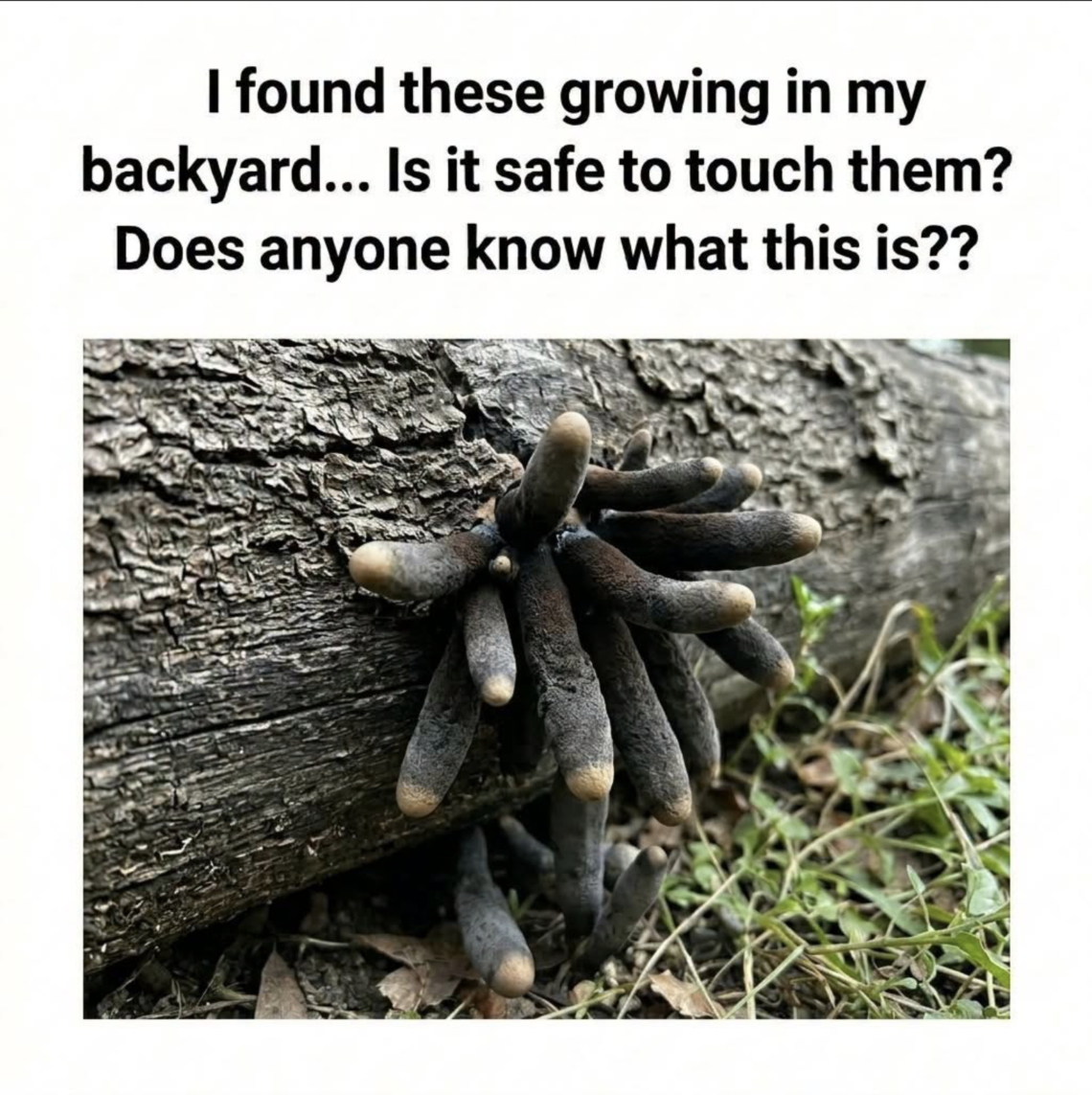
As you wander along the trail, something unusual catches your attention near the base of an old, decaying tree stump. Emerging from the ground is a cluster of dark, finger-like shapes. They appear rough, black, and oddly human, almost as though a hand is reaching up through the forest floor.
For a split second, your imagination takes over.
Could it be the remains of tree roots? A strange plant? Something left behind by another hiker?
The truth is both less frightening and far more fascinating.
What you’ve discovered is likely Dead Man’s Fingers, one of nature’s most unusual fungi. Despite its eerie appearance, this remarkable organism plays an essential role in maintaining healthy forest ecosystems.
What Is Dead Man’s Fingers?
Dead Man’s Fingers is the common name for several species of fungi in the genus Xylaria, with Xylaria polymorphabeing one of the best-known examples.
Rather than producing the familiar umbrella-shaped mushrooms many people expect, this fungus develops thick, club-like structures that strongly resemble human fingers emerging from the soil or decaying wood.
Its haunting appearance has made it one of the most photographed fungi in forests around the world.
Why Does It Look So Creepy?
Nature often surprises us with forms that resemble familiar objects.
Dead Man’s Fingers earns its name because its fruiting bodies often resemble:
- Human fingers
- Charred hands
- Blackened claws
- Knuckles pushing through soil
Young specimens may even appear grayish or bluish before gradually darkening with age.
Their rough, wrinkled texture adds to the illusion, making many hikers stop in their tracks.
Where Does It Grow?
Dead Man’s Fingers grows primarily on:
- Decaying hardwood stumps
- Fallen logs
- Buried tree roots
- Rotting branches
- Old woodland debris
It is commonly found in:
- Temperate forests
- Woodland trails
- Nature reserves
- Parks
- Gardens containing old tree stumps
Because much of the wood it colonizes may be hidden underground, the fungus sometimes appears to grow directly from the soil.
A Master of Decomposition
Although its appearance may seem unsettling, Dead Man’s Fingers performs an incredibly valuable ecological function.
It is a saprotrophic fungus, meaning it feeds on dead and decaying organic matter.
As it grows, it breaks down:
- Dead wood
- Fallen branches
- Tree roots
- Organic plant material
This process recycles nutrients back into the soil, helping forests remain healthy and productive.
Without fungi like this, fallen trees would accumulate much more slowly, and nutrient cycling would be significantly reduced.
The Life Cycle of Dead Man’s Fingers
Like many fungi, Dead Man’s Fingers spends most of its life hidden from view.
The visible “fingers” are actually the fruiting bodies, whose purpose is reproduction.
The fungus begins as an underground network of microscopic threads called mycelium.
This network spreads through decaying wood, absorbing nutrients.
When environmental conditions become favorable—typically during moist periods—it produces the finger-like structures that release spores into the air.
Those spores may eventually land on another suitable piece of dead wood, beginning the cycle again.
Why Does It Appear After Rain?
Moisture is essential for fungal growth.
Rain provides ideal conditions by:
- Increasing humidity
- Softening decaying wood
- Supporting spore production
- Encouraging fruiting body development
This is why many hikers notice Dead Man’s Fingers after wet weather.
Is It Dangerous?
Despite its frightening appearance, Dead Man’s Fingers is not considered dangerous to touch.
However, as with any wild fungus:
- Avoid eating it.
- Wash your hands after handling it.
- Leave it undisturbed whenever possible.
Many fungi cannot be safely identified by appearance alone, so wild mushrooms should never be consumed unless identified by an experienced expert.
Can You Eat It?
Dead Man’s Fingers is not regarded as an edible mushroom.
Its tough, woody texture makes it unsuitable for cooking, and it has no culinary value.
Because edible and poisonous fungi can sometimes resemble one another, it’s safest to admire this fungus without attempting to harvest it.
A Favorite Among Nature Photographers
Because of its dramatic appearance, Dead Man’s Fingers has become popular among:
- Wildlife photographers
- Nature enthusiasts
- Forest hikers
- Mushroom foragers
- Macro photography lovers
Its unusual shape creates striking photographs, particularly during misty autumn mornings.
Seasonal Appearance
Although timing varies depending on climate, Dead Man’s Fingers is often most noticeable during:
- Late summer
- Autumn
- Mild, wet periods
- After extended rainfall
The fruiting bodies may persist for several months.
Why Forests Need Fungi Like This
Fungi are among the most important organisms in forest ecosystems.
Species like Dead Man’s Fingers help:
- Decompose dead trees
- Release nutrients into the soil
- Support plant growth
- Improve soil health
- Create habitats for insects and microorganisms
Without decomposer fungi, forests would struggle to recycle essential nutrients.
Fascinating Biological Features
Dead Man’s Fingers belongs to a large group of fungi known as Ascomycetes, sometimes called sac fungi.
These fungi produce microscopic spores inside tiny sac-like structures.
Although invisible to the naked eye, millions of spores may be released from a single mature fruiting body.
Wind then carries these spores throughout the forest.
Why It Often Appears Near Old Stumps
Many people believe the fungus grows directly from the soil.
In reality, it is usually feeding on:
- Buried roots
- Hidden pieces of wood
- Decaying tree stumps beneath the surface
Only the fruiting bodies emerge above ground.
Similar Fungi
Several fungi have equally unusual appearances.
Examples include:
- Coral fungi
- Earth tongues
- Devil’s fingers
- Stinkhorn mushrooms
- Bird’s nest fungi
Each has evolved unique structures for reproduction and spore dispersal.
Common Myths
Myth: It’s poisonous to touch.
No. Touching it is not generally considered harmful, though handling wild fungi unnecessarily is discouraged.
Myth: It grows from human remains.
Absolutely not.
Its appearance inspired its common name, but it grows on decaying wood—not people.
Myth: It’s a plant.
False.
Fungi belong to their own biological kingdom, separate from both plants and animals.
Frequently Asked Questions
Why is it called Dead Man’s Fingers?
Its finger-like fruiting bodies resemble blackened human fingers emerging from the ground.
Can it grow in gardens?
Yes.
If old tree roots or buried wood are present, Dead Man’s Fingers may occasionally appear in gardens or landscaped areas.
Should I remove it?
Usually not.
If it is growing on decaying wood outdoors, it is simply carrying out its natural role as a decomposer.
Does it harm healthy trees?
Dead Man’s Fingers primarily colonizes dead or decaying wood. While some related fungi may infect weakened trees under certain conditions, it is most commonly associated with wood that is already dying or dead.
Amazing Facts About Fungi
Scientists estimate that Earth may be home to millions of fungal species, many of which remain undiscovered. Fungi recycle nutrients, form partnerships with plant roots, produce medicines such as antibiotics, assist in food production, and help maintain healthy ecosystems around the globe. Although mushrooms are the most visible part, they represent only a small portion of the vast underground fungal networks that quietly support life on Earth.

Welcome to my kitchen!
I’m a passionate home cook and recipe creator who loves turning simple ingredients into delicious, comforting meals that everyone can enjoy. Through this website, I share carefully prepared recipes, practical cooking tips, and easy-to-understand food education to help you feel more confident in the kitchen.
My goal is to make cooking simple, enjoyable, and accessible. Whether you are looking for a quick family dinner, a delicious dessert, healthy meal ideas, or traditional recipes with a modern touch, you’ll find inspiration here.
More Than Just Recipes
I believe that cooking is also a way to learn. That’s why this website is not only about recipes. I also create educational articles about ingredients, cooking techniques, kitchen tips, food preparation, and the stories behind different dishes.
Each article is designed to give you useful knowledge that you can apply in your own kitchen. From understanding how ingredients work together to learning better cooking methods, my aim is to help you become a more confident and creative cook.
My Philosophy
Good food doesn’t always require complicated ingredients or professional equipment. With a little knowledge, patience, and creativity, simple ingredients can become something truly special.
I believe in sharing recipes that are practical, clearly explained, and enjoyable to make. I also love exploring new flavors while appreciating traditional cooking and the recipes passed down through generations.
Thank you for visiting my kitchen and being part of this food-loving community. I hope my recipes and articles inspire you to cook, learn, experiment, and most importantly, enjoy every bite!
Happy cooking!