At first glance, the puzzle seems incredibly simple.
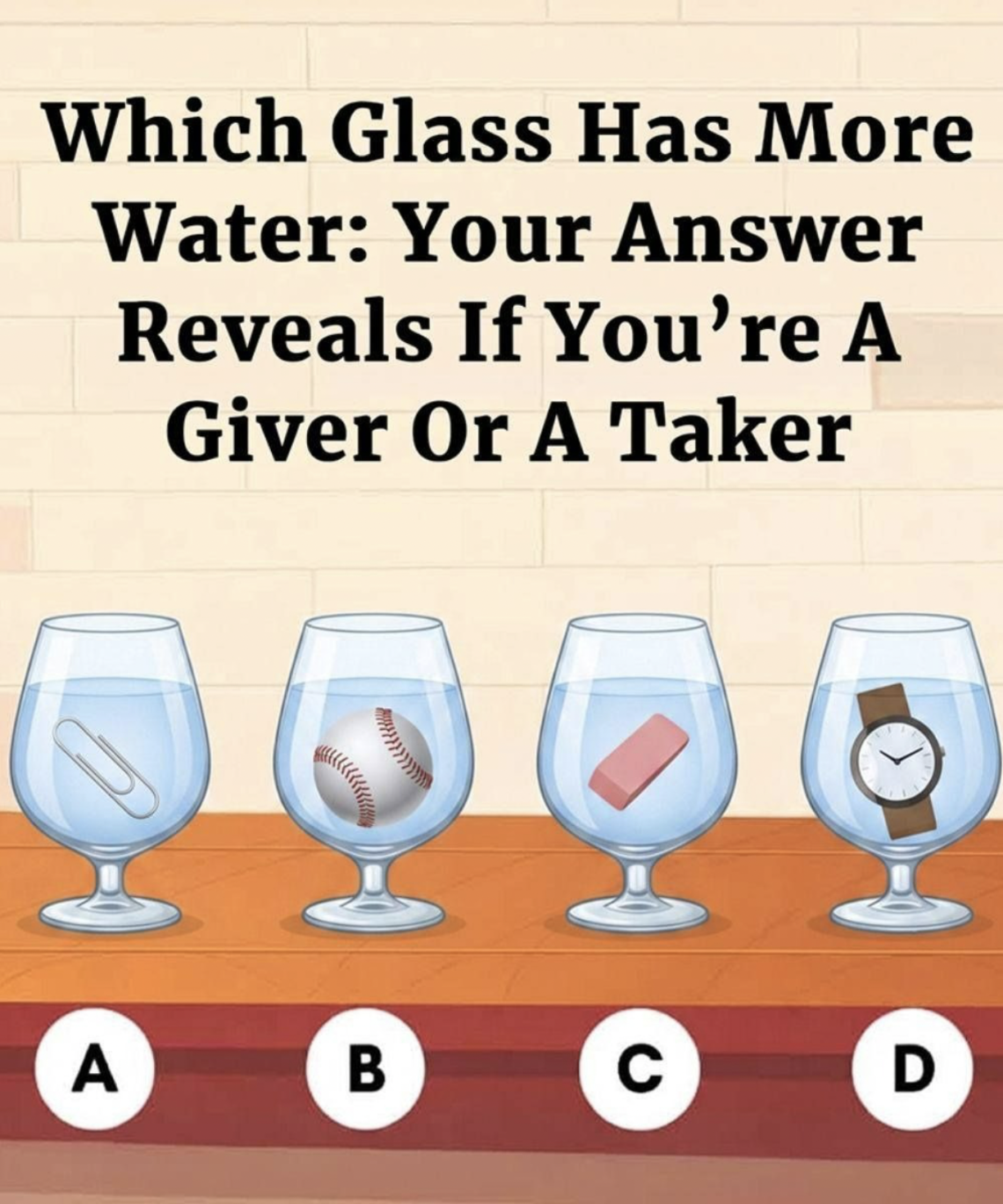
Four identical glasses labeled A, B, C, and D sit side by side. Each appears filled to the exact same water level. However, each glass also contains a different object:
- A paperclip
- A coin
- A marble
- A cork
The challenge is straightforward:
Which glass actually contains the most water?
But almost immediately, the puzzle becomes more interesting than expected. People begin debating. Some answer quickly and confidently, while others stare carefully, trying to calculate displacement and volume. Before long, conversations drift away from physics and into psychology, personality, perception, and even human behavior.
Then comes the dramatic twist often attached to viral versions of the puzzle:
“Your answer reveals whether you are a giver or a taker.”
Of course, that personality claim is mostly playful entertainment rather than serious science, but it is part of what makes these puzzles so fascinating. They sit at the intersection of:
- Logic
- Visual reasoning
- Human perception
- Social psychology
- Internet curiosity
The puzzle appears simple, yet it reveals how differently people interpret the same visual information.
The Setup of the Puzzle
Imagine four identical glasses:
- Same shape
- Same size
- Same visible water level
Inside each glass sits a different object.
Typically, the objects vary in:
- Size
- Density
- Shape
- Buoyancy
The question is not:
Which glass looks fullest?
Instead, it asks:
Which glass contains the greatest actual amount of water?
This distinction matters enormously.
Understanding Water Displacement
The key scientific concept behind the puzzle is displacement.
What Is Displacement?
When an object is placed into water, it pushes water aside.
This is called:
- Water displacement
or - Volume displacement
The amount of space the object occupies inside the glass reduces the amount of water needed to reach the visible fill line.
The Important Realization
If all four glasses display the same water level, then:
- Larger submerged objects displace more water
- Smaller submerged objects displace less water
Therefore:
The glass containing the smallest object actually contains the most water.
This is the central trick of the puzzle.
Why Many People Initially Get It Wrong
Most people instinctively focus on:
- Water height
rather than - Water volume
The brain naturally assumes:
- Equal height = equal amount
But the hidden variable is the object inside the glass.
The object changes how much actual water fits into the container.
Example Breakdown
Imagine the objects are:
- A paperclip
- A coin
- A marble
- A cork
Assuming:
- All objects are fully or mostly submerged
- All glasses reach the same visible level
then the smallest object displaces the least water.
So the glass with the tiny paperclip would likely contain the most water overall.
Why the Cork Complicates Things
The cork introduces an interesting twist because cork floats.
This changes how displacement works visually.
A floating object only displaces water equal to its weight, not necessarily its entire volume beneath the surface.
This detail sometimes confuses puzzle solvers and creates debate.
Why These Puzzles Fascinate People
The puzzle becomes addictive because it combines:
- Visual illusion
- Logic
- Hidden assumptions
- A sudden “aha” moment
People enjoy discovering that their first instinct may have been incorrect.
The Psychology of Perception
Humans rely heavily on visual shortcuts.
The brain constantly simplifies information to make decisions quickly.
In this puzzle, the brain sees:
- Same glass
- Same water line
and rapidly concludes:
Same amount of water.
But deeper analysis reveals otherwise.
The Brain and Mental Shortcuts
Psychologists often refer to these shortcuts as:
- Heuristics
Heuristics help people process information efficiently, but they can sometimes lead to errors.
The puzzle exploits this tendency beautifully.
Why the Puzzle Feels Satisfying
The moment someone understands displacement, the answer suddenly feels obvious.
This creates:
- Surprise
- Satisfaction
- Mental reward
The brain enjoys resolving contradictions between:
- Expectation
and - Reality
The Viral Personality Twist
Many online versions add playful personality interpretations such as:
- “If you chose A, you are generous.”
- “If you chose B, you are analytical.”
- “If you chose C, you are a taker.”
These interpretations are generally not scientific.
They are designed mainly for:
- Entertainment
- Social sharing
- Conversation
Why People Love Personality-Based Puzzles
Humans are naturally curious about themselves.
Any puzzle claiming to reveal:
- Personality
- Intelligence
- Hidden traits
immediately becomes more engaging.
Even when people know the claims are exaggerated, they still enjoy participating.
The Social Element
These puzzles work especially well in groups because they encourage:
- Debate
- Different interpretations
- Friendly competition
At dinner parties, classrooms, or online comment sections, people defend their answers passionately.
Why the Puzzle Sparks Arguments
People often disagree because they interpret the problem differently.
Some focus on:
- Object size
Others think about:
- Density
- Floating behavior
- Full immersion
- Water line accuracy
The ambiguity creates discussion.
The Science Behind Floating Objects
The cork introduces principles related to buoyancy.
Floating vs Sinking Objects
A sinking object displaces water equal to its entire submerged volume.
A floating object displaces water equal to:
- The weight of the object
This means a large floating cork may actually displace less water than expected.
Archimedes’ Principle
This puzzle indirectly relates to a famous scientific concept called Archimedes’ Principle.
Fb=ρgV
This principle explains how buoyancy works and how fluids respond to submerged objects.
It is one of the foundational ideas in fluid physics.
Why the Puzzle Feels Like an IQ Test
Although not a true intelligence test, the puzzle creates that impression because it rewards:
- Careful observation
- Logical reasoning
- Scientific thinking
People enjoy challenges that make them feel perceptive or clever.
The Role of Attention to Detail
Success often depends on noticing:
- Tiny differences
- Hidden assumptions
- Unspoken conditions
This encourages deeper thinking instead of relying on first impressions.
Why Visual Puzzles Spread So Easily Online
Puzzles like this thrive online because they:
- Create instant curiosity
- Invite participation
- Encourage comments
- Trigger debate
People naturally want to compare answers.
The Emotional Side of “Getting It Wrong”
One reason these puzzles are memorable is because they expose how easily perception can mislead us.
Realizing the mistake creates:
- Humility
- Surprise
- Curiosity
This emotional reaction helps the puzzle stick in memory.
Educational Value
Despite being entertaining, the puzzle also teaches real scientific concepts:
- Volume
- Displacement
- Buoyancy
- Observation skills
Teachers sometimes use similar puzzles to introduce physics concepts in engaging ways.
Why Simplicity Makes It Powerful
The puzzle succeeds because it uses:
- Everyday objects
- Simple visuals
- Familiar materials
Complex scientific ideas become accessible through ordinary situations.
The Difference Between Looking and Seeing
One deeper lesson hidden inside the puzzle is this:
There is a difference between:
- Looking at something
and - Truly analyzing it.
The glasses appear identical, but careful reasoning reveals important differences beneath the surface.
Why Humans Enjoy “Aha” Moments
Psychologists sometimes study the pleasure associated with sudden insight.
The instant realization:
“The smallest object means more water!”
creates a rewarding mental shift.
This insight experience is one reason puzzles remain so satisfying.
Are Personality Interpretations Meaningful?
Scientifically speaking, not really.
Choosing a particular glass does not reliably determine whether someone is:
- Generous
- Selfish
- Analytical
- Emotional
These interpretations are mostly playful storytelling.
However, the discussions themselves can reveal interesting things about how people think and approach problems.
Welcome to my kitchen!
I’m a passionate home cook and recipe creator who loves turning simple ingredients into delicious, comforting meals that everyone can enjoy. Through this website, I share carefully prepared recipes, practical cooking tips, and easy-to-understand food education to help you feel more confident in the kitchen.
My goal is to make cooking simple, enjoyable, and accessible. Whether you are looking for a quick family dinner, a delicious dessert, healthy meal ideas, or traditional recipes with a modern touch, you’ll find inspiration here.
More Than Just Recipes
I believe that cooking is also a way to learn. That’s why this website is not only about recipes. I also create educational articles about ingredients, cooking techniques, kitchen tips, food preparation, and the stories behind different dishes.
Each article is designed to give you useful knowledge that you can apply in your own kitchen. From understanding how ingredients work together to learning better cooking methods, my aim is to help you become a more confident and creative cook.
My Philosophy
Good food doesn’t always require complicated ingredients or professional equipment. With a little knowledge, patience, and creativity, simple ingredients can become something truly special.
I believe in sharing recipes that are practical, clearly explained, and enjoyable to make. I also love exploring new flavors while appreciating traditional cooking and the recipes passed down through generations.
Thank you for visiting my kitchen and being part of this food-loving community. I hope my recipes and articles inspire you to cook, learn, experiment, and most importantly, enjoy every bite!
Happy cooking!