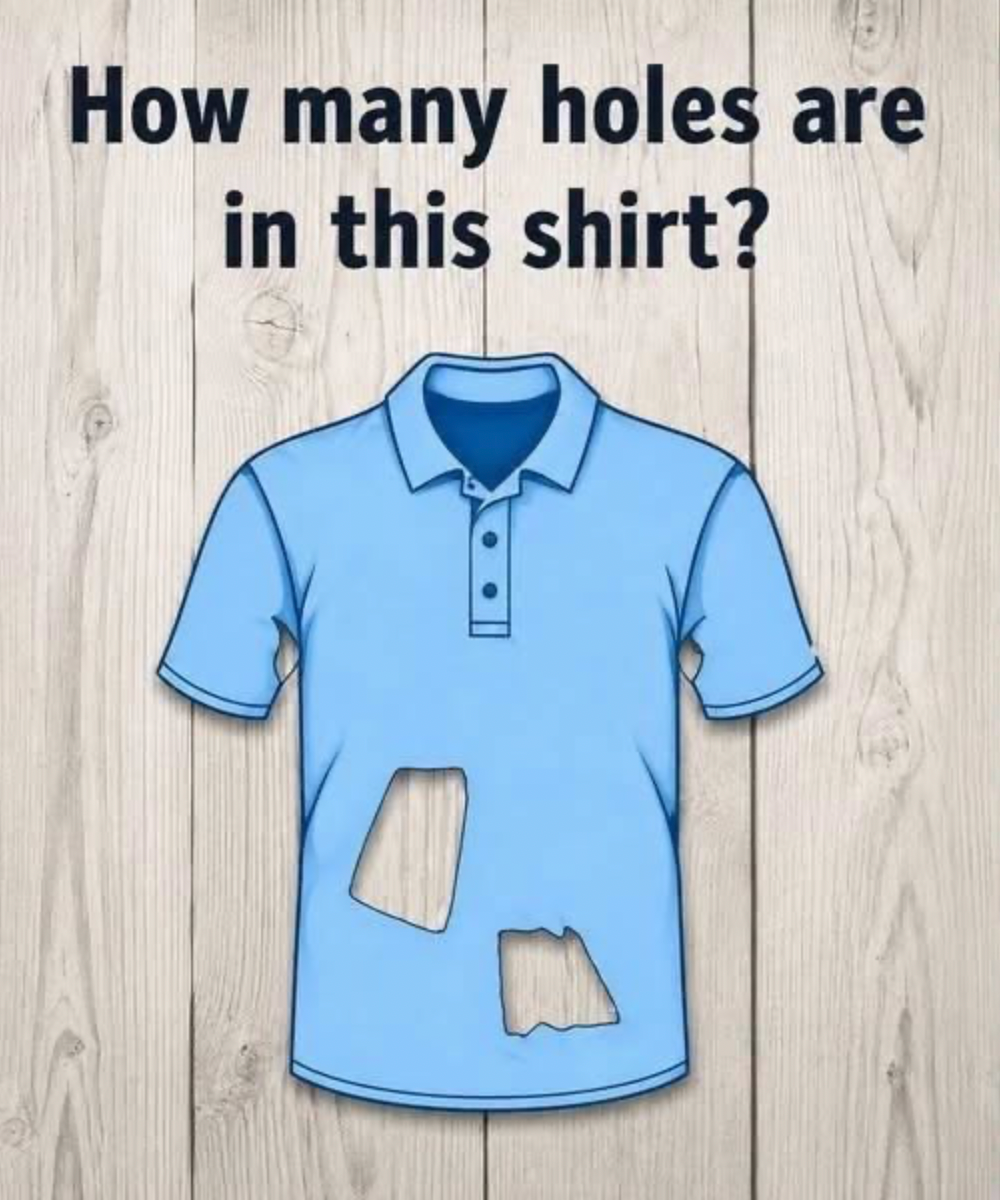
Brain teasers have become one of the internet’s favorite forms of entertainment. Every day, millions of people stop scrolling to solve a simple-looking puzzle that often turns out to be much trickier than expected. One of the most famous examples is the classic “How many holes does this T-shirt have?” challenge.
At first glance, the question seems almost too easy. Most people instinctively begin counting the obvious openings and quickly settle on an answer. But these puzzles are designed to test much more than basic counting—they challenge observation, attention to detail, and the ability to think beyond your first impression.
The headline often claims that “Only 1 in 7 people get this right,” encouraging readers to test their perception before looking at the solution. Whether or not that statistic is accurate, the puzzle remains a fun exercise in careful observation and logical thinking.
Let’s break down the riddle and explore why so many people arrive at different answers.
The First Answer Most People Give
When someone asks:
“How many holes does a T-shirt have?”
the immediate answer for most people is:
Four.
Why?
Because every normal T-shirt has four standard openings:
- One neck opening
- One opening for the left sleeve
- One opening for the right sleeve
- One opening at the bottom
This answer is perfectly logical if you’re thinking about a brand-new shirt with no damage.
Why the Puzzle Is Actually Trickier
The viral image used in this puzzle usually shows an old T-shirt with additional tears or holes.
Here’s where many people make a mistake.
They focus only on the obvious clothing openings while ignoring the damaged parts of the fabric.
The challenge is designed to encourage careful observation instead of automatic thinking.
The Famous Viral Version
In the classic version of the puzzle, the shirt typically contains:
- the four normal openings
- two visible tears somewhere on the body of the shirt
At first glance, many people simply add:
4 + 2 = 6
But that’s not always the correct answer.
The Hidden Detail Everyone Misses
The key observation is that the additional tears often go completely through both the front and the back of the shirt.
A T-shirt isn’t a single flat sheet of fabric.
It has:
- a front layer
- a back layer
If a hole passes through both layers, you can see completely through the shirt.
That means each damaged opening actually creates:
- one hole in the front
- one corresponding hole in the back
So instead of counting each tear once, you count both sides.
The Classic Solution
Let’s assume the standard viral image contains:
Four normal openings
- Neck
- Left sleeve
- Right sleeve
- Bottom
Total:
4 holes
Two ripped holes
Each rip passes through both sides.
So each tear counts as:
- Front opening
- Back opening
Meaning:
2 tears × 2 = 4 holes
Final Answer
4 normal openings
4 damaged openings
=
8 holes
This is the answer most commonly associated with the viral puzzle.
Why So Many People Say Six
Many participants count:
- four original openings
- two visible tears
This gives:
6
It’s an understandable mistake because people often view the shirt as a flat picture instead of a three-dimensional object.
Why Some People Say Four
Others ignore the damage entirely and simply think about what makes up a standard T-shirt.
They answer:
- neck
- sleeves
- bottom
Result:
4
Again, perfectly reasonable—but only if the shirt has no tears.
Could There Be Other Answers?
Interestingly, yes.
The correct answer always depends on the exact picture.
Some versions include:
- one tear
- two tears
- three tears
- overlapping holes
- folded fabric
- hidden damage
That’s why it’s important not to memorize an answer but to carefully inspect the specific image.
What This Puzzle Really Tests
Although it looks like a math question, it isn’t.
Instead, it measures several mental skills.
Observation
Can you notice every detail?
Spatial Thinking
Can you imagine the shirt as a three-dimensional object?
Attention
Do you rush toward the first answer?
Or do you slow down and examine the picture?
Critical Thinking
Do you question your initial assumption?
Many people don’t.
That’s exactly why the puzzle works so well.
Why Our Brains Fall Into the Trap
Human brains are incredibly efficient.
Instead of analyzing every situation from scratch, we rely on shortcuts called mental patterns.
When we see a T-shirt, our brains immediately recognize:
- neck
- sleeves
- bottom
We stop looking because we think we already know the answer.
The puzzle exploits this habit by hiding extra information in plain sight.
The Psychology Behind Viral Brain Teasers
Challenges like this become popular because they trigger curiosity.
People naturally want to know:
- Did I get it right?
- What did I miss?
- How did others answer?
Once they discover a surprising solution, many immediately share the puzzle with friends.
That creates the viral effect seen across social media.
Why Brain Teasers Are Good Mental Exercise
Visual riddles won’t dramatically increase intelligence overnight, but they can help keep the brain active.
They encourage:
- concentration
- careful observation
- flexible thinking
- patience
- problem-solving
They also remind us that the first answer isn’t always the correct one.
Sometimes taking a few extra seconds completely changes the outcome.
A Lesson Beyond the Puzzle
Perhaps the biggest lesson isn’t about counting holes at all.
It’s about slowing down.
In everyday life, we often jump to conclusions based on our first impression.
Whether we’re solving puzzles, reading headlines, or making decisions, taking another look can reveal details we completely overlooked.
The T-shirt challenge is a simple reminder that appearances can be deceptive, and careful observation often leads to better answers.

Welcome to my kitchen!
I’m a passionate home cook and recipe creator who loves turning simple ingredients into delicious, comforting meals that everyone can enjoy. Through this website, I share carefully prepared recipes, practical cooking tips, and easy-to-understand food education to help you feel more confident in the kitchen.
My goal is to make cooking simple, enjoyable, and accessible. Whether you are looking for a quick family dinner, a delicious dessert, healthy meal ideas, or traditional recipes with a modern touch, you’ll find inspiration here.
More Than Just Recipes
I believe that cooking is also a way to learn. That’s why this website is not only about recipes. I also create educational articles about ingredients, cooking techniques, kitchen tips, food preparation, and the stories behind different dishes.
Each article is designed to give you useful knowledge that you can apply in your own kitchen. From understanding how ingredients work together to learning better cooking methods, my aim is to help you become a more confident and creative cook.
My Philosophy
Good food doesn’t always require complicated ingredients or professional equipment. With a little knowledge, patience, and creativity, simple ingredients can become something truly special.
I believe in sharing recipes that are practical, clearly explained, and enjoyable to make. I also love exploring new flavors while appreciating traditional cooking and the recipes passed down through generations.
Thank you for visiting my kitchen and being part of this food-loving community. I hope my recipes and articles inspire you to cook, learn, experiment, and most importantly, enjoy every bite!
Happy cooking!