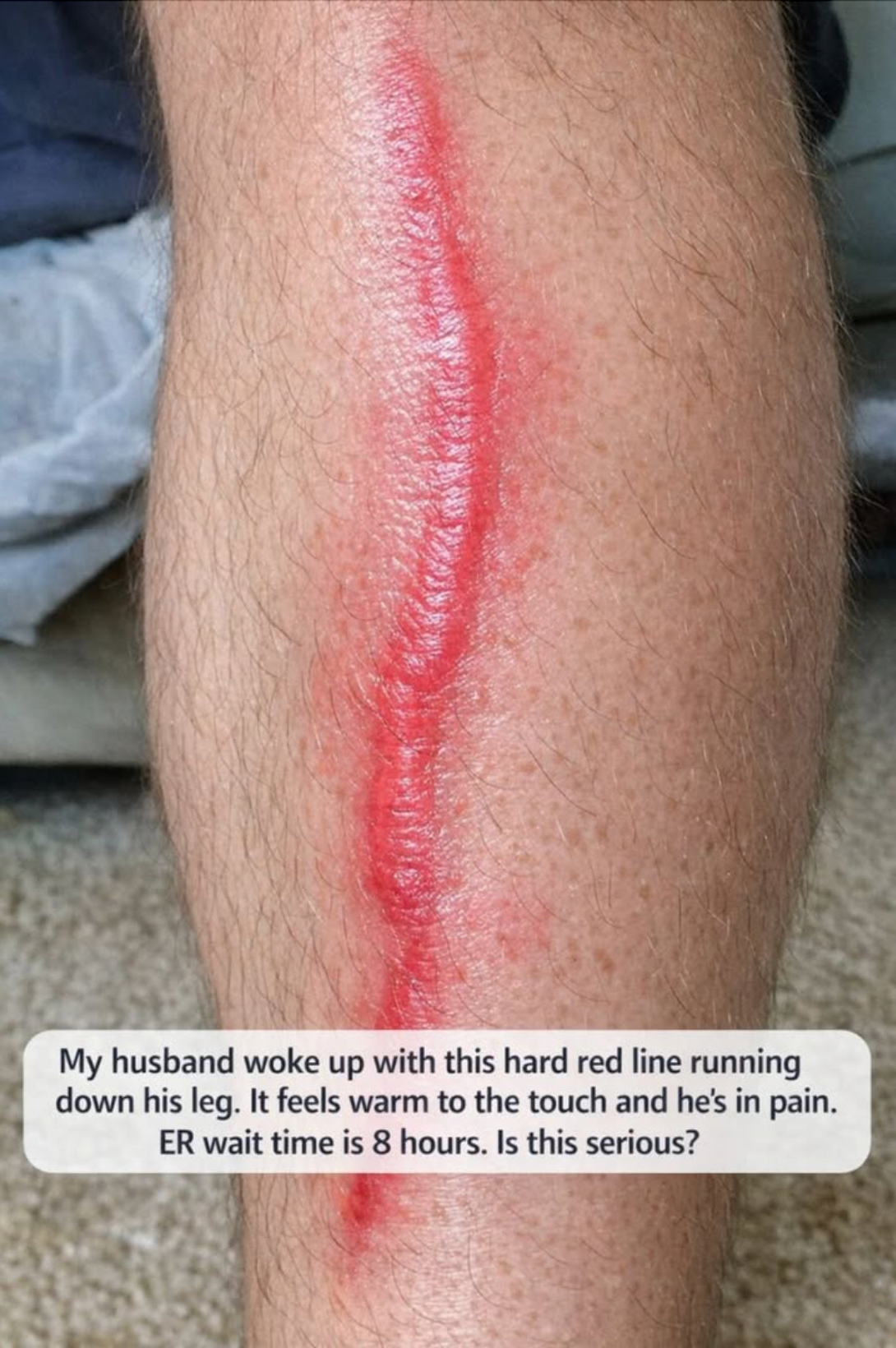
Waking up and noticing a hard, red line running down the leg that is warm and painful is not something to ignore or watch casually. Even though many everyday conditions can cause redness or irritation of the skin, the specific combination of a defined line, warmth, and pain raises concern for conditions that can become serious if not evaluated and treated promptly.
This type of symptom is different from a simple rash or muscle strain. It suggests that something is happening beneath the skin surface—either involving the skin and lymphatic system, or the blood vessels. In both cases, early medical attention can make a significant difference in outcome.
In this detailed guide, you will understand:
- The most likely medical explanations
- Why the “red line” pattern is important
- How to distinguish between possible causes
- What symptoms make the situation urgent
- What to do right now while waiting for care
- What doctors will likely check and treat
Why a Red Line Is an Important Clue
A red line on the skin is not random. The body has structured pathways:
- Lymphatic vessels that drain infection and fluid
- Veins that carry blood back to the heart
- Tissue planes where infection can spread
When redness appears in a linear pattern, it often means something is traveling along one of these pathways. That is why doctors pay close attention to this kind of symptom.
Most Concerning Possible Causes
1. Lymphangitis
This is one of the most important conditions to consider when a red line is visible.
What it is
Lymphangitis is an infection of the lymphatic vessels, which are part of the immune system. These vessels carry fluid and help fight infection. When bacteria enter through a small cut, insect bite, or skin break, they can travel along these vessels.
Key signs
- Red streak or line moving along the limb
- Skin feels warm
- Pain or tenderness
- Possible swelling
- Sometimes fever or chills
Why it is serious
This condition can progress quickly. If untreated, the infection can:
- Spread deeper into tissues
- Enter the bloodstream
- Lead to systemic infection
The visible red line is often a sign that the infection is actively spreading.
2. Cellulitis
What it is
Cellulitis is a bacterial infection of the deeper layers of the skin.
Symptoms
- Redness that may spread
- Warmth
- Pain or tenderness
- Swelling
- Skin may feel tight
Sometimes cellulitis presents with irregular patches, but it can also appear with streaking if it begins to involve lymphatic vessels.
Why it matters
Cellulitis can worsen rapidly and may require:
- Oral antibiotics
- In more severe cases, intravenous treatment
If left untreated, it can lead to complications such as abscess formation or bloodstream infection.
3. Deep Vein Thrombosis
What it is
Deep vein thrombosis (DVT) is a blood clot that forms in a deep vein, usually in the leg.
Symptoms
- Pain in the leg (often described as aching or tightness)
- Warmth in the affected area
- Redness or discoloration
- Swelling, especially in one leg
Why it is dangerous
The most serious risk is that part of the clot can break off and travel to the lungs, causing a pulmonary embolism. This can be life-threatening.
Although DVT does not always create a clear “line,” it can sometimes present with localized redness and warmth that people describe as a streak or area.
4. Superficial Thrombophlebitis
This is a clot in a vein closer to the surface.
Symptoms
- A firm, cord-like structure under the skin
- Redness along the vein
- Tenderness
- Warmth
This condition is usually less dangerous than deep vein thrombosis, but still requires medical evaluation.
Understanding the Symptoms Together
The combination of:
- A visible red line
- Warmth
- Pain
- A firm or hard feeling
is what makes this situation concerning.
Each symptom alone could be mild, but together they suggest:
- Active inflammation
- Possible infection
- Possible involvement of vessels
Questions That Help Narrow It Down
While waiting for medical care, these details can provide useful clues:
1. Did it appear suddenly?
A sudden appearance overnight can indicate:
- Infection
- Clot formation
2. Is it spreading?
- A growing red line suggests infection
- A stable area may still be serious but slightly less urgent
3. Is there swelling?
- Swelling increases concern for clot or severe infection
4. Is there fever?
- Fever suggests systemic infection
5. Is there a wound or bite?
- Even a small cut can allow bacteria to enter
When It Becomes an Emergency
Seek immediate care if any of the following occur:
- Fever or chills
- Rapid spreading of redness
- Severe pain
- Swelling of the leg
- Shortness of breath
- Chest pain
These signs may indicate:
- Infection spreading through the body
- A blood clot affecting circulation or lungs
What to Do Right Now
Even if the ER wait is long, the situation should be taken seriously.
Practical steps:
- Go to the ER and clearly describe symptoms
- Try urgent care or a private clinic if available
- Keep the leg elevated when possible
- Avoid unnecessary movement if a clot is suspected
What Not to Do
Avoid these actions:
- Do not massage the area
- Do not apply strong pressure
- Do not ignore worsening symptoms
- Do not rely only on home remedies
Massaging can be especially dangerous if a clot is present.
What Doctors Will Likely Do
When evaluated, medical professionals may:
1. Perform a physical exam
- Check temperature of the skin
- Examine the pattern of redness
- Look for swelling
2. Order tests
Depending on suspicion:
- Blood tests
- Ultrasound (to check for clots)
- Imaging if needed
3. Start treatment
If infection is suspected:
- Antibiotics
If a clot is suspected:
- Blood thinners
- Monitoring
Early treatment significantly reduces risk.
Why Early Action Matters
Delaying care can lead to complications such as:
- Infection spreading to bloodstream
- Tissue damage
- Clot migration to lungs
Prompt evaluation helps prevent these outcomes.
Psychological Aspect
It is normal to hesitate when faced with long wait times or uncertainty. Many people hope symptoms will improve on their own. However, in cases like this, the visible signs are the body’s way of signaling that something needs attention.
Common Misconceptions
“It is just a muscle strain”
Muscle strain does not cause a red line with warmth.
“It will go away by itself”
Some mild conditions resolve, but these symptoms are not typical of minor issues.
“No fever means it is not serious”
Serious conditions can exist without fever initially.
Summary
A hard, warm, painful red line on the leg is a symptom that should be taken seriously. It can be associated with:
- Lymphangitis
- Cellulitis
- Deep Vein Thrombosis
Each of these conditions requires medical evaluation, and some can become dangerous if not treated promptly.

Welcome to my kitchen!
I’m a passionate home cook and recipe creator who loves turning simple ingredients into delicious, comforting meals that everyone can enjoy. Through this website, I share carefully prepared recipes, practical cooking tips, and easy-to-understand food education to help you feel more confident in the kitchen.
My goal is to make cooking simple, enjoyable, and accessible. Whether you are looking for a quick family dinner, a delicious dessert, healthy meal ideas, or traditional recipes with a modern touch, you’ll find inspiration here.
More Than Just Recipes
I believe that cooking is also a way to learn. That’s why this website is not only about recipes. I also create educational articles about ingredients, cooking techniques, kitchen tips, food preparation, and the stories behind different dishes.
Each article is designed to give you useful knowledge that you can apply in your own kitchen. From understanding how ingredients work together to learning better cooking methods, my aim is to help you become a more confident and creative cook.
My Philosophy
Good food doesn’t always require complicated ingredients or professional equipment. With a little knowledge, patience, and creativity, simple ingredients can become something truly special.
I believe in sharing recipes that are practical, clearly explained, and enjoyable to make. I also love exploring new flavors while appreciating traditional cooking and the recipes passed down through generations.
Thank you for visiting my kitchen and being part of this food-loving community. I hope my recipes and articles inspire you to cook, learn, experiment, and most importantly, enjoy every bite!
Happy cooking!