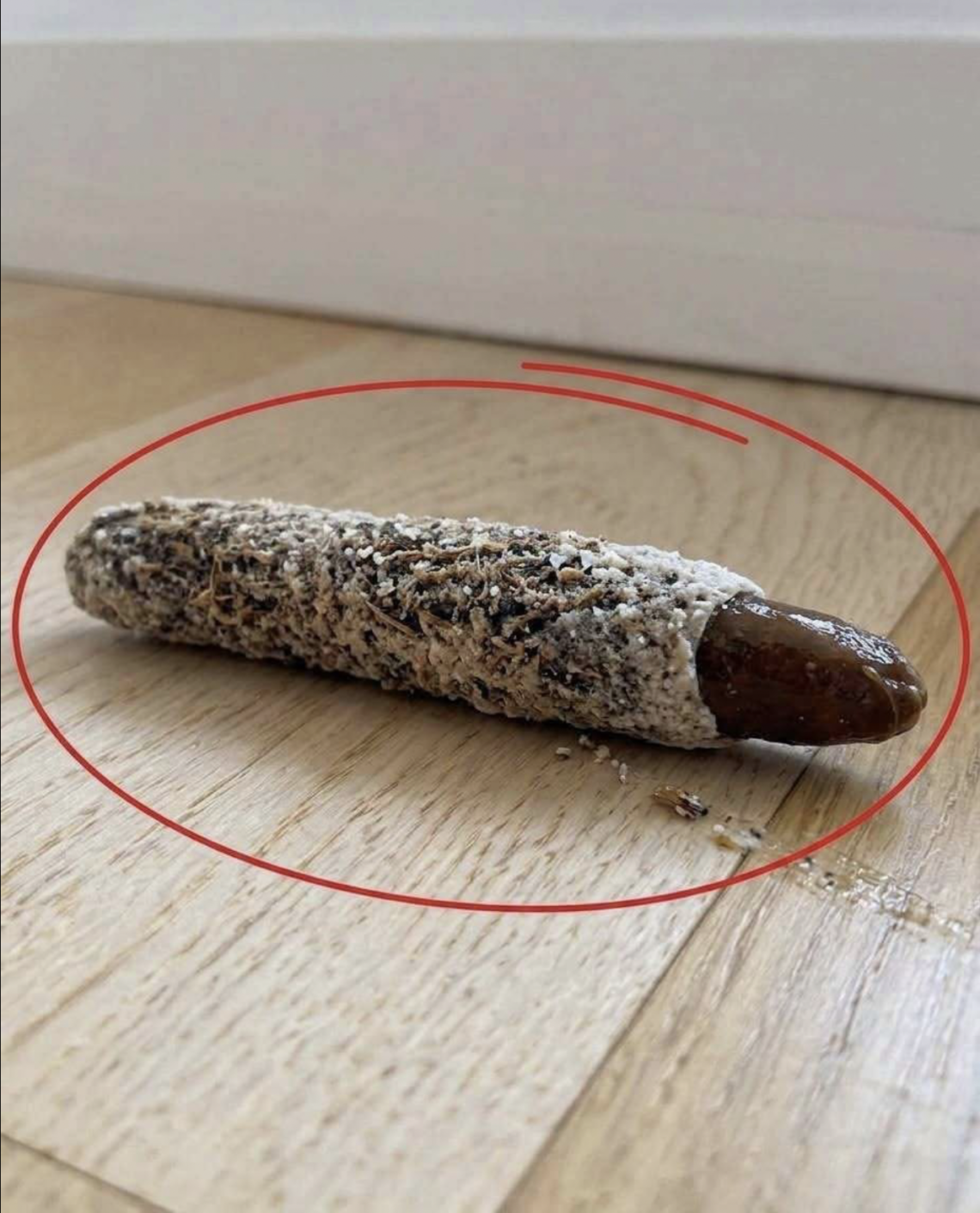
At first, the tiny object on the floor looked like nothing more than a piece of dirt.
It was small, dusty, and oddly shaped, almost like a little dried leaf, a piece of lint, or a fragment of debris that had somehow escaped the vacuum cleaner. It would have been very easy to sweep it away without a second thought.
But there was something unusual about it.
Its surface appeared to contain tiny fibers and particles that seemed almost deliberately arranged. Instead of looking completely random, the object had a strange, structured appearance. It looked almost as though something had carefully constructed a miniature tube from whatever materials happened to be lying around.
That observation turned an ordinary bit of household debris into a fascinating little mystery.
And the explanation was even more surprising.
The strange object could be the protective case of a household casebearer, an insect commonly nicknamed a plaster bagworm. Despite the name, it isn’t actually a worm. It is the larval stage of a small moth, and the larva spends much of its development living inside a tiny portable case that it constructs from silk and bits of material gathered from its surroundings.
In other words, what looked like a piece of dirt could actually have been a tiny animal carrying its own house around.
It Looks Like Dirt for a Very Good Reason
One of the most fascinating things about a household casebearer’s case is how effectively it blends into its surroundings.
The larva uses silk to construct the basic structure and incorporates small particles from the environment. Depending on where it lives, the case can contain dust, sand, fibers, hairs, insect remains, and other tiny pieces of debris.
The finished structure can therefore look remarkably similar to the floor, wall, or other surface where it is found.
That provides excellent camouflage.
A predator—or a curious human—might simply look at it and think:
“That’s just a piece of dirt.”
And that’s exactly the advantage.
The insect doesn’t need a brightly colored shell or an elaborate hiding place. Instead, it essentially makes itself disappear by becoming part of the environment.
There’s a Tiny Caterpillar Inside
This is the detail that makes the discovery so fascinating.
The little case isn’t simply an empty shell.
When the larva is active, it lives inside the structure. It can extend its head and legs through an opening, grip the surface, and pull the case forward as it moves.
From a distance, it can look as though a tiny piece of dust is mysteriously crawling across the floor.
The larva can also retreat back inside when disturbed.
So the object has two identities.
To us, it looks like debris.
To the caterpillar, it is a portable shelter, camouflage system, and protective retreat.
The Case Is Carefully Designed
Although it may look like an accidental collection of lint, the case is actually constructed.
The larva produces silk and uses available materials to strengthen and camouflage its shelter.
The case is generally narrow and flattened rather than perfectly round. It has openings that allow the larva to extend itself outward when it needs to move or feed.
That design gives the insect remarkable flexibility.
It doesn’t have to abandon its shelter every time it wants to travel.
Instead, it takes its protection with it.
It’s a little like carrying your bedroom, raincoat, and hiding place everywhere you go—but on a microscopic scale.
Why Would It Be on the Floor?
A floor can provide surprisingly good conditions for these tiny insects.
Even in a clean home, floors inevitably collect microscopic amounts of organic material.
There may be:
- Hair
- Pet fur
- Dust
- Lint
- Tiny insect remains
- Natural fibers
- Spider-web material
- Small particles brought indoors from outside
Most of us don’t even notice these materials.
A tiny larva does.
Household casebearers are especially associated with areas where old spider webs and other organic debris accumulate. That means corners, behind furniture, around baseboards, closets, storage areas, garages, and other relatively undisturbed locations can sometimes provide suitable habitat.
So finding one doesn’t necessarily mean your home is dirty.
It simply means that a very small insect has discovered a place where food and construction materials are available.
Why Are They Sometimes Found on Walls?
This is where the story becomes even stranger.
People sometimes discover these little cases attached to walls or apparently moving upward.
The reason is simple: the larva is capable of dragging its case along surfaces.
It extends its body through the opening, grips the surface with its legs, and pulls the protective case behind it.
Because the case itself doesn’t look alive, the movement can be extremely difficult to notice.
You might look at a wall and see what appears to be a tiny seed or piece of dirt.
Then, after looking away and returning later, you discover that it has moved.
That’s when the mystery really begins.
It Isn’t Actually a “Bagworm”
The nickname plaster bagworm can be confusing.
True bagworms belong to a different group of moths. The household casebearer belongs to the family of moths that includes several species known for larvae that create protective cases.
The more accurate common name is therefore household casebearer.
Still, the nickname plaster bagworm remains popular because the cases are often found attached to walls and other surfaces.
So if you’ve heard both names, they’re referring to the same general type of household insect in this context.
What Does the Larva Eat?
The larva isn’t simply wandering around looking for random food.
It is particularly associated with materials such as old spider webs and the remains of insects caught in those webs.
It can also make use of various animal-based fibers and accumulated organic debris.
This explains why the insect can sometimes be found in quiet, undisturbed parts of a house.
A corner with an old spider web may look completely insignificant to us.
For a tiny case-bearing larva, however, it can provide both food and material for its protective case.
That is an impressively efficient arrangement.
The Spider Web Connection
This is one of the most useful clues if you’re trying to understand why these cases have appeared.
If you discover several cases in one particular area, look around for old spider webs.
You may find that the insects are concentrated in corners where webs have accumulated.
Cleaning away old webs and vacuuming dusty areas can therefore remove some of the resources that allow these larvae to thrive.
It’s a good example of how ordinary housekeeping can sometimes be more useful than immediately reaching for a chemical treatment.
Does Finding One Mean There’s an Infestation?
Not necessarily.
One tiny case doesn’t automatically indicate a serious pest problem.
A single larva may simply have wandered into a suitable location.
Even finding several doesn’t necessarily mean your home has a major infestation.
However, if you repeatedly discover large numbers of cases, especially around closets, stored clothing, carpets, or natural-fiber materials, it makes sense to investigate more carefully.
Pay particular attention to areas that are:
- Humid
- Poorly ventilated
- Rarely disturbed
- Covered with old spider webs
- Accumulating dust or hair
- Used to store natural fabrics
The important thing is to look for the environmental conditions supporting the insects.
Are These Creatures Dangerous?
For most people, household casebearers are primarily a nuisance rather than a dangerous household pest.
They aren’t known for attacking people, and they don’t have the behavior of biting or stinging insects.
Their presence is usually much more interesting than threatening.
The main concern is that some case-bearing moth larvae can make use of animal-based fibers and other natural materials.
If you repeatedly find them around stored wool, silk, felt, or similar fabrics, it’s worth inspecting those materials for signs of damage.
But discovering one little case on the floor isn’t a reason to panic.
Why Does the Case Contain Hair and Lint?
This is perhaps the strangest detail of all.
The insect isn’t shopping for building materials.
It simply uses what’s available.
A tiny piece of hair that we would normally consider household waste can become part of the insect’s protective shelter.
The same applies to lint, dust, fibers, and other small particles.
This makes every case slightly different.
The appearance depends partly on the environment where it was constructed.
One case might look gray.
Another might look brown.
Another might contain so much fiber that it resembles a tiny piece of fluff.
The insect essentially becomes an architect using recycled materials.
The Larva Grows, and Its House Grows With It
A particularly clever feature of the case is that it isn’t necessarily a fixed structure.
As the larva develops, it can enlarge and modify its shelter.
That means the protective case can change during the insect’s development.
The animal doesn’t have to abandon its home simply because its body has grown.
Instead, it gradually adapts the structure.
It’s an incredibly practical solution to a basic biological problem:
How do you grow while remaining protected?
Build a bigger house.
What Happens When It Becomes an Adult?
Eventually, the larval stage ends.
The insect enters the next stage of its life cycle and eventually becomes a small moth.
The case can remain behind after the insect has completed its development.
That means not every case you discover will contain a living larva.
Some may be old, empty cases.
This is another reason why the objects can accumulate in corners and on walls without appearing to move.
You may be looking at the remains of an earlier stage of the insect’s life rather than an active creature.
What Should You Do If You Find One?
If you find one of these little cases indoors, the simplest response is usually straightforward cleaning.
You can vacuum or sweep it up.
Then inspect the surrounding area.
Look at the corners.
Check behind furniture.
Remove old spider webs.
Vacuum accumulated dust and hair.
Pay attention to closets and areas where fabrics are stored.
If there is noticeable humidity, improving ventilation and reducing unnecessary moisture can also make the environment less favorable for various household pests.
There is usually no reason to treat the entire house simply because you’ve discovered a single case.
When Should You Pay More Attention?
Repeated discoveries are more informative than a single specimen.
If you keep finding these cases in the same room, ask yourself what that location has in common.
Perhaps it has:
Old spider webs.
Poor ventilation.
Higher humidity.
Lots of dust.
Stored fabrics.
Undisturbed furniture or storage spaces.
Addressing those conditions can be more useful than simply removing individual cases one at a time.
You aren’t just getting rid of the insects.
You’re making the environment less attractive to them.
A Tiny Masterpiece of Natural Engineering
The more you learn about the little case, the less ordinary it seems.
What initially looked like dirt turns out to be a carefully constructed shelter.
The fibers aren’t necessarily random.
The shape isn’t accidental.
The openings serve a purpose.
The material provides camouflage.
And the entire structure can be transported by the tiny creature living inside.
It’s an extraordinary example of how animals solve problems using whatever resources are available around them.
No factory.
No tools.
No blueprint.
Just silk, debris, and an instinctive understanding of survival.
Why We Miss Things Like This Every Day
Perhaps the most interesting lesson isn’t about the insect itself.
It’s about how easily we overlook the miniature world around us.
Our homes are full of tiny organisms and natural processes that go completely unnoticed.
A speck on a wall might be an insect case.
A strange powder in a corner might be pollen.
A tiny web might be a carefully constructed hunting trap.
A mysterious hole in wood might tell a story about an insect that lived there months earlier.
Most of the time, we simply sweep these things away.
But occasionally, taking a second look reveals something genuinely fascinating.

Welcome to my kitchen!
I’m a passionate home cook and recipe creator who loves turning simple ingredients into delicious, comforting meals that everyone can enjoy. Through this website, I share carefully prepared recipes, practical cooking tips, and easy-to-understand food education to help you feel more confident in the kitchen.
My goal is to make cooking simple, enjoyable, and accessible. Whether you are looking for a quick family dinner, a delicious dessert, healthy meal ideas, or traditional recipes with a modern touch, you’ll find inspiration here.
More Than Just Recipes
I believe that cooking is also a way to learn. That’s why this website is not only about recipes. I also create educational articles about ingredients, cooking techniques, kitchen tips, food preparation, and the stories behind different dishes.
Each article is designed to give you useful knowledge that you can apply in your own kitchen. From understanding how ingredients work together to learning better cooking methods, my aim is to help you become a more confident and creative cook.
My Philosophy
Good food doesn’t always require complicated ingredients or professional equipment. With a little knowledge, patience, and creativity, simple ingredients can become something truly special.
I believe in sharing recipes that are practical, clearly explained, and enjoyable to make. I also love exploring new flavors while appreciating traditional cooking and the recipes passed down through generations.
Thank you for visiting my kitchen and being part of this food-loving community. I hope my recipes and articles inspire you to cook, learn, experiment, and most importantly, enjoy every bite!
Happy cooking!