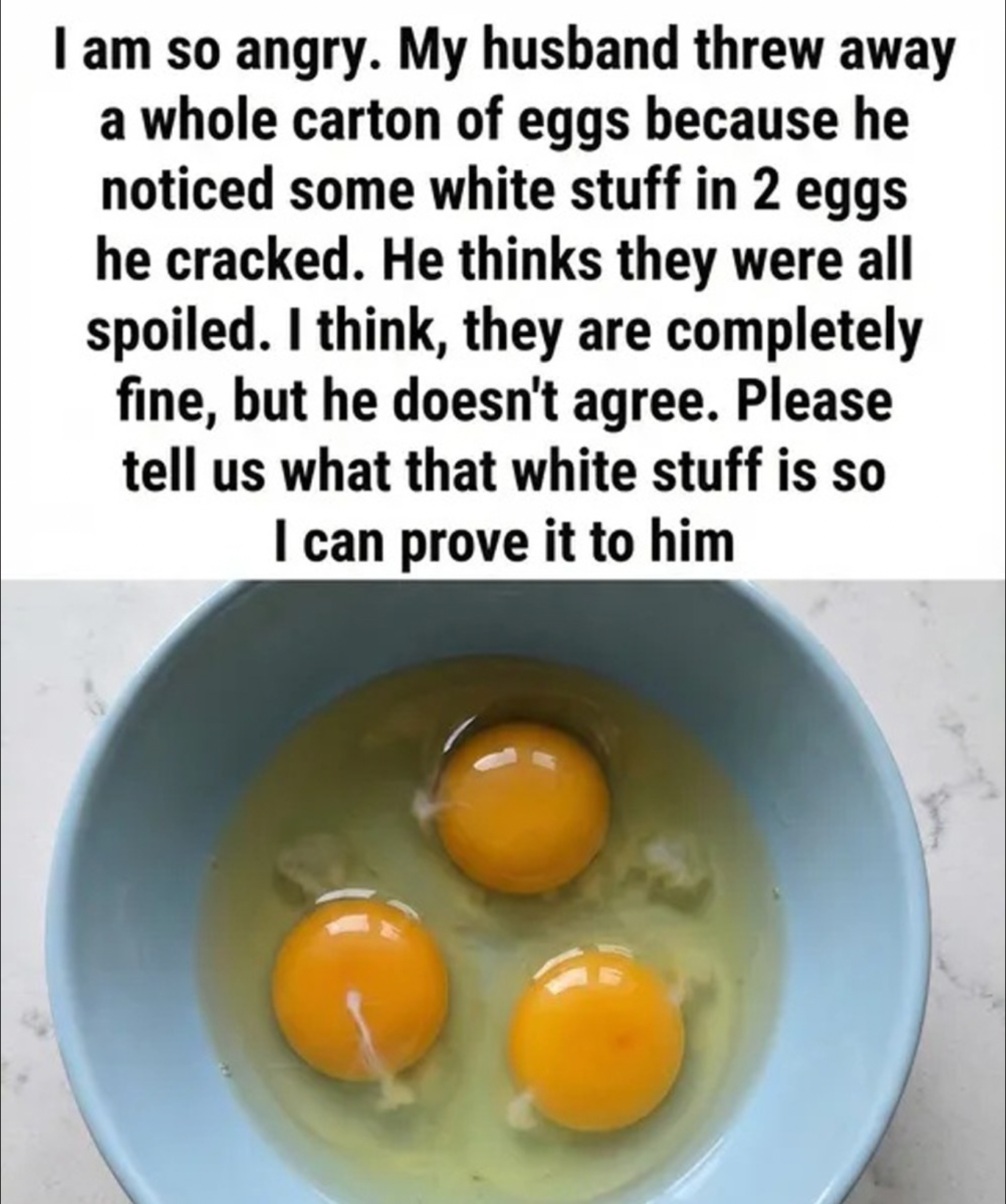
If you’ve ever cracked open an egg and noticed a thick, white, stringy strand floating near the yolk—or clinging to it like a little rope—you’re not alone. It’s one of those tiny kitchen mysteries that catches people off guard, especially if you’re cracking eggs into a bowl under bright light or making a recipe where you can clearly see every detail.
Many people instantly assume it’s something bad.
Some think it’s:
- a sign the egg has spoiled
- an undeveloped embryo
- a parasite or worm
- “old egg gunk”
- something that must be removed before cooking
But here’s the truth:
That white strand is completely normal, completely harmless, and actually a sign of freshness.
It even has a name.
The Name of the White Strand: Chalaza (kuh-LAY-zuh)
That white, twisty strand is called the chalaza (plural: chalazae).
It’s a natural part of the egg, created by the hen as the egg forms. It’s not a defect, not contamination, and not something added later.
Think of it as the egg’s built-in support system.
What Does the Chalaza Do?
It’s basically the yolk’s “seatbelt.”
The chalaza is made of thickened egg white proteins that twist into rope-like strands.
Its main job is to:
✔ Hold the yolk centered in the egg
The chalaza keeps the yolk suspended in the middle of the egg so it doesn’t smash against the shell.
This matters because eggs get moved around a lot:
- inside the hen
- during laying
- during collection and packaging
- in transport
- in your fridge
- in your hands while cooking
Without the chalaza, the yolk would drift and break more easily.
So when you see it, what you’re really seeing is nature’s clever design—something that helps protect the yolk and keep the egg intact.
Is the White Strand a Sign the Egg Is Fertilized?
This is one of the biggest myths.
❌ No — the chalaza does NOT mean the egg is fertilized.
A fertilized egg may have a small white spot on the yolk called the germinal disc, but even that doesn’t mean it’s developing into anything unless incubated.
Most grocery store eggs are not fertilized at all, and even if they were, they are not incubated, so there is no embryo.
The chalaza is present in both fertilized and unfertilized eggs.
Is the Chalaza Safe to Eat?
✔ Yes, 100% safe.
It’s just egg white protein—same material as the rest of the egg white, only thicker and more structured.
It:
- has no harmful effect
- does not change safety
- does not mean the egg is bad
- does not affect nutrition in a negative way
If you cook the egg, the chalaza will simply blend in and disappear into the texture.
Why Does It Look Bigger in Some Eggs?
Great question — because sometimes it looks tiny, and sometimes it looks like a thick cord.
Doctors and food scientists explain that the chalaza can vary because of:
1) Freshness
A fresher egg often has:
- firmer whites
- more visible chalaza
So ironically…
The more visible the strand, the fresher the egg often is.
2) Egg Handling
If an egg has been shaken or bounced during transport, the chalaza may stretch, twist, or shift.
3) Egg Type and Breed
Different hens and egg sizes can naturally produce slightly different chalaza thickness.
Should You Remove It Before Cooking?
Most of the time: NO.
You don’t need to remove it for normal cooking like:
- scrambled eggs
- fried eggs
- omelets
- boiled eggs
- baking
But there are a few special cases where some cooks choose to remove it.
When People Remove It (Optional)
1) Custards, flans, and very smooth desserts
If you want a perfectly silky custard (like crème brûlée), you may strain the egg mixture anyway. Straining removes chalaza automatically.
2) Fine baking or pastry
In some pastry recipes, chefs want absolutely smooth egg texture, so they remove it out of habit.
3) Egg whites for fancy meringue
Even then, chalaza won’t ruin meringue, but some bakers prefer a cleaner separation.
How to remove it:
Just scoop it out with a spoon or fork tip after cracking the egg into a bowl.
But again: it’s optional, not required.
Does Chalaza Mean the Egg Is Spoiled?
❌ No.
A spoiled egg is identified by other signs, not chalaza.
Real Signs an Egg Is Bad
1) Smell
A rotten egg has a very strong sulfur smell.
If it smells bad, throw it away.
2) Appearance
If the egg white is:
- pink
- green
- glittery
- unusually cloudy with strange lumps
Or the yolk looks:
- extremely flat
- discolored
- leaking
It’s safer to discard.
3) Float test (for age, not perfect safety)
Put egg in water:
- sinks and lays flat = fresh
- sinks but stands upright = older
- floats = very old (usually discard)
Why Do Some Eggs Have Two Strands?
Sometimes you’ll see two rope-like strands—one on each side of the yolk.
That’s normal.
Most eggs have two chalazae, one anchoring each side of the yolk, like two support cords holding it centered.
You may only notice one depending on where it is positioned when you crack the egg.
What Happens to Chalaza When You Cook Eggs?
It disappears into the egg.
- In scrambled eggs: blends into the white
- In fried eggs: becomes part of the cooked white
- In baking: mixes into batter
- In boiling: stays attached inside but you don’t notice it
So even if it looks strange raw, it is not noticeable after cooking.
A Fun Way to Think About It
If the egg were a tiny planet:
- the yolk is the core
- the egg white is the atmosphere
- the chalaza is the suspension system holding the core in place
It’s like the egg’s internal engineering.
Why This Egg Mystery Makes People Nervous
This strand freaks people out because it looks like something living—like a worm.
But it’s not.
It’s simply a thickened protein cord, and it’s one of those reminders that eggs are a natural food, not a factory product.
Modern eggs are so clean and uniform that when people see something “extra,” it triggers suspicion.
But chalaza is actually a reassuring sign.
Final Takeaway
So, what is that white strand in eggs?
It’s the chalaza — a natural egg structure that:
- holds the yolk centered
- protects the yolk from breaking
- often indicates a fresher egg
- is completely safe to eat
It’s not a parasite.
It’s not spoilage.
It’s not a baby chick.
It’s just part of how eggs are built.