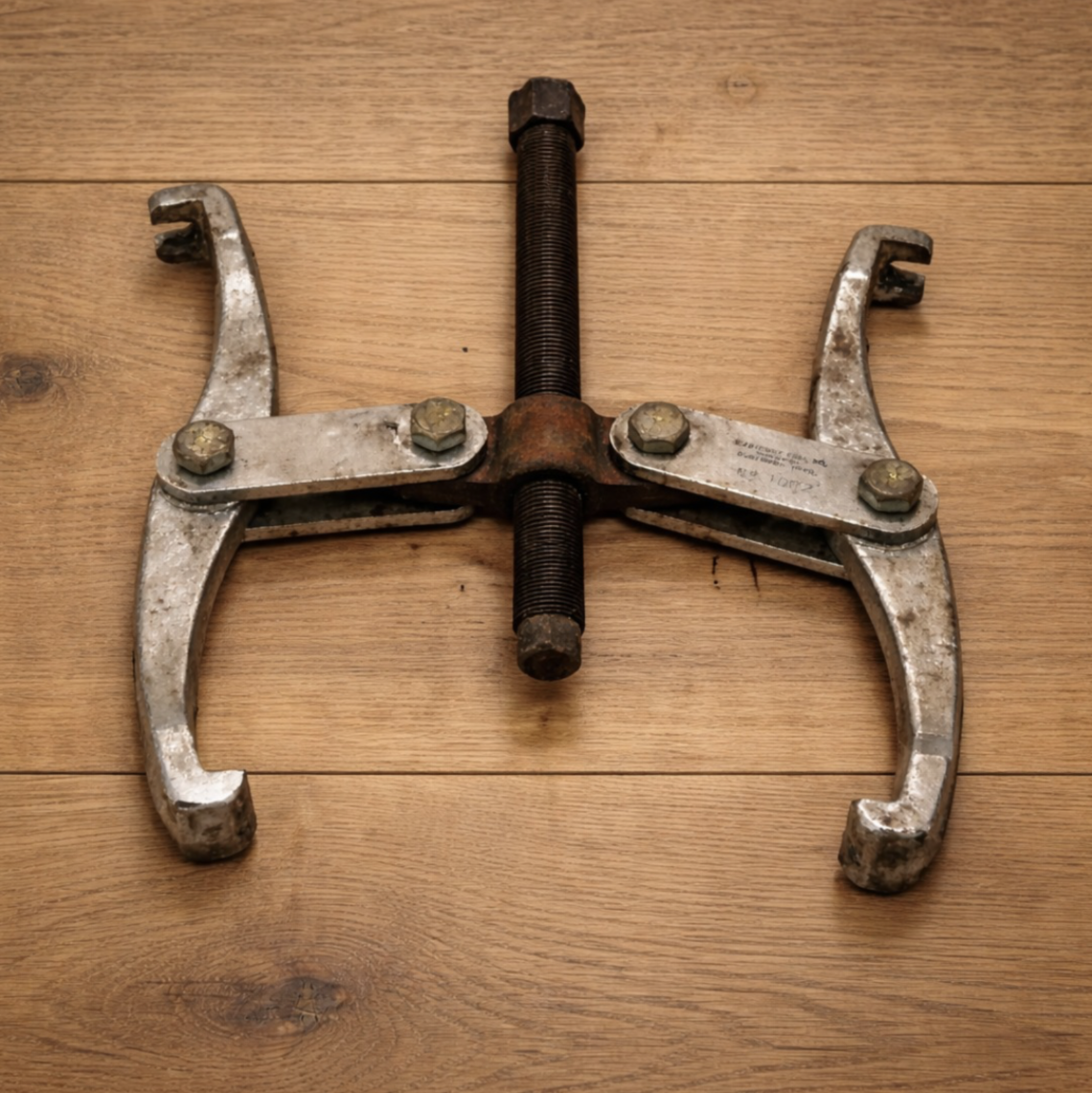
At first glance, a vintage gear puller may not look particularly remarkable. It lacks the polished appearance of modern power tools and doesn’t have the complexity of advanced machinery. To the untrained eye, it may appear to be nothing more than a collection of metal arms attached to a threaded bolt. Yet for generations of mechanics, machinists, engineers, and equipment operators, the gear puller has been one of the most valuable tools in the workshop.
Its purpose is straightforward but essential: to safely remove gears, pulleys, bearings, bushings, sprockets, flywheels, and other tightly fitted components from shafts and axles without damaging the surrounding machinery. What makes the gear puller remarkable is not complexity, but efficiency. It solves a difficult mechanical problem through a simple application of leverage, pressure, and precision.
For decades, gear pullers have been trusted in automotive garages, factories, farms, rail yards, shipyards, and industrial plants around the world. Many vintage pullers manufactured generations ago remain fully functional today, a testament to their robust design and the quality of materials used in their construction.
Understanding the Challenge: Why Parts Get Stuck
To appreciate the importance of the gear puller, it helps to understand why gears and bearings become difficult to remove in the first place.
In many machines, components are intentionally installed with an extremely tight fit. Engineers often design parts so that gears, bearings, or pulleys fit snugly onto shafts. This prevents slipping during operation and ensures efficient transfer of power.
Over time, however, several factors can make removal difficult:
Corrosion
Moisture and oxygen can create rust between metal surfaces. Even a thin layer of corrosion can effectively “glue” parts together.
Heat Cycles
Machines repeatedly heat up and cool down during operation. These expansion and contraction cycles can create an extremely tight bond between components.
Pressure and Wear
Years of operation place constant stress on mechanical assemblies. Components can effectively settle into place under pressure.
Dirt and Contamination
Dust, grease, and debris can accumulate around fitted parts, making disassembly more difficult.
As a result, a gear or bearing that originally slid onto a shaft relatively easily may become nearly impossible to remove by hand years later.
Before Gear Pullers: A Difficult and Risky Process
Before specialized pullers became common, mechanics often had to rely on crude methods to remove stuck components.
These methods included:
- Hammering
- Chiseling
- Prying with bars
- Heating parts with torches
- Striking components repeatedly
While these approaches sometimes worked, they carried significant risks.
Damaged Bearings
Hammer impacts could deform delicate bearing surfaces.
Bent Shafts
Excessive force might bend a shaft, rendering an expensive machine unusable.
Cracked Gears
Cast-iron gears could fracture under uneven stress.
Personal Injury
Flying metal fragments and slipping tools posed serious hazards.
Repair jobs that should have taken minutes could turn into expensive and frustrating projects.
The invention of the gear puller dramatically improved the situation by allowing force to be applied evenly and predictably.
The Birth of the Gear Puller
The exact origins of the gear puller are difficult to trace, but puller-style tools became increasingly common during the Industrial Revolution and the rapid expansion of mechanized manufacturing.
As machinery grew more sophisticated, mechanics needed a reliable method for servicing equipment without causing damage.
Toolmakers developed pullers based on a simple concept:
Instead of striking a component loose, apply gradual, controlled force until it releases naturally.
This idea transformed maintenance work.
By the late nineteenth and early twentieth centuries, gear pullers had become standard equipment in many workshops.
How a Gear Puller Works
Although designs vary, most gear pullers operate according to the same mechanical principles.
A typical puller consists of:
- Two or three gripping arms (jaws)
- A central forcing screw
- A frame connecting the jaws
The jaws hook onto the component that needs to be removed.
The central screw is positioned against the shaft.
As the screw is tightened, it pushes against the shaft while simultaneously pulling on the gear or bearing.
This creates opposing forces:
- The shaft is pushed inward.
- The component is pulled outward.
Eventually, the component breaks free and slides off.
The process is smooth, controlled, and far safer than hammering.
The Science Behind Controlled Force
The gear puller’s effectiveness comes from mechanical advantage.
When a mechanic turns the central screw, rotational force is converted into linear force.
This allows a person using an ordinary wrench to generate thousands of pounds of pulling pressure.
A relatively small effort applied to the wrench can produce tremendous force at the point of contact.
Because the force is applied gradually and evenly, the risk of damage is greatly reduced.
Common Types of Gear Pullers
Over time, many specialized puller designs have been developed.
Two-Jaw Pullers
These use two arms to grip the component.
Advantages include:
- Quick setup
- Access to tight spaces
- Lightweight design
However, they can sometimes apply uneven force.
Three-Jaw Pullers
These use three equally spaced arms.
Benefits include:
- Better balance
- More even force distribution
- Reduced risk of slipping
Three-jaw pullers are among the most popular designs in modern workshops.
Bearing Pullers
Designed specifically for removing bearings.
These often include:
- Split collars
- Specialized attachments
- Precision gripping surfaces
They allow removal of delicate bearings without damage.
Hydraulic Pullers
For extremely stubborn components, hydraulic systems replace manual screws.
Advantages:
- Massive pulling force
- Less physical effort
- Improved safety
These are commonly found in industrial settings.
Automotive Applications
The automotive industry relies heavily on gear pullers.
Common uses include removing:
- Wheel bearings
- Crankshaft pulleys
- Steering wheel hubs
- Gears
- Timing components
- Harmonic balancers
Without pullers, many automotive repairs would become significantly more difficult and expensive.
Professional mechanics often consider them essential tools.
Industrial Uses
Beyond automobiles, gear pullers play a crucial role in industry.
They are used in:
- Manufacturing plants
- Mining operations
- Agricultural equipment repair
- Power generation facilities
- Rail transportation
- Marine engineering
Wherever rotating machinery exists, gear pullers are likely nearby.
Why Vintage Gear Pullers Are Still Valued
One reason collectors and mechanics appreciate vintage gear pullers is their exceptional durability.
Many older tools were manufactured from:
- Forged steel
- Cast steel
- High-carbon alloys
These materials were designed to withstand decades of heavy use.
Unlike some modern tools made with lighter materials, vintage pullers were often built with longevity as the primary goal.
It is not uncommon to find pullers that are:
- 50 years old
- 75 years old
- Over a century old
and still fully operational.
Characteristics of Vintage Models
Older gear pullers often feature:
Thick Metal Construction
Heavy-duty steel components resist bending.
Large Threads
Coarse screw threads provide strength and durability.
Simple Design
Fewer moving parts mean fewer opportunities for failure.
Repairability
Many vintage pullers can be cleaned, lubricated, and restored with minimal effort.
Collecting Vintage Mechanical Tools
Today, vintage gear pullers are increasingly appreciated by:
- Tool collectors
- Antique enthusiasts
- Mechanics
- Industrial historians
Collectors value them because they represent a period when tools were designed primarily for performance and durability.
Each puller tells a story about the machines it serviced and the industries it helped maintain.
The Importance of Proper Use
Even though gear pullers are highly effective, proper technique is essential.
Good practices include:
- Inspecting the tool before use
- Ensuring jaws are securely attached
- Applying force gradually
- Wearing eye protection
- Using the correct size puller
Improper use can lead to slipping jaws or damaged components.
Why the Design Has Endured
Many tools become obsolete as technology advances.
The gear puller is different.
Its design has remained largely unchanged because it solves a problem so effectively.
Modern versions may feature:
- Better materials
- Hydraulic assistance
- Improved ergonomics
But the fundamental principle remains exactly the same as it was generations ago.
That is often the hallmark of great engineering.

Welcome to my kitchen!
I’m a passionate home cook and recipe creator who loves turning simple ingredients into delicious, comforting meals that everyone can enjoy. Through this website, I share carefully prepared recipes, practical cooking tips, and easy-to-understand food education to help you feel more confident in the kitchen.
My goal is to make cooking simple, enjoyable, and accessible. Whether you are looking for a quick family dinner, a delicious dessert, healthy meal ideas, or traditional recipes with a modern touch, you’ll find inspiration here.
More Than Just Recipes
I believe that cooking is also a way to learn. That’s why this website is not only about recipes. I also create educational articles about ingredients, cooking techniques, kitchen tips, food preparation, and the stories behind different dishes.
Each article is designed to give you useful knowledge that you can apply in your own kitchen. From understanding how ingredients work together to learning better cooking methods, my aim is to help you become a more confident and creative cook.
My Philosophy
Good food doesn’t always require complicated ingredients or professional equipment. With a little knowledge, patience, and creativity, simple ingredients can become something truly special.
I believe in sharing recipes that are practical, clearly explained, and enjoyable to make. I also love exploring new flavors while appreciating traditional cooking and the recipes passed down through generations.
Thank you for visiting my kitchen and being part of this food-loving community. I hope my recipes and articles inspire you to cook, learn, experiment, and most importantly, enjoy every bite!
Happy cooking!