At first glance, they can look almost completely mysterious.
You might walk past one near a beach, campground, marina, boardwalk, or waterfront parking area and wonder what on earth you’re looking at.
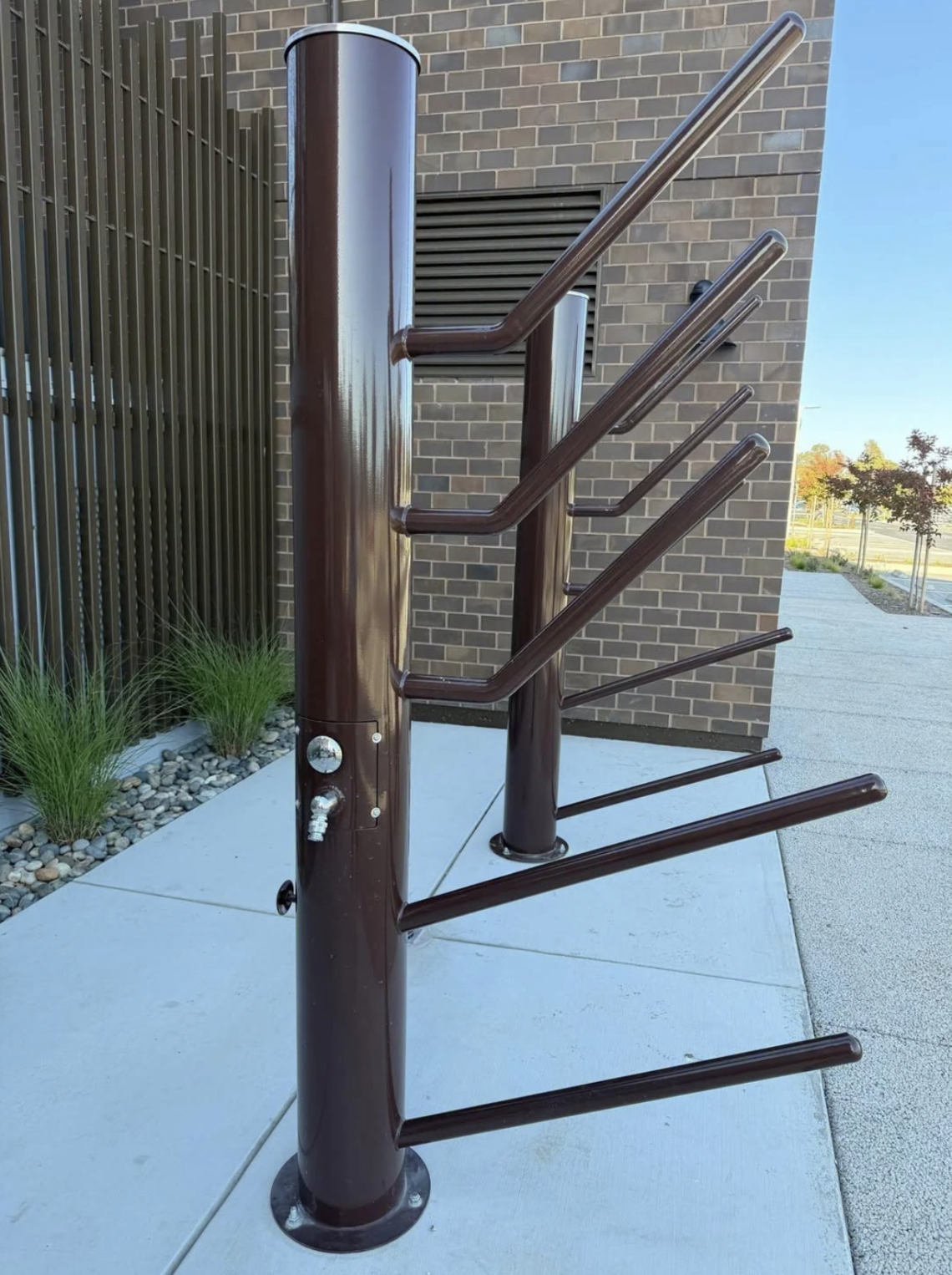
A vertical metal post stands firmly in the ground, while several narrow arms extend outward at different heights. Some versions have symmetrical branches that resemble an abstract sculpture. Others look like a strangely shaped bicycle rack or a piece of industrial playground equipment.
There may be no obvious sign explaining what the structure is for.
And yet, the unusual shape isn’t accidental.
These structures are generally surfboard wash stations or surfboard racks designed to help surfers rinse, drain, and temporarily support their equipment after being in the ocean.
What looks like random metalwork is actually a simple solution to a very practical problem.
What Is a Surfboard Wash Station?
A surfboard wash station is an outdoor facility designed to make it easier to rinse equipment after surfing.
Depending on the location, it may include:
- A water supply
- Rinse nozzles or shower heads
- Drainage
- A rack or series of supports
- Hooks for accessories
- Separate spaces for multiple boards
The exact design varies from place to place.
Some stations are elaborate structures with dedicated showers and drainage systems.
Others are little more than a collection of metal supports next to a water source.
The unusual branching shapes are often designed to accommodate boards and equipment without requiring surfers to lay everything directly on the ground.
Why Do Surfboards Need to Be Rinsed?
Ocean water contains salt, minerals, sand, and other material that can remain on equipment after a session.
Surfers may rinse their boards and accessories with fresh water to remove saltwater and sand.
This is especially useful for equipment that is repeatedly exposed to the ocean.
A quick freshwater rinse can help keep equipment cleaner and reduce the amount of salt and sand being carried into vehicles, homes, and changing areas.
It’s also simply more pleasant to handle equipment that isn’t covered in gritty sand.
Why Does the Structure Have So Many Arms?
This is the part that often makes people stop and stare.
Why would anyone design a rack with all those strange metal branches?
The answer is surprisingly straightforward:
The arms create multiple points where equipment can rest or be supported.
Surfboards are long, relatively wide objects.
A conventional rack designed for bicycles or small pieces of equipment wouldn’t necessarily be suitable.
The branching supports allow boards to be positioned at different heights or angles while leaving enough space for water to drain away.
In busy beach areas, the design can also allow several people to use the facility without everything being piled together.
The Shape Is About Space
Surfboards aren’t particularly convenient objects to store.
They’re long.
They’re wide.
They’re relatively delicate compared with something like a metal tool.
And they can be awkward to carry through crowded spaces.
A good rack therefore needs to support the board without requiring a huge amount of ground space.
Vertical organization solves part of the problem.
Instead of placing multiple boards flat on the ground, the rack uses height and spacing to organize them.
That is why these structures can appear much more complicated than they really are.
The designer is essentially solving a three-dimensional storage problem.
It’s Not Just About Surfboards
Depending on the design and location, these stations may also be useful for other beach equipment.
People may use appropriately designed racks for things such as:
- Bodyboards
- Paddleboards or related equipment
- Wetsuits
- Leashes
- Fins
- Beach gear
However, the exact intended use depends on the particular station.
Not every unusual metal rack near the ocean is necessarily designed for every type of equipment.
Some are specifically designed around particular board shapes or local beach facilities.
Why Not Just Leave the Board on the Ground?
That seems like the obvious alternative.
But placing a surfboard directly on the ground can create several problems.
Sand can accumulate around it.
People can accidentally step on it.
The board can be knocked over.
Water may not drain as easily.
And in a busy public area, boards lying across walkways can become a tripping hazard.
A rack lifts equipment away from foot traffic and gives it a designated place.
That makes the beach environment more organized.
The Importance of Freshwater
For many surf facilities, the rinse station is just as important as the rack itself.
Freshwater can wash away salt and sand after a session.
Surfers often appreciate having a place where they can rinse equipment before putting it into a vehicle.
This is particularly useful when the alternative is placing a wet, sandy board inside a car.
Anyone who has ever discovered beach sand in a vehicle weeks after a vacation can appreciate the value of a dedicated rinse area.
A Practical Design Hidden in Plain Sight
One fascinating thing about these structures is how easily their purpose can be overlooked.
Good functional design often disappears into the environment.
Once you understand what the object does, the strange arrangement of metal arms suddenly makes sense.
The height.
The spacing.
The angles.
The sturdy vertical support.
The open structure.
None of these elements are random.
They are there to accommodate equipment while making the station easy to use.
Why Metal Is Such a Common Material
Beach environments are demanding places for outdoor equipment.
Structures have to deal with:
- Moisture
- Rain
- Salt air
- Sand
- Wind
- Frequent public use
- Temperature changes
Metal can provide the strength necessary for a heavily used outdoor rack.
However, not every metal is equally resistant to coastal conditions.
That’s why outdoor installations may use corrosion-resistant materials or protective finishes designed to withstand exposure to moisture and salt.
Even so, coastal metalwork can eventually show signs of corrosion if maintenance is neglected.
The Design Has to Be Sturdy
A surfboard may not be extremely heavy, but it can be awkward.
A rack needs to remain stable when someone places equipment on it or removes equipment from it.
That means the base and vertical support have to be strong enough to withstand repeated use.
Public equipment also has to tolerate people interacting with it in ways the original designer might not have anticipated.
A well-designed rack therefore needs both structural strength and sensible spacing.
Why These Stations Are Especially Useful at Public Beaches
Imagine a popular beach on a sunny weekend.
Dozens of surfers arrive.
They park their vehicles, carry boards toward the water, spend time surfing, and eventually return with wet equipment covered in salt and sand.
Without designated facilities, people may rinse equipment wherever convenient.
Boards may be left against walls.
Wetsuits may be hung over railings.
Equipment may spread across walkways.
A dedicated wash and storage area gives everyone a common place to deal with the mess.
That small piece of infrastructure can make a surprisingly large difference.
The Environmental Side
There is another reason designated wash areas can be useful: water management.
A properly designed station can direct rinse water toward an appropriate drainage system rather than allowing people to create puddles throughout pedestrian areas.
The exact drainage arrangements vary by location, and users should follow local instructions about what can and cannot be rinsed.
The goal is to make equipment cleaning convenient while keeping public spaces orderly.
Surf Culture and Community
Surfboard wash stations are also part of the infrastructure of surfing communities.
They are often located near places where surfers naturally gather.
That can include:
- Beach parking areas
- Surf clubs
- Coastal parks
- Public changing facilities
- Waterfront promenades
- Surf schools
A simple rack can therefore become part of the familiar landscape of a surfing community.
For experienced surfers, it may be an instantly recognizable object.
For everyone else, it can look like a wonderfully strange piece of modern sculpture.
Why the Structures Look Almost Artistic
There is something visually appealing about these racks.
The repeated metal arms create patterns.
Some have a tree-like appearance.
Others resemble abstract geometric sculptures.
Because they are designed primarily for function, their appearance is often dictated by practical considerations rather than decoration.
Yet practical design can accidentally become beautiful.
The symmetry of the supports and the repetition of the metal shapes can give the structure an almost sculptural quality.
A Great Example of Form Following Function
Architects and industrial designers often talk about the relationship between form and function.
In simple terms, an object’s shape should help it perform its job.
A surfboard rack is a perfect example.
The shape isn’t strange because someone wanted to make a mysterious-looking sculpture.
It’s strange because surfboards themselves have unusual dimensions.
The rack’s form develops naturally from the problem it needs to solve.
Once you know that, the design becomes much easier to understand.
What You Shouldn’t Do With One
If you encounter one of these structures, don’t assume it is a general-purpose public rack.
Avoid placing heavy objects on it unless the station clearly indicates that they’re permitted.
Don’t climb on it.
Don’t attach bicycles, bags, or other equipment if doing so could interfere with its intended use.
And if there is a nearby sign explaining how the wash station should be used, follow those instructions.
Public equipment is designed with specific loads and uses in mind.
The Mystery Disappears Once You Know the Purpose
That’s the fun thing about unfamiliar everyday objects.
Before you know what you’re looking at, the object seems completely bizarre.
After you understand its purpose, everything suddenly clicks.
Those strange metal branches aren’t random.
They’re not necessarily abstract art.
They’re not an unfinished bicycle rack.
They’re an example of practical design created around the unusual shape and needs of surf equipment.