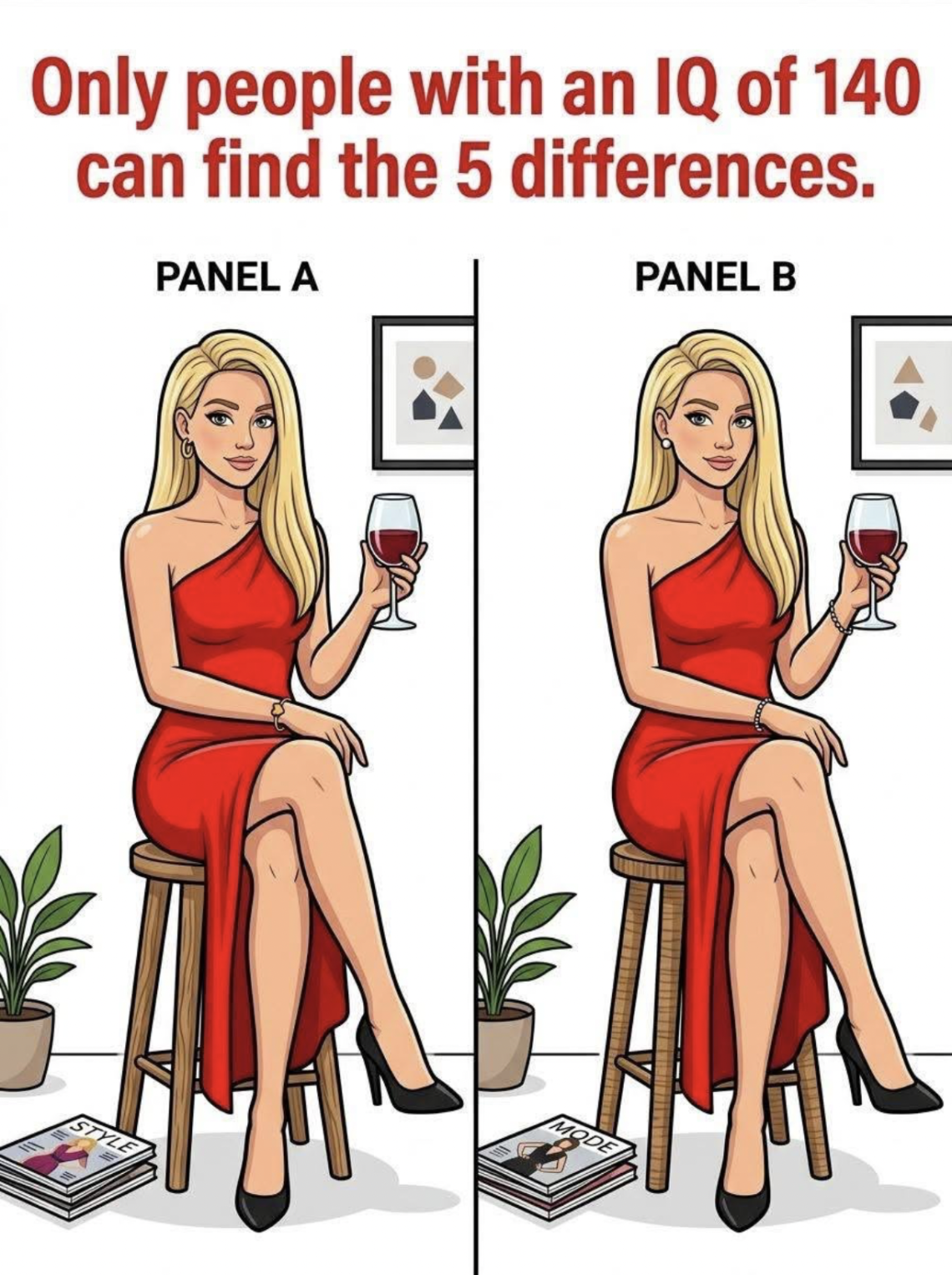
The internet is filled with visual challenges that promise to test your observation skills, attention to detail, and even your intelligence. Among the most popular are “spot the difference” puzzles—those side-by-side images that appear identical at first glance but secretly contain several subtle changes.
One of the most common headlines reads:
“These Two Images Look Identical — But Only 1% Of People Can Find All 5 Differences.”
The claim is intriguing. It immediately challenges your confidence and sparks curiosity. You look at the images and think, “How hard can it be?” Then a few minutes pass, and suddenly you find yourself staring at the same picture, convinced that you’ve discovered everything—only to realize you’re still missing one tiny detail.
But why are these puzzles so popular, and what do they actually reveal about the human mind?
The Truth Behind the “Only 1%” Claim
Before diving into the psychology, it’s worth understanding that most viral puzzle statistics are not based on scientific research.
When a post claims:
- “Only 1% can solve it”
- “Only geniuses can find all differences”
- “99% of people fail”
those numbers are usually marketing tools designed to encourage engagement.
The goal is simple:
Make people curious enough to try.
When someone believes a challenge is difficult, they become more motivated to prove they can solve it.
This phenomenon is known as a challenge-response effect.
People naturally want to test themselves against a perceived obstacle.
Why Spot-the-Difference Puzzles Are So Addictive
These puzzles appeal to several powerful psychological mechanisms.
1. Pattern Recognition
The human brain is a pattern-detecting machine.
Every day, your brain automatically searches for:
- familiar faces
- shapes
- movements
- symbols
- visual irregularities
When two nearly identical images are presented side by side, your brain immediately begins comparing them.
The challenge activates the same mental systems that help humans navigate the world.
2. The Reward of Discovery
Every time you find a hidden difference, your brain experiences a small reward.
Psychologists often call this an “aha moment.”
That feeling of:
- satisfaction
- accomplishment
- excitement
encourages you to keep searching.
The more difficult the discovery, the stronger the sense of achievement.
3. Curiosity
Humans dislike incomplete information.
Once you know there are five differences, finding only four creates a sense of tension.
Your brain wants closure.
This psychological phenomenon is one reason people keep searching long after they intended to stop.
Why Some Differences Are Easy to Spot
Certain visual changes immediately attract attention.
Examples include:
- missing objects
- bright color changes
- altered shapes
- large missing sections
The brain notices these quickly because they create strong visual contrasts.
These obvious differences often serve as confidence boosters.
They make you think:
“This puzzle isn’t so hard.”
Then the final hidden details become much more challenging.
Why Some Differences Are So Difficult to Find
The hardest differences often involve subtle changes.
Examples include:
- slight color variations
- tiny missing lines
- small shape adjustments
- changes hidden in cluttered backgrounds
These differences exploit limitations in human visual attention.
Even though your eyes may be looking directly at the altered area, your brain may not immediately recognize the discrepancy.
The Science of Change Blindness
One fascinating psychological phenomenon helps explain these puzzles:
Change Blindness
Change blindness occurs when people fail to notice obvious changes in a visual scene.
This might sound surprising, but it happens constantly.
For example:
A person can briefly look away during a conversation and fail to notice:
- a missing object
- a changed background
- a different clothing item
The brain does not record every visual detail.
Instead, it creates simplified models of the environment.
As a result, surprisingly large changes can go unnoticed.
Spot-the-difference puzzles take advantage of this tendency.
Seeing Is Not the Same as Observing
Many people assume that if something is visible, they will automatically notice it.
In reality, attention is limited.
Your eyes collect enormous amounts of information every second.
Your brain filters most of it.
Observation requires active focus.
That is why two people can look at the same image and notice completely different details.
Why Some People Find Differences Faster
Several factors influence performance.
Attention to Detail
People who naturally notice small details often excel at these puzzles.
They may:
- observe carefully
- scan methodically
- focus on tiny inconsistencies
Patience
Many differences are missed simply because people rush.
Those who slow down and examine each section carefully tend to perform better.
Visual Experience
Artists, photographers, designers, engineers, and puzzle enthusiasts often develop strong visual comparison skills through practice.
Strategy
Successful puzzle solvers rarely search randomly.
Instead, they:
- divide the image into sections
- compare one area at a time
- move systematically
This approach reduces missed details.
Common Types of Hidden Differences
Most spot-the-difference puzzles use several recurring tricks.
Missing Objects
An item appears in one image but not the other.
Examples:
- a missing flower
- a missing button
- a missing cloud
Color Changes
A subtle color shift can be surprisingly difficult to detect.
Examples:
- blue becomes green
- red becomes orange
- dark becomes light
Shape Alterations
Objects may change size or form slightly.
Examples:
- shorter branches
- altered windows
- modified facial features
Direction Changes
Objects may face different directions.
Examples:
- reversed arrows
- flipped animals
- rotated decorations
Added Details
A small extra element appears in one image.
Examples:
- an extra leaf
- a hidden line
- an additional button
Why We Often Miss the Last Difference
Many people experience the same frustration:
They find four differences quickly.
Then the fifth seems impossible.
This happens because obvious differences attract attention first.
The remaining difference is usually designed to be:
- smaller
- less noticeable
- hidden in a visually busy area
As the search continues, fatigue also becomes a factor.
The longer you stare at an image, the easier it becomes to overlook details.
The Myth of the “Genius Puzzle”
Many viral posts suggest that success indicates exceptional intelligence.
In reality, spot-the-difference puzzles primarily test:
- visual attention
- patience
- observation skills
They do not measure:
- IQ
- creativity
- wisdom
- overall intelligence
A brilliant scientist may struggle with a visual puzzle, while a child may solve it quickly.
Different mental abilities are involved.
What These Puzzles Actually Teach
The greatest lesson is not about intelligence.
It is about perception.
They remind us that:
- first impressions can be incomplete
- details matter
- observation requires effort
- assumptions can be misleading
These lessons apply far beyond puzzles.
In daily life, important information is often hidden in plain sight.
Why Social Media Loves These Challenges
Spot-the-difference puzzles thrive online because they encourage engagement.
People naturally want to:
- test themselves
- compare results
- challenge friends
- share successes
A simple image can generate thousands of comments as people debate where the hidden differences are located.
The Connection Between Observation and Everyday Life
Observation is a valuable skill outside of entertainment.
Strong observational abilities can help with:
- problem-solving
- learning
- communication
- safety awareness
- decision-making
The habit of looking carefully before reaching conclusions can be beneficial in many areas of life.
Tips for Solving Spot-the-Difference Puzzles Faster
If you enjoy these challenges, try the following methods:
Work Methodically
Scan from top to bottom rather than jumping around.
Divide the Image
Compare one section at a time.
Focus on Edges
Many hidden changes appear along borders and outlines.
Look for Symmetry Breaks
Objects that seem slightly “off” often reveal differences.
Take Breaks
Sometimes stepping away for a moment makes hidden details obvious upon return.

Welcome to my kitchen!
I’m a passionate home cook and recipe creator who loves turning simple ingredients into delicious, comforting meals that everyone can enjoy. Through this website, I share carefully prepared recipes, practical cooking tips, and easy-to-understand food education to help you feel more confident in the kitchen.
My goal is to make cooking simple, enjoyable, and accessible. Whether you are looking for a quick family dinner, a delicious dessert, healthy meal ideas, or traditional recipes with a modern touch, you’ll find inspiration here.
More Than Just Recipes
I believe that cooking is also a way to learn. That’s why this website is not only about recipes. I also create educational articles about ingredients, cooking techniques, kitchen tips, food preparation, and the stories behind different dishes.
Each article is designed to give you useful knowledge that you can apply in your own kitchen. From understanding how ingredients work together to learning better cooking methods, my aim is to help you become a more confident and creative cook.
My Philosophy
Good food doesn’t always require complicated ingredients or professional equipment. With a little knowledge, patience, and creativity, simple ingredients can become something truly special.
I believe in sharing recipes that are practical, clearly explained, and enjoyable to make. I also love exploring new flavors while appreciating traditional cooking and the recipes passed down through generations.
Thank you for visiting my kitchen and being part of this food-loving community. I hope my recipes and articles inspire you to cook, learn, experiment, and most importantly, enjoy every bite!
Happy cooking!