Why Millions of People Keep Arguing Over “Simple” Equations
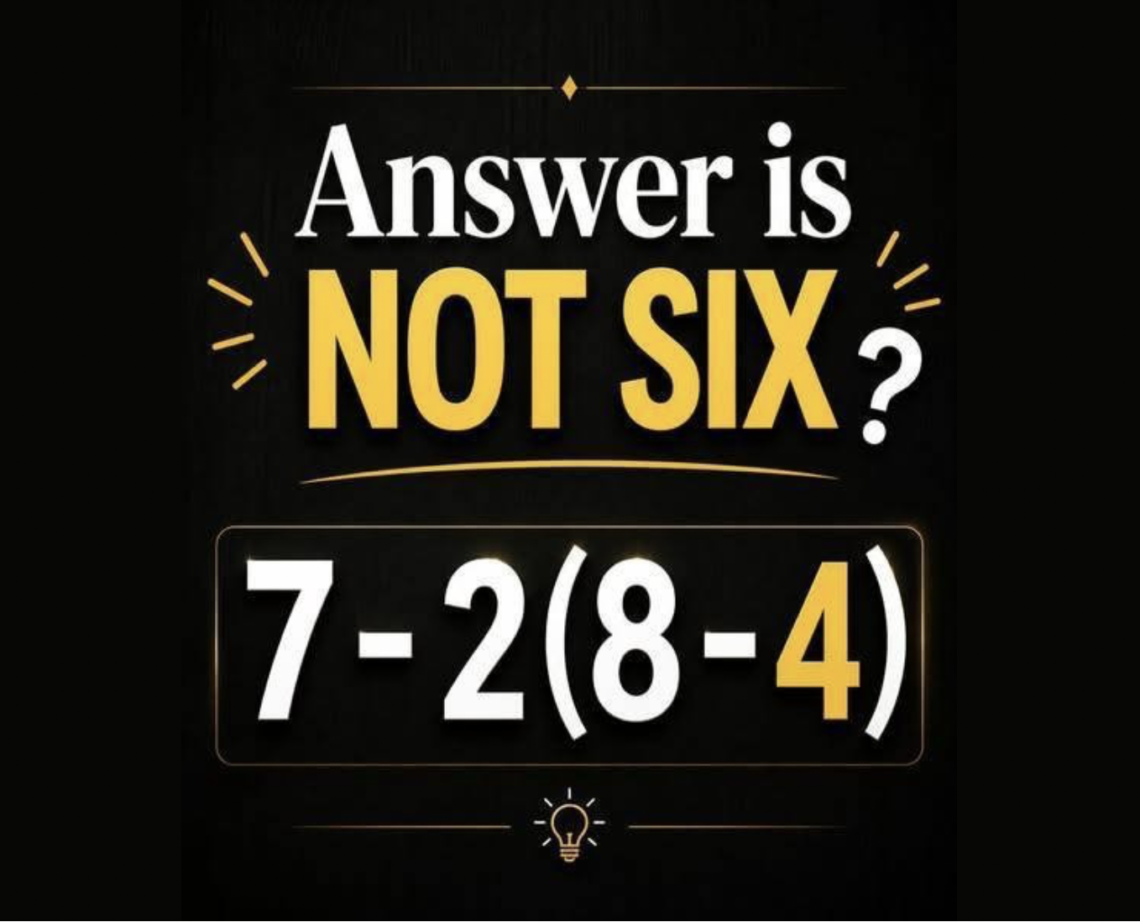
You’ve probably seen one of these viral math posts before.
A blurry screenshot.
A basic-looking equation.
A caption that says:
“Only geniuses get this right.”
“99% fail this test.”
“What’s the answer?”
At first glance, the problem seems ridiculously easy.
Maybe it looks something like:
And yet within minutes, the comments section becomes chaos.
Some people confidently insist the answer is:
- 9
Others argue passionately for:
- 1
Soon:
- calculators appear
- teachers disagree
- YouTube explanations explode
- engineers debate strangers online
- people accuse others of “not understanding basic math”
So what’s actually happening?
The answer is surprisingly fascinating—and it reveals a lot about:
- how humans interpret symbols
- how math notation evolved
- how the brain handles ambiguity
- and why internet arguments spread so quickly
Why These Problems Go Viral So Easily
These equations are not usually difficult because of arithmetic.
They are difficult because of:
ambiguity and interpretation
The numbers themselves are simple.
The confusion comes from:
- order of operations
- notation style
- missing parentheses
- outdated conventions
- visual assumptions
The puzzle exploits the fact that different people learned math notation differently.
The Famous “16 vs 1” Debate
One of the most famous examples resembles:
Let’s solve it step by step.
Step 1: Solve Parentheses First
Inside parentheses:
Now the equation becomes:
Which can also be written as:
Step 2: Multiplication and Division Have Equal Priority
This is where the war begins.
According to standard modern order of operations:
- multiplication and division are performed left to right
So:
First:
Then:
So under modern convention:
Final Answer: 16
So Why Do Some People Get 1?
Because many people interpret:
as a tightly connected grouped expression.
They mentally treat it like:
combined as one unit.
So they calculate:
which becomes:
The Real Source of the Confusion
The issue is not arithmetic skill.
It’s notation ambiguity.
Historically, implicit multiplication:
like:
was often treated differently from explicit multiplication:
like:
Older textbooks and some scientific contexts gave implicit multiplication stronger grouping power.
Modern calculators and formal standards usually do not.
PEMDAS Is Partly Responsible
Most people learn order of operations through acronyms like:
- PEMDAS
- BODMAS
- BIDMAS
For example:
- Parentheses
- Exponents
- Multiplication
- Division
- Addition
- Subtraction
But the acronym creates a misunderstanding.
Many students wrongly assume:
- multiplication ALWAYS comes before division
In reality:
- multiplication and division are equal priority
- operations happen left to right
The same applies to addition and subtraction.
The Internet Loves Ambiguous Problems
These equations spread because they create:
- instant disagreement
- emotional certainty
- public competition
- easy participation
Everyone thinks:
“This is basic math. I must be right.”
That confidence fuels arguments.
Why Smart People Still Disagree
Even mathematicians sometimes acknowledge that poorly written notation can be ambiguous.
In professional mathematics, ambiguous expressions are avoided entirely.
Instead, mathematicians use:
- clearer parentheses
- fractions
- spacing
- formatting
For example, instead of writing:
they would likely write either:
or
to remove all ambiguity.
Calculators Make It More Confusing
Different calculators sometimes produce different answers because:
- they parse expressions differently
- software uses different syntax rules
- some prioritize implicit multiplication differently
This convinces people:
“My calculator proves I’m correct.”
But calculators only follow programming rules—not universal mathematical truth.
The Psychology Behind the Arguments
These viral math debates trigger something powerful:
cognitive ego defense
Because math feels objective, people associate being wrong with:
- embarrassment
- incompetence
- loss of intelligence status
So disagreements become emotional surprisingly fast.
Social Media Amplifies Conflict
Platforms reward:
- controversy
- certainty
- argument
- emotional reactions
A peaceful equation with one obvious answer doesn’t spread.
But a problem that divides millions?
That becomes viral instantly.
Why Ambiguity Matters in Real Life
This isn’t just internet entertainment.
Ambiguous notation can create real-world problems in:
- engineering
- coding
- finance
- science
- medicine
That’s why professionals prioritize:
- precision
- formatting clarity
- explicit notation
The Hidden Lesson of These Math Traps
The most important lesson isn’t the answer itself.
It’s this:
Clear communication matters more than clever confusion.
A well-written equation should not require internet warfare to interpret.
Why People Enjoy These Puzzles Anyway
Despite the arguments, people love these viral problems because they:
- create curiosity
- trigger competitive thinking
- provide quick mental challenges
- produce satisfying “aha” moments
They turn ordinary arithmetic into social entertainment.
Welcome to my kitchen!
I’m a passionate home cook and recipe creator who loves turning simple ingredients into delicious, comforting meals that everyone can enjoy. Through this website, I share carefully prepared recipes, practical cooking tips, and easy-to-understand food education to help you feel more confident in the kitchen.
My goal is to make cooking simple, enjoyable, and accessible. Whether you are looking for a quick family dinner, a delicious dessert, healthy meal ideas, or traditional recipes with a modern touch, you’ll find inspiration here.
More Than Just Recipes
I believe that cooking is also a way to learn. That’s why this website is not only about recipes. I also create educational articles about ingredients, cooking techniques, kitchen tips, food preparation, and the stories behind different dishes.
Each article is designed to give you useful knowledge that you can apply in your own kitchen. From understanding how ingredients work together to learning better cooking methods, my aim is to help you become a more confident and creative cook.
My Philosophy
Good food doesn’t always require complicated ingredients or professional equipment. With a little knowledge, patience, and creativity, simple ingredients can become something truly special.
I believe in sharing recipes that are practical, clearly explained, and enjoyable to make. I also love exploring new flavors while appreciating traditional cooking and the recipes passed down through generations.
Thank you for visiting my kitchen and being part of this food-loving community. I hope my recipes and articles inspire you to cook, learn, experiment, and most importantly, enjoy every bite!
Happy cooking!