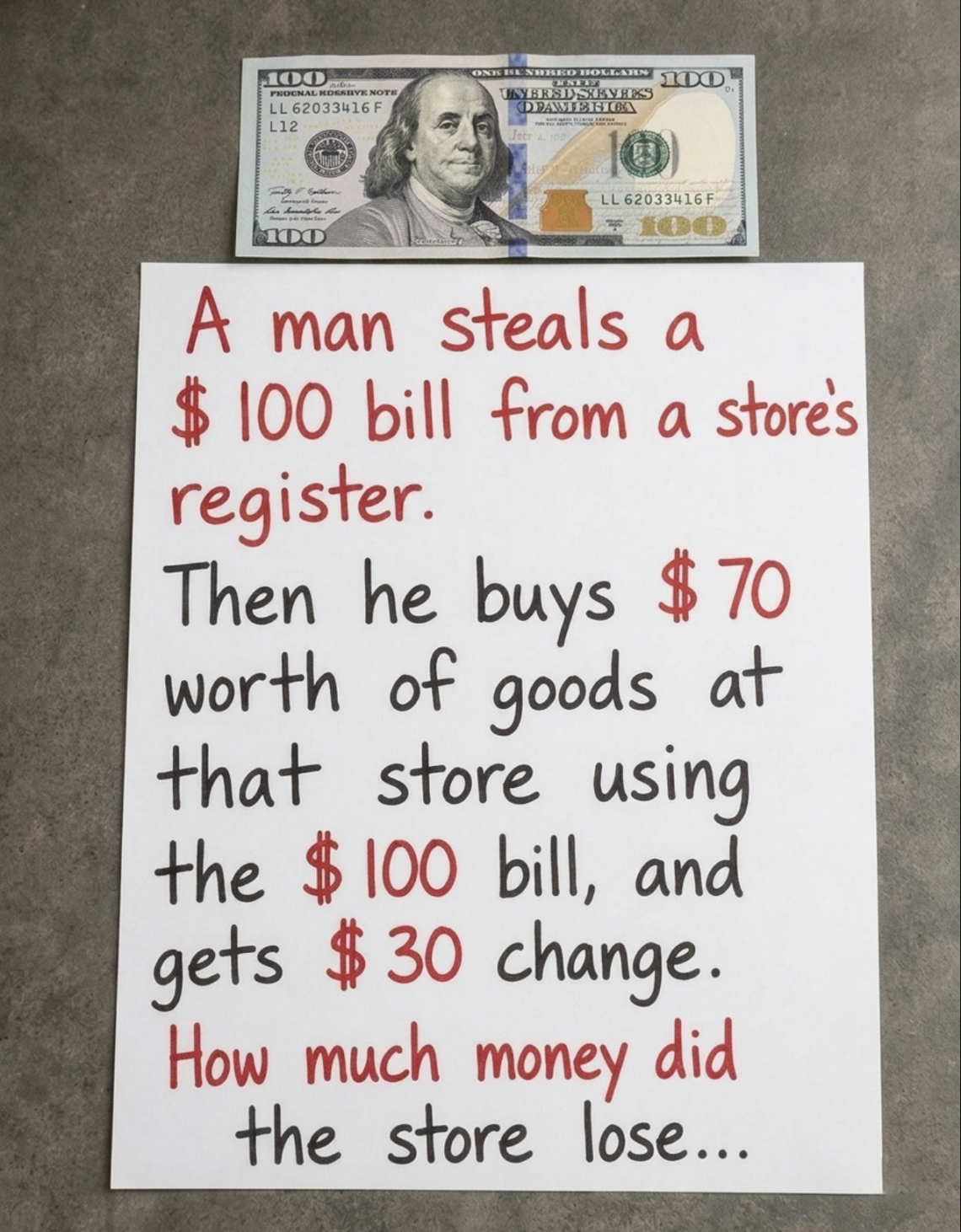
A Classic Logic Puzzle That Tricks the Brain More Than the Math
At first glance, this puzzle feels complicated. People start adding numbers repeatedly:
- the stolen money
- the merchandise
- the change
- the returned bill
Very quickly, the calculations become confusing, and many people end up with answers like:
- $170
- $200
- or even larger totals
But the puzzle becomes much easier when you focus on one simple idea:
Only track what the store actually lost.
That’s the key.
The Puzzle Setup
Here’s the classic scenario:
A thief steals:
- $100 from a store register
Later, the thief returns and uses that same stolen $100 bill to buy:
- $70 worth of merchandise
The cashier unknowingly accepts the stolen bill and gives:
- $30 in change
The question:
How much did the store actually lose?
Why This Puzzle Confuses So Many People
The human brain often struggles when:
- the same money moves around multiple times
- cash leaves and returns
- inventory and cash mix together
People mistakenly count the same $100 more than once.
But in accounting and logic, money returning to the register matters.
You must separate:
- temporary movement of money
from - final net loss.
Step-by-Step Breakdown
Let’s slow everything down carefully.
Step 1: The Theft
The thief steals:
- $100 cash from the register
At this moment:
Store loss = $100
Simple so far.
Step 2: The Thief Returns
The thief comes back and buys:
- $70 worth of products
He uses:
- the exact same stolen $100 bill
This changes everything.
Why?
Because the store gets its stolen $100 back.
Important Realization
Once the cashier accepts the stolen bill:
- the register is no longer missing the original $100
That stolen money has returned to the business.
So the store has recovered the original cash theft.
But now the store loses something else instead.
Step 3: What the Store Gives Away
The store provides:
- $70 in merchandise
PLUS - $30 in real cash change
That means the store parts with:
$70 goods
$30 cash
Total:
$100 total loss
The Correct Answer
The store lost exactly $100.
Not $170.
Not $200.
Not $130.
Just:
$100.
Why People Incorrectly Answer $170
Many people calculate:
- $100 stolen initially
PLUS - $70 merchandise
PLUS - $30 change
Which equals:
- $200
Then they subtract the returned $100 bill:
- leaving $100 again
Others incorrectly add the merchandise and change on top of the original theft without recognizing the stolen bill returned to the register.
The confusion comes from:
counting the same $100 multiple times.
A Simpler Way to Think About It
Imagine the store at the very end of the story.
What is physically missing?
Missing:
- $70 worth of products
- $30 cash
That’s it.
Total:
$100 gone forever
The original stolen bill is back inside the register.
Why This Puzzle Feels Harder Than It Is
This puzzle exploits several psychological tendencies:
1. Motion Confuses Us
When money moves around repeatedly, our brains assume complexity.
2. We Emotionally Anchor to the Theft
The initial theft feels separate from the later purchase, even though the same money returns.
3. Inventory and Cash Mix Together
People struggle combining:
- physical goods
- money
- change
into one clean calculation.
The Core Logic Principle
The easiest way to solve puzzles like this is:
Ignore the story drama.
Track only the final net loss.
At the end:
- register is down $30
- inventory is down $70
Total:
$100
Similar Puzzles Use the Same Trick
Many viral “impossible” math riddles work by:
- recycling the same money repeatedly
- overwhelming attention with extra details
- encouraging double counting
The math itself is usually simple.
The challenge is filtering irrelevant movement.
Real-World Accounting Perspective
Businesses think in terms of:
- net position
- assets remaining
- total value lost
From an accounting standpoint:
- the store recovered the original stolen cash
- but lost merchandise and legitimate register money instead
Net result:
$100 loss total.
Why People Love These Puzzles
These riddles spread online because they:
- feel deceptively simple
- trigger debate
- expose mental shortcuts
- create “aha!” moments
They are less about advanced math and more about:
- logical tracking
- careful reasoning
- resisting emotional assumptions.

Welcome to my kitchen!
I’m a passionate home cook and recipe creator who loves turning simple ingredients into delicious, comforting meals that everyone can enjoy. Through this website, I share carefully prepared recipes, practical cooking tips, and easy-to-understand food education to help you feel more confident in the kitchen.
My goal is to make cooking simple, enjoyable, and accessible. Whether you are looking for a quick family dinner, a delicious dessert, healthy meal ideas, or traditional recipes with a modern touch, you’ll find inspiration here.
More Than Just Recipes
I believe that cooking is also a way to learn. That’s why this website is not only about recipes. I also create educational articles about ingredients, cooking techniques, kitchen tips, food preparation, and the stories behind different dishes.
Each article is designed to give you useful knowledge that you can apply in your own kitchen. From understanding how ingredients work together to learning better cooking methods, my aim is to help you become a more confident and creative cook.
My Philosophy
Good food doesn’t always require complicated ingredients or professional equipment. With a little knowledge, patience, and creativity, simple ingredients can become something truly special.
I believe in sharing recipes that are practical, clearly explained, and enjoyable to make. I also love exploring new flavors while appreciating traditional cooking and the recipes passed down through generations.
Thank you for visiting my kitchen and being part of this food-loving community. I hope my recipes and articles inspire you to cook, learn, experiment, and most importantly, enjoy every bite!
Happy cooking!