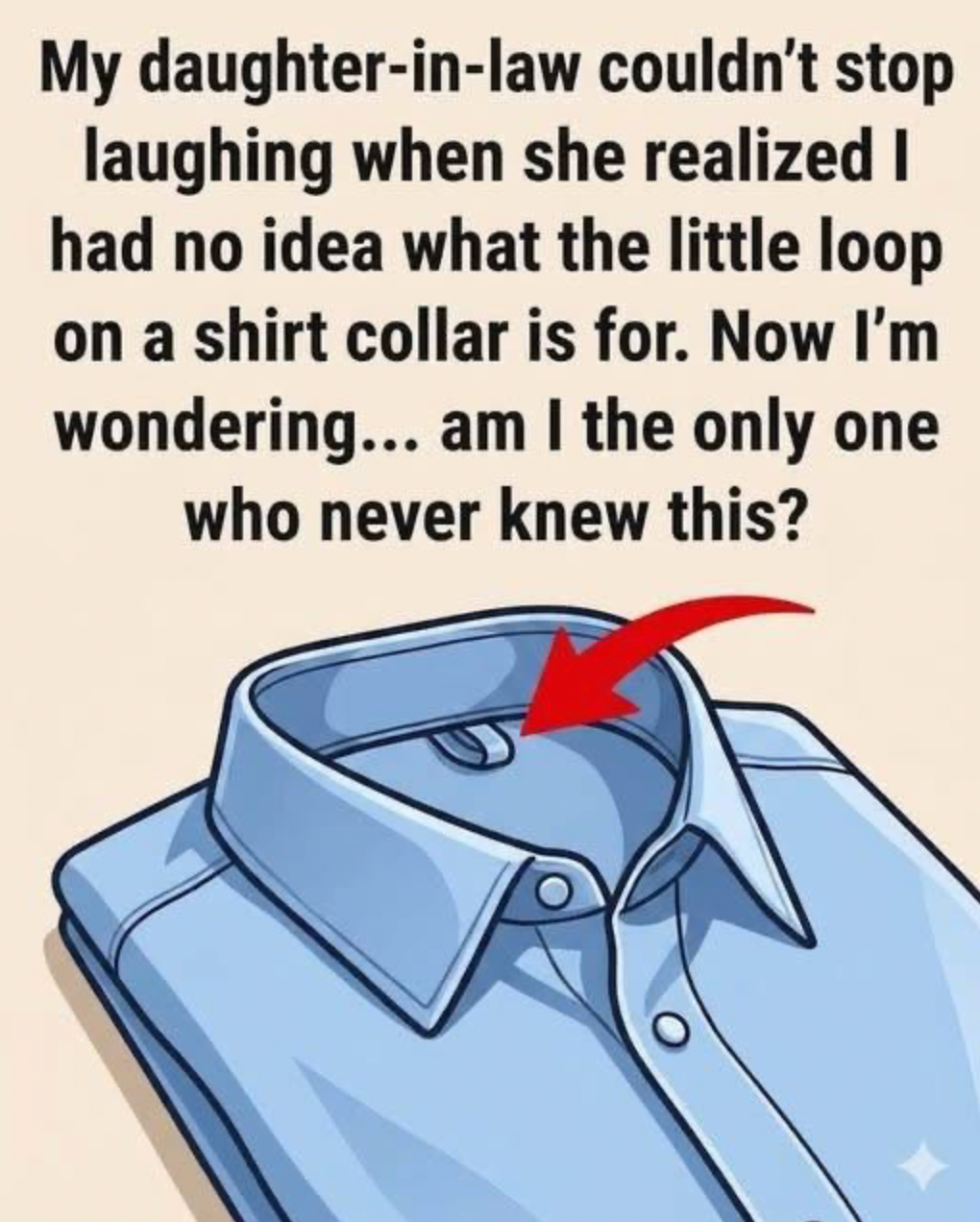
If you’ve ever looked closely at a dress shirt—especially older or classic-style ones—you may have noticed a small fabric loop sewn on the back of the collar. It’s subtle, easy to miss, and most people wear shirts their whole lives without ever wondering what it’s for.
At first glance, it seems like a decorative detail. Something added for style. A leftover design choice that serves no real purpose in modern fashion.
But that tiny loop actually has a surprisingly interesting history, rooted in practicality, tradition, and even a bit of social culture. It’s one of those small details that quietly survived decades of fashion changes while most people never learned its original function.
So what exactly is that little loop on the back of a shirt collar, and why was it created?
What the Loop Is Actually Called
That small loop has a name:
Locker loop
It is usually found on the upper back of shirts, right below the collar seam. In some designs it is made from fabric, while in others it is a stitched strip or reinforced band.
Today, many people think it is just decorative. But originally, it had a very practical purpose.
The Original Purpose: Hanging Shirts Without Wrinkles
The locker loop was designed to solve a simple but very real problem:
How do you hang a shirt without damaging or wrinkling it?
Before modern closets and anti-wrinkle fabrics became common, people needed a better way to store shirts.
If you hang a shirt normally:
- it can stretch at the shoulders
- it can develop crease lines
- it may lose its shape over time
So clothing manufacturers added a small loop on the back so shirts could be hung in a different way.
The “Locker Room” Connection
The most common theory about the name “locker loop” comes from American universities and sports culture.
In locker rooms, athletes often had:
- limited space
- metal hooks instead of full hangers
- tightly packed storage areas
The loop allowed shirts to be hung on a simple hook without needing a full hanger.
This kept shirts:
- more compact
- less wrinkled
- easier to store in crowded spaces
Over time, the feature became associated with “locker rooms,” giving it the name locker loop.
The Ivy League Fashion Tradition
The locker loop is also closely tied to mid-20th-century American fashion, especially Ivy League style.
During the 1950s and 1960s, clothing brands began producing “preppy” shirts for college students.
These shirts often included features like:
- button-down collars
- slim tailoring
- soft fabrics
- locker loops
In this context, the loop was not only practical but also symbolic.
It represented:
- casual elegance
- athletic influence
- campus lifestyle fashion
Students sometimes even used the loop in a playful social way.
A Fashion Myth: The “Boyfriend Hook”
At one point in fashion history, the locker loop gained an unexpected social meaning.
In some college cultures, it was rumored that:
- a woman could hang her shirt on a hook
- or a man could use the loop to identify that she was “taken” or “in a relationship”
This idea was never a formal rule, but it became part of fashion folklore in certain places.
Because of this, some brands temporarily stopped including the loop to avoid confusion.
Why It Still Exists Today
Even though most people no longer use locker loops for hanging shirts, they are still included in many designs for several reasons:
1. Tradition
Clothing brands often preserve historical design elements to maintain classic style.
The locker loop has become part of shirt heritage.
2. Aesthetic Balance
Some designers feel the loop adds a subtle visual detail that enhances the back of the shirt.
It creates symmetry and texture without being distracting.
3. Brand Identity
Certain fashion brands use locker loops as a signature feature, especially in:
- Oxford shirts
- button-down shirts
- vintage-inspired clothing
4. Minimal Functional Use
Even today, some people still use the loop to hang shirts on hooks, especially when traveling.
It can be useful in:
- hotel rooms
- dormitories
- tight storage spaces
Why Most People Don’t Notice It
The locker loop is placed on the back of the shirt, an area people rarely inspect closely.
Because of that, it often goes unnoticed for years.
Even when people do see it, they assume:
- it’s decorative stitching
- a brand logo attachment
- a reinforcement patch
Very few people immediately recognize its original purpose.
Similar Hidden Clothing Features
The locker loop is not the only “hidden function” in clothing design. Many garments include small details with practical origins.
For example:
- button-down collar buttons (originally for sports players)
- shoulder epaulets (from military uniforms)
- small inner shirt pockets (for pens or glasses)
- reinforced trouser seams (for durability)
Modern fashion often keeps these features even when their original purpose becomes less relevant.
The Engineering of Everyday Clothing
It’s easy to forget that clothing is not just fashion—it is also design engineering.
Every stitch, seam, and fold is created with a purpose such as:
- comfort
- durability
- flexibility
- appearance
- functionality
The locker loop is a perfect example of how a small detail can solve a real-world problem while remaining visually subtle.
Why This Tiny Detail Survived Fashion Changes
Fashion trends come and go, but some features remain because they quietly work.
The locker loop survived because:
- it never caused harm or inconvenience
- it had practical value in certain situations
- it became part of traditional shirt design
- it was simple to include during manufacturing
Even when its original purpose became less important, it stayed as a legacy feature.
The Hidden Story in Everyday Objects
The most interesting thing about the locker loop is not just what it does, but what it represents.
It shows that:
- everyday objects often have hidden history
- design is shaped by real human needs
- small details can survive for generations
- functionality can become tradition
Most people walk through life surrounded by objects like this without ever realizing the stories behind them.

Welcome to my kitchen!
I’m a passionate home cook and recipe creator who loves turning simple ingredients into delicious, comforting meals that everyone can enjoy. Through this website, I share carefully prepared recipes, practical cooking tips, and easy-to-understand food education to help you feel more confident in the kitchen.
My goal is to make cooking simple, enjoyable, and accessible. Whether you are looking for a quick family dinner, a delicious dessert, healthy meal ideas, or traditional recipes with a modern touch, you’ll find inspiration here.
More Than Just Recipes
I believe that cooking is also a way to learn. That’s why this website is not only about recipes. I also create educational articles about ingredients, cooking techniques, kitchen tips, food preparation, and the stories behind different dishes.
Each article is designed to give you useful knowledge that you can apply in your own kitchen. From understanding how ingredients work together to learning better cooking methods, my aim is to help you become a more confident and creative cook.
My Philosophy
Good food doesn’t always require complicated ingredients or professional equipment. With a little knowledge, patience, and creativity, simple ingredients can become something truly special.
I believe in sharing recipes that are practical, clearly explained, and enjoyable to make. I also love exploring new flavors while appreciating traditional cooking and the recipes passed down through generations.
Thank you for visiting my kitchen and being part of this food-loving community. I hope my recipes and articles inspire you to cook, learn, experiment, and most importantly, enjoy every bite!
Happy cooking!