Why Your Brain “Sees” Things That May Not Actually Be There
At first glance, it seems like a simple visual challenge.
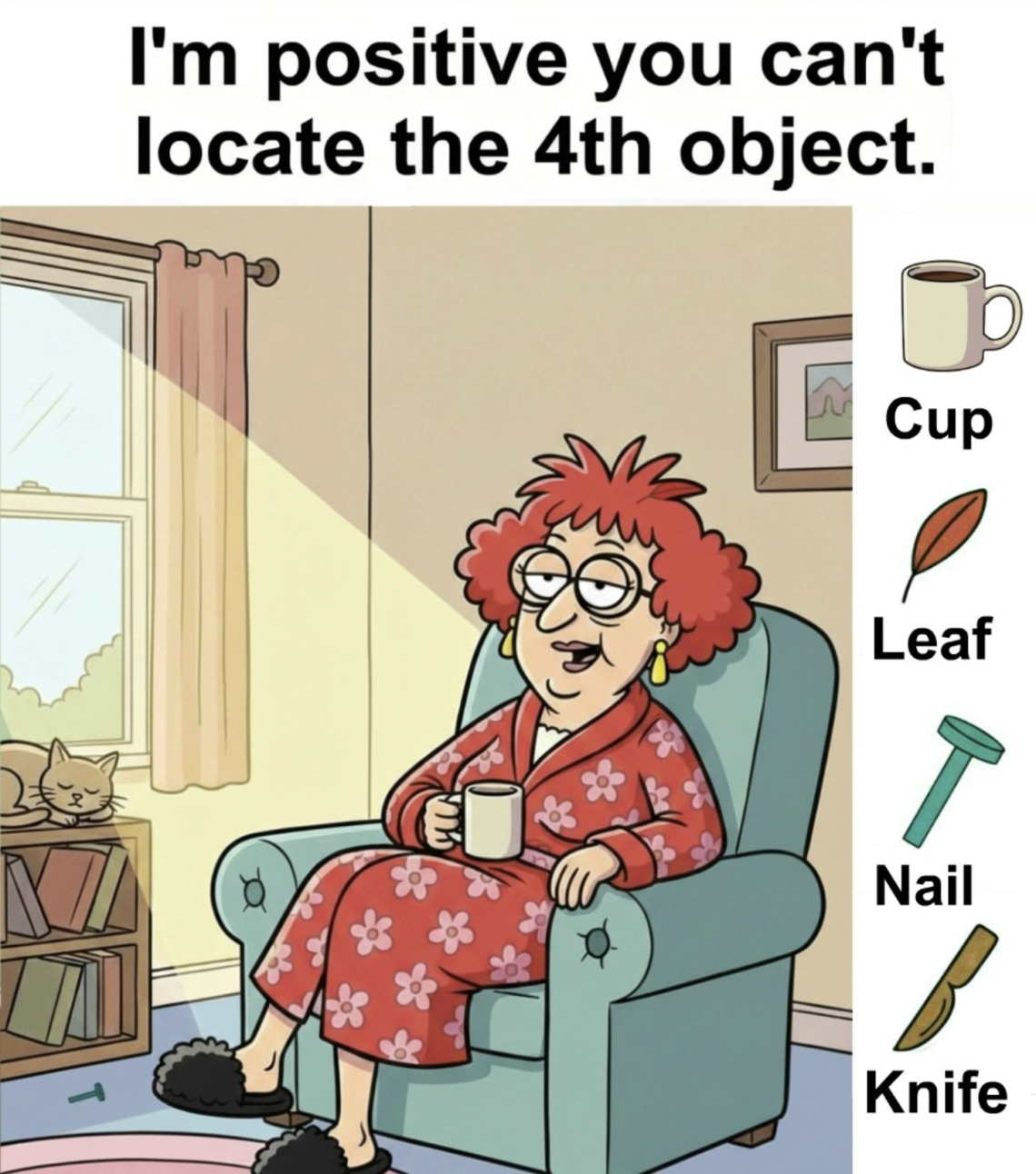
The instructions tell you to find four objects hidden within an image:
Cup
Leaf
Nail
Knife
You begin scanning the picture carefully. Within seconds, you might spot the cup. A little later, perhaps the leaf. The nail eventually reveals itself.
Then comes the knife.
Suddenly, something interesting happens.
Some people immediately claim they found it.
Others stare for minutes and become frustrated.
A few begin seeing knife-like shapes everywhere.
And that’s exactly what makes this puzzle so fascinating.
The puzzle isn’t just testing observation skills.
It’s demonstrating how the human brain processes expectations, suggestions, and incomplete information.
In many ways, the real subject of the puzzle isn’t the hidden objects at all.
It’s you.
Your Brain Is a Prediction Machine
Most people think vision works like a camera.
The common assumption is:
- Eyes capture information.
- Brain receives information.
- Brain shows reality.
But neuroscience tells a more complicated story.
Your brain isn’t merely recording reality.
It’s constantly predicting it.
Every second, your brain receives enormous amounts of visual information.
Processing every detail perfectly would require tremendous energy.
Instead, the brain takes shortcuts.
It uses:
- past experiences
- expectations
- context
- assumptions
to fill in missing information.
This helps us navigate the world efficiently.
But it can also lead to mistakes.
Why the Knife Is So Powerful
Imagine the puzzle only asked you to find:
- a cup
- a leaf
- a nail
You would search specifically for those items.
Now add:
- a knife
The moment you read the word “knife,” your brain creates a mental template.
Without realizing it, you begin searching for:
- a blade shape
- a handle shape
- long narrow outlines
- pointed objects
The suggestion changes how you see the image.
Suddenly, random lines begin looking meaningful.
Ordinary shapes become potential clues.
This phenomenon is known as expectation bias.
What Is Expectation Bias?
Expectation bias occurs when your expectations influence what you perceive.
Instead of objectively examining information, your brain begins searching for evidence that confirms what it already expects.
In everyday life, this happens constantly.
For example:
If someone tells you:
“That person looks angry.”
You may start noticing signs of anger.
If someone says:
“This restaurant has terrible service.”
You may become more sensitive to delays.
If someone claims:
“There’s a hidden knife in the picture.”
Your brain starts hunting for knife-like patterns.
The expectation changes perception.
Suggestibility: The Brain’s Hidden Shortcut
Another important concept at work is suggestibility.
Suggestibility refers to how easily our thoughts, memories, and perceptions can be influenced by outside information.
When the puzzle explicitly says:
“Find the knife.”
It plants an idea.
Your brain treats that information as important.
Instead of asking:
“Is there really a knife?”
It begins asking:
“Where is the knife?”
Notice the difference.
The existence of the knife is no longer questioned.
The brain assumes it’s there.
This subtle shift dramatically affects perception.
Pattern Recognition: A Powerful Human Skill
Humans evolved to recognize patterns.
This ability helped our ancestors survive.
Imagine walking through a forest thousands of years ago.
Recognizing:
- animal tracks
- food sources
- dangerous predators
- weather changes
could mean the difference between life and death.
As a result, the human brain became extremely sensitive to patterns.
Sometimes too sensitive.
We often see patterns even when none exist.
The Phenomenon of Pareidolia
One of the most famous examples is called pareidolia.
Pareidolia occurs when people perceive meaningful images in random shapes.
Examples include:
- faces in clouds
- animals in rock formations
- shapes on the moon
- faces on pieces of toast
The brain prefers meaning over randomness.
When it encounters ambiguity, it tries to create order.
A visual puzzle exploits this tendency perfectly.
Why Different People See Different Things
One fascinating aspect of these puzzles is that people often report different answers.
This happens because perception is influenced by:
Past Experiences
A chef may notice shapes differently than an engineer.
A carpenter may identify tool-like outlines more quickly.
An artist may focus on visual composition.
Attention
No two people examine an image in exactly the same way.
Some focus on edges.
Others focus on shadows.
Others search for familiar shapes.
Expectations
The stronger your expectation, the more likely you are to interpret ambiguous shapes in a certain way.
Personality
Research suggests that personality traits can subtly influence perception.
Some individuals are naturally skeptical.
Others are more likely to accept suggestions.
The Puzzle Isn’t Testing Eyesight
Many people assume these challenges measure visual ability.
In reality, they often measure:
- attention
- cognitive flexibility
- pattern recognition
- expectation management
Two people with identical eyesight may have completely different experiences.
The difference isn’t in the eyes.
It’s in the brain.
Confirmation Bias Joins the Party
Once someone believes they have found the knife, another psychological effect appears:
confirmation bias.
Confirmation bias is the tendency to seek information that supports existing beliefs.
After deciding:
“That’s the knife.”
The brain begins defending that conclusion.
Evidence supporting the interpretation is noticed.
Evidence contradicting it is ignored.
This explains why puzzle comment sections become surprisingly heated.
People become convinced they are right.
Why These Puzzles Go Viral
Visual puzzles spread rapidly online because they trigger several psychological rewards.
Curiosity
Humans dislike uncertainty.
When told there is a hidden object, we feel compelled to find it.
Competition
People enjoy testing themselves.
Finding the answer creates a sense of achievement.
Surprise
The realization that perception can be manipulated is fascinating.
Social Comparison
People naturally wonder:
“Why can they see it and I can’t?”
This keeps engagement high.
What These Puzzles Teach Us About Real Life
The lessons extend beyond entertainment.
Visual puzzles reveal important truths about human thinking.
They remind us that:
- perception is not always objective
- expectations shape experiences
- assumptions influence conclusions
- seeing is not always believing
The same psychological mechanisms operate in everyday situations.
We don’t simply observe reality.
We interpret it.
And sometimes those interpretations can be influenced by subtle suggestions.
The Brain’s Constant Balancing Act
Your brain faces a difficult challenge every second.
It must:
- process incomplete information
- make rapid decisions
- predict what matters
- ignore what doesn’t
Most of the time, this system works remarkably well.
It allows us to navigate a complex world efficiently.
But visual puzzles expose the shortcuts.
They reveal the hidden machinery behind perception.

Welcome to my kitchen!
I’m a passionate home cook and recipe creator who loves turning simple ingredients into delicious, comforting meals that everyone can enjoy. Through this website, I share carefully prepared recipes, practical cooking tips, and easy-to-understand food education to help you feel more confident in the kitchen.
My goal is to make cooking simple, enjoyable, and accessible. Whether you are looking for a quick family dinner, a delicious dessert, healthy meal ideas, or traditional recipes with a modern touch, you’ll find inspiration here.
More Than Just Recipes
I believe that cooking is also a way to learn. That’s why this website is not only about recipes. I also create educational articles about ingredients, cooking techniques, kitchen tips, food preparation, and the stories behind different dishes.
Each article is designed to give you useful knowledge that you can apply in your own kitchen. From understanding how ingredients work together to learning better cooking methods, my aim is to help you become a more confident and creative cook.
My Philosophy
Good food doesn’t always require complicated ingredients or professional equipment. With a little knowledge, patience, and creativity, simple ingredients can become something truly special.
I believe in sharing recipes that are practical, clearly explained, and enjoyable to make. I also love exploring new flavors while appreciating traditional cooking and the recipes passed down through generations.
Thank you for visiting my kitchen and being part of this food-loving community. I hope my recipes and articles inspire you to cook, learn, experiment, and most importantly, enjoy every bite!
Happy cooking!