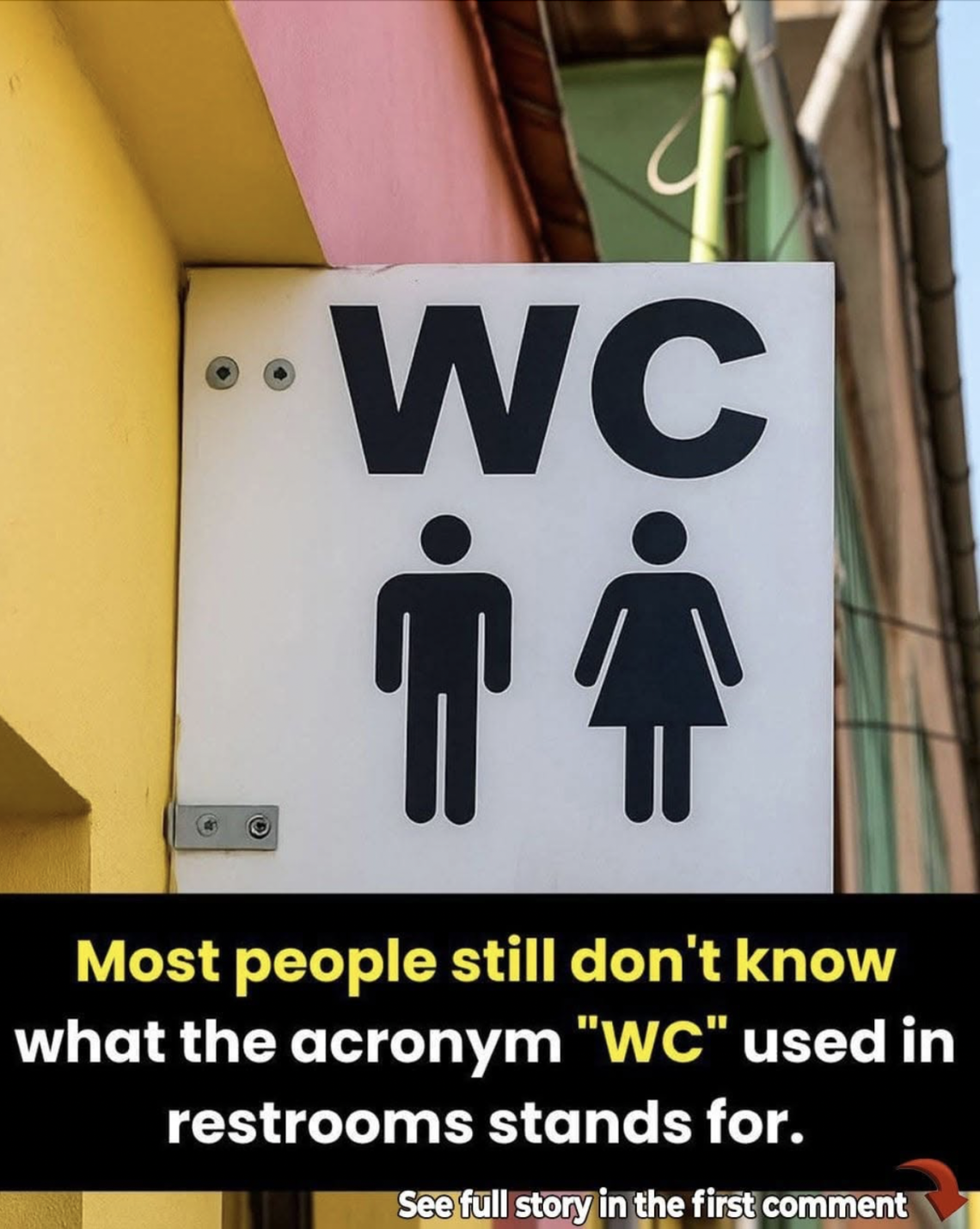
It’s one of those small details you see almost everywhere—on airport doors, restaurant hallways, train stations, and hotel corridors. A simple sign: “WC”.
Most people walk past it without thinking twice. Others assume it’s just another modern abbreviation or a stylized icon. But recently, many people have been surprised to learn that “WC” actually has a long history—and a very straightforward meaning that goes back over a century.
So what does it stand for, and why is it still used today?
The answer is both simple and surprisingly historical.
What “WC” Actually Means
The abbreviation WC stands for:
“Water Closet”
This term refers to a small room containing a toilet and (originally) running water for flushing and basic washing purposes.
In modern language, it simply means:
- bathroom
- toilet
- restroom
- washroom
So when you see “WC,” it is not a brand name or a modern code—it is an older, formal term for a toilet facility.
Where the Term “Water Closet” Comes From
To understand “WC,” we have to go back to the early development of indoor plumbing.
Before modern bathrooms existed, people used:
- outhouses
- chamber pots
- shared public facilities
There was no private, hygienic toilet system inside homes.
As plumbing technology developed in the 18th and 19th centuries, inventors created enclosed rooms where waste could be flushed away using water. These early installations were revolutionary at the time.
Because the toilet was now located in a small enclosed “closet” space with water flushing technology, it became known as a water closet.
Why “Closet”?
The word “closet” might sound strange today because we associate it with storage, but historically it simply meant:
a small private room or enclosed space
So a “water closet” literally meant:
a small room with water-based sanitation
It had nothing to do with clothing storage like modern closets.
Why “WC” Is Still Used Today
Even though the term “water closet” feels old-fashioned in English-speaking countries, the abbreviation WC is still widely used around the world.
You’ll often see it in:
- Europe
- Asia
- airports and train stations
- hotels and international signage
There are a few reasons for its continued use:
1. Universality
“WC” is short and easy to recognize across many languages.
Even if someone does not speak English, they may still recognize WC as a bathroom sign.
2. Space Efficiency
On signs, maps, and building layouts, space is limited.
“WC” is:
- short
- clear
- easy to print
- visually simple
3. International Standardization
In many public systems, especially transportation hubs, signage is designed to be globally understandable.
Symbols and abbreviations like WC help reduce language barriers.
4. Historical Continuity
Some regions simply continued using the term long after newer words like:
- restroom
- bathroom
- toilet
became common in everyday language.
Why It Confuses So Many People Today
In modern English, “water closet” is rarely used in conversation.
Most people prefer:
- bathroom
- restroom
- toilet
- washroom
Because of that, younger generations or travelers may see “WC” and have no idea what it means.
It looks like:
- a code
- a brand
- a technical abbreviation
But in reality, it’s just an old-fashioned term that never disappeared.
How “WC” Differs Around the World
Different countries use different terms for the same concept:
- United States → restroom / bathroom
- United Kingdom → toilet / loo
- Canada → washroom
- Europe → WC (very common)
Despite the differences in language, they all refer to the same basic facility.
The Evolution of Bathroom Language
The words we use for toilets have changed significantly over time.
Originally:
- privy
- outhouse
- chamber pot
Then:
- water closet (WC)
Now:
- bathroom
- restroom
- toilet
- washroom
Each shift reflects changes in hygiene, plumbing, and cultural language preferences.
Why Old Terms Still Stick Around
Language does not update everywhere at the same speed.
Some terms remain because:
- they are already built into infrastructure
- signs are expensive to replace
- people recognize them globally
- they are short and practical
That’s why “WC” continues to appear in modern spaces even though the phrase itself is rarely spoken today.
A Simple Sign With a Long History
What looks like a small, forgettable label actually carries a long historical journey:
From early indoor plumbing innovations
to modern international travel signage
“WC” has survived for over a century as a practical abbreviation for one of the most essential rooms in any building.
Welcome to my kitchen!
I’m a passionate home cook and recipe creator who loves turning simple ingredients into delicious, comforting meals that everyone can enjoy. Through this website, I share carefully prepared recipes, practical cooking tips, and easy-to-understand food education to help you feel more confident in the kitchen.
My goal is to make cooking simple, enjoyable, and accessible. Whether you are looking for a quick family dinner, a delicious dessert, healthy meal ideas, or traditional recipes with a modern touch, you’ll find inspiration here.
More Than Just Recipes
I believe that cooking is also a way to learn. That’s why this website is not only about recipes. I also create educational articles about ingredients, cooking techniques, kitchen tips, food preparation, and the stories behind different dishes.
Each article is designed to give you useful knowledge that you can apply in your own kitchen. From understanding how ingredients work together to learning better cooking methods, my aim is to help you become a more confident and creative cook.
My Philosophy
Good food doesn’t always require complicated ingredients or professional equipment. With a little knowledge, patience, and creativity, simple ingredients can become something truly special.
I believe in sharing recipes that are practical, clearly explained, and enjoyable to make. I also love exploring new flavors while appreciating traditional cooking and the recipes passed down through generations.
Thank you for visiting my kitchen and being part of this food-loving community. I hope my recipes and articles inspire you to cook, learn, experiment, and most importantly, enjoy every bite!
Happy cooking!