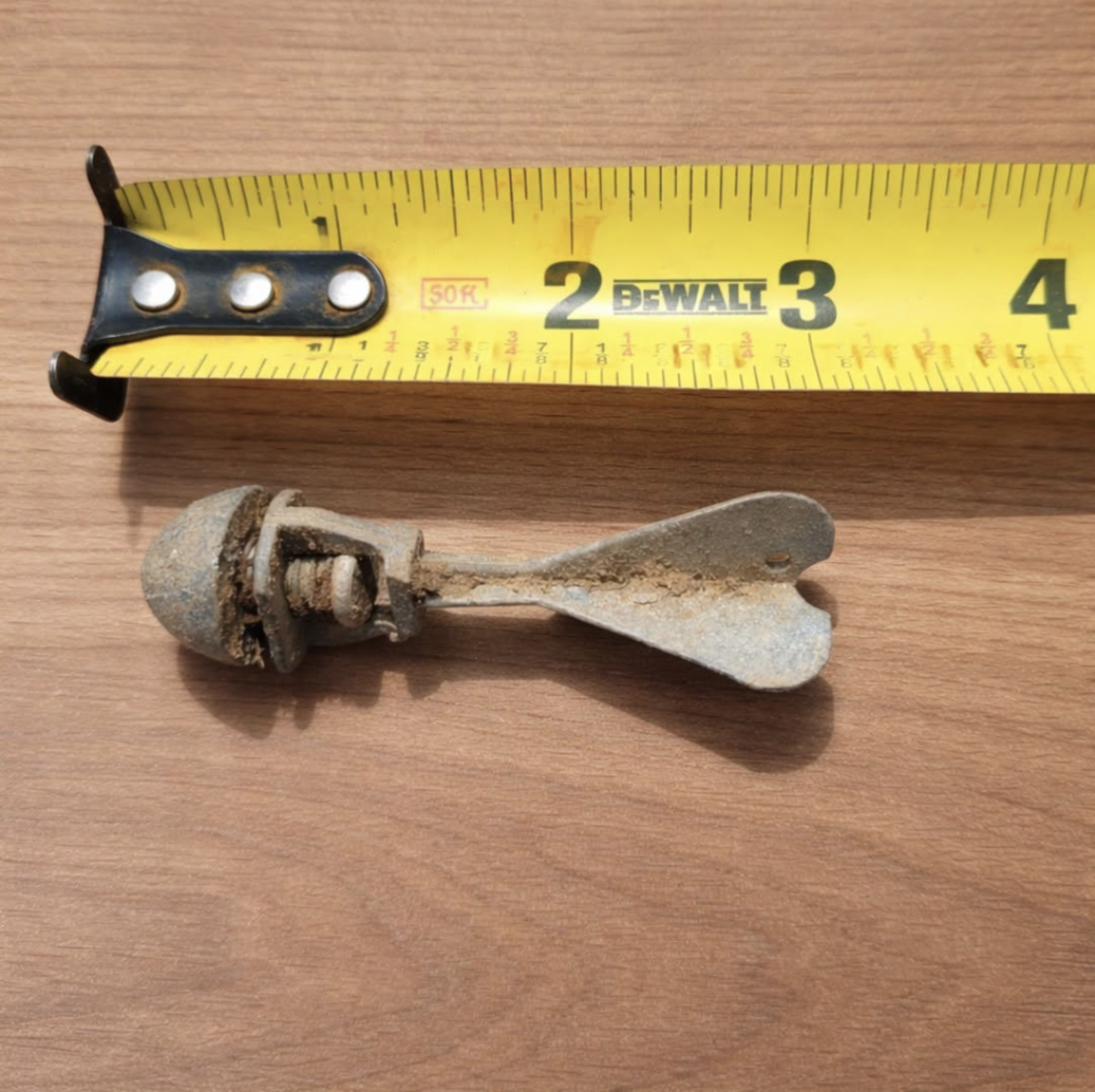
Finding a small metal object in your yard is one of those moments that immediately pulls your attention in a strange way.
It doesn’t matter how modern your life is—once you see something half-buried in soil, rusted, and unfamiliar, your brain shifts gears instantly.
You stop thinking about your day.
You start thinking about possibilities.
What is this?
How long has it been here?
Is it dangerous?
Is it old?
Is it even supposed to be here?
And when the object is small, metallic, dart-shaped, and slightly corroded, the uncertainty becomes even stronger.
In many cases across the Northeast United States, objects like this turn out to be something unexpected:
a vintage 1950s cap grenade toy
A small relic of a time when children’s toys were mechanical, noisy, and designed to simulate adventure in the most literal way possible.
The First Impression: Why It Feels “Wrong” at First
When someone finds one of these today, the reaction is almost always the same:
It looks unfamiliar.
Not like modern plastic toys.
Not like household tools.
Not like anything clearly harmless at first glance.
Instead, it often resembles:
- a small dart or bolt
- a mechanical pin
- a fragment of machinery
- or even something vaguely military
That initial uncertainty is completely normal, because the object has lost its original identity over time.
Decades underground or exposed to weather will do that.
Metal oxidizes.
Edges soften.
Paint disappears.
Mechanical parts vanish.
What remains is only the shape—not the story.
What It Actually Was: A Cap Grenade Toy
Despite its intimidating appearance and name, the object is not a weapon, nor anything dangerous.
It is a mid-20th-century novelty toy, commonly known as:
- Cap Grenade
- Cap Bomb
- Cap Popper Grenade
- Metal Cap Toy Grenade
These toys were part of a larger category of “cap toys” popular in the 1940s, 1950s, and early 1960s.
They were designed to produce a loud popping sound using small chemical cap strips—similar to those used in toy cap guns.
No projectiles.
No explosion in the modern sense.
Just a sharp, satisfying pop meant to mimic action and excitement.
The Cultural Moment Behind It
To understand why toys like this existed, you have to understand the era.
In the 1950s:
- television was still relatively new
- Western films were extremely popular
- toy soldiers and pretend battles were common childhood play themes
- “action sounds” were highly valued in toys
Children didn’t just want silent toys.
They wanted toys that felt alive.
So manufacturers created items that could:
- click
- snap
- pop
- mimic explosions
- simulate battlefield sound effects
The cap grenade fit perfectly into that world.
It was dramatic.
It was loud.
And for kids, it felt incredibly real.
How the Cap Grenade Actually Worked
Even though it looks mechanical and complex today, the internal system was surprisingly simple.
A typical cap grenade toy worked like this:
1. Loading the caps
A small strip of cap material (containing a pressure-sensitive compound) was placed inside a chamber.
These caps were similar to those used in toy pistols.
2. Arming the toy
The user would:
- insert a pin
- or compress a spring mechanism
- or set a trigger lever
This prepared the striker.
3. Activation
When triggered (often by pulling a pin or releasing a spring-loaded part):
- a small metal striker hit the cap strip
- the chemical compound reacted instantly
- a loud popping sound was produced
That was it.
No fire.
No explosion.
Just sound and mechanical motion.
Why These Toys Were So Popular
To modern eyes, they seem strange. But in their time, they were extremely appealing.
1. They made play feel real
Children could simulate:
- battles
- action scenes
- adventure games
The sound added emotional intensity.
2. They were affordable
Most families could buy them easily, making them common in everyday play.
3. They were durable
Metal construction meant they survived rough handling—though not always decades of burial.
4. They fit the imagination of the era
Before digital entertainment, children relied heavily on:
- imagination
- physical toys
- sound effects
The cap grenade was part of that storytelling culture.
Why You Might Find One in a Yard Today
If you discover one in the Northeast USA, there are several likely explanations:
1. Lost during childhood play
Backyards were often used as:
- battlefields for toy games
- exploration zones
- informal play areas
A toy could easily be dropped and forgotten.
2. Buried over time
Soil, grass growth, and landscaping can gradually cover objects.
What was once visible becomes hidden in a few seasons.
3. Left behind from old property owners
Many homes in the Northeast are decades old.
It is very common for objects from the 1950s–1970s to still surface during:
- gardening
- digging
- construction work
4. Discarded broken toys
When the toy stopped working, it often ended up:
- tossed into the yard
- buried during cleanup
- or left in outdoor storage areas
Why It Looks Confusing Today
Time changes perception.
What was once clearly a toy now looks like:
- industrial hardware
- mechanical debris
- antique equipment
- or something unexplained
This happens because:
Metal degradation
Rust alters shape and color.
Missing components
Plastic or spring parts decay first, leaving only the metal core.
Loss of context
Without packaging or memory, the object becomes meaningless visually.
Collector and Historical Value
Today, these items are often:
- vintage toy collectibles
- nostalgic childhood artifacts
- examples of mid-century design
- small museum-worthy curiosities
Condition matters a lot:
- intact pieces = higher collector interest
- rusted fragments = historical curiosity
- rare brands = higher value
Even broken pieces are still considered interesting because they represent a specific cultural era.
Why It Feels So Mysterious When Found
There is something psychologically powerful about finding unknown objects.
Your brain automatically tries to classify it:
- Is it dangerous?
- Is it modern or old?
- Should I touch it?
- What is its purpose?
When the answer is unclear, imagination fills the gap.
That is why many people initially assume:
- military object
- mechanical device
- or something unusual
Before realizing it is simply a toy.

Welcome to my kitchen!
I’m a passionate home cook and recipe creator who loves turning simple ingredients into delicious, comforting meals that everyone can enjoy. Through this website, I share carefully prepared recipes, practical cooking tips, and easy-to-understand food education to help you feel more confident in the kitchen.
My goal is to make cooking simple, enjoyable, and accessible. Whether you are looking for a quick family dinner, a delicious dessert, healthy meal ideas, or traditional recipes with a modern touch, you’ll find inspiration here.
More Than Just Recipes
I believe that cooking is also a way to learn. That’s why this website is not only about recipes. I also create educational articles about ingredients, cooking techniques, kitchen tips, food preparation, and the stories behind different dishes.
Each article is designed to give you useful knowledge that you can apply in your own kitchen. From understanding how ingredients work together to learning better cooking methods, my aim is to help you become a more confident and creative cook.
My Philosophy
Good food doesn’t always require complicated ingredients or professional equipment. With a little knowledge, patience, and creativity, simple ingredients can become something truly special.
I believe in sharing recipes that are practical, clearly explained, and enjoyable to make. I also love exploring new flavors while appreciating traditional cooking and the recipes passed down through generations.
Thank you for visiting my kitchen and being part of this food-loving community. I hope my recipes and articles inspire you to cook, learn, experiment, and most importantly, enjoy every bite!
Happy cooking!