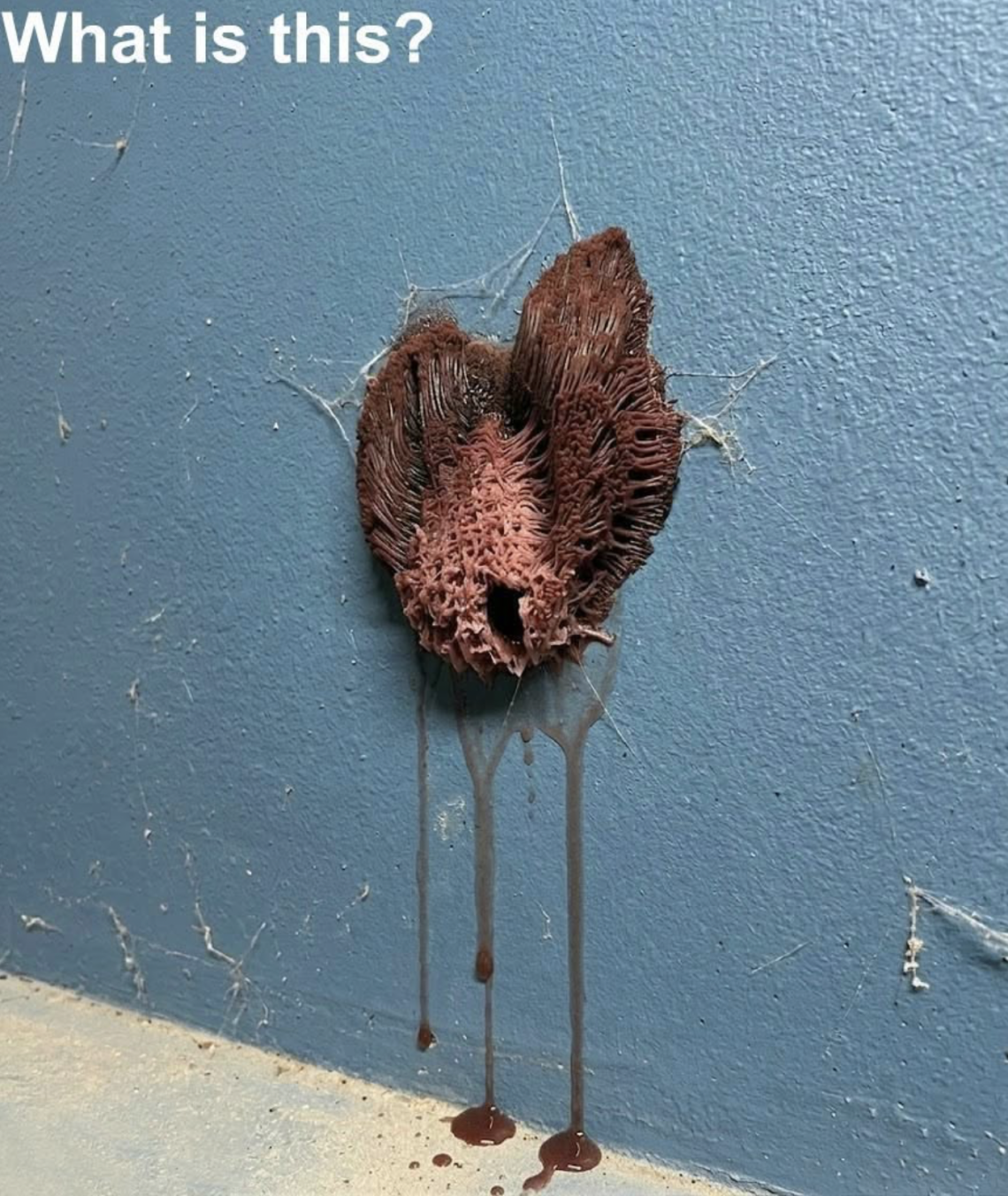
One evening, I stepped into the garage to put away a few things and noticed something unusual on the wall.
At first glance, it looked like an ordinary stain—the kind of mark that can gradually appear in a garage where boxes, tools, shelves, and seasonal decorations spend months sitting undisturbed.
But when I looked more closely, I realized this wasn’t simply a little dirt or an old paint mark.
The surface had changed.
There was a strange patch along the wall, and its texture looked different from the surrounding paint. Some areas appeared discolored, while others seemed slightly raised or uneven.
That was enough to make me stop and take a closer look.
And that’s when an ordinary garage inspection turned into a reminder of something every homeowner should know:
A strange mark on a wall can sometimes be a clue that moisture is hiding somewhere you cannot see.
The Mystery Behind the Wall
Garages are particularly vulnerable to moisture problems.
Unlike the main living areas of a home, garages are often exposed to large temperature changes.
A garage door opens and closes throughout the day.
Rainwater can enter around doors.
Snow and wet vehicles can bring moisture inside.
Concrete floors can release moisture under certain conditions.
Plumbing lines may run through walls.
And roofs, gutters, windows, and exterior walls can all develop small leaks.
Sometimes the moisture is obvious.
Other times, it remains hidden for weeks or months.
A small patch on the wall may be one of the first visible clues.
Not Every Strange Growth Is Mold
This is an important distinction.
When people see something unusual growing or spreading across a wall, the first thought is often:
“That’s mold.”
But an unusual patch can have many possible causes.
It could be mold or mildew.
It could be mineral deposits.
It could be efflorescence caused by moisture moving through masonry.
It could be dirt mixed with condensation.
It could be damaged paint.
It could even be residue from an old leak that has already stopped.
Without examining the material properly, it is impossible to identify an unknown substance with certainty simply from its appearance.
That’s why the real mystery isn’t necessarily, “What is this growth?”
The more useful question is:
“Why is this part of the wall becoming damp enough for something unusual to appear?”
Why Moisture Matters
Moisture is one of the most important factors behind many household maintenance problems.
A dry wall generally doesn’t provide the same environment as a damp one.
When water repeatedly enters a wall or remains trapped against a surface, it can create conditions that encourage biological growth and deterioration.
Over time, moisture can also affect:
- paint,
- drywall,
- wood framing,
- insulation,
- adhesives,
- metal fasteners,
- and other building materials.
The visible mark may therefore be only the surface expression of a larger problem.
Where Could the Moisture Be Coming From?
There are several possibilities.
1. A roof leak
Water entering through the roof can travel along building materials before appearing somewhere else.
That means the visible stain isn’t necessarily directly underneath the original leak.
A small opening around roofing materials, flashing, or another penetration can allow water into the structure.
2. Gutters and downspouts
A clogged or damaged gutter can allow rainwater to accumulate where it shouldn’t.
If downspouts aren’t directing water away from the building, moisture can collect around the foundation or exterior walls.
Repeated exposure can eventually create damp conditions inside the garage.
3. Problems around windows and doors
Garage doors and windows have numerous joints and seals.
Over time, seals can deteriorate.
Heavy rain can expose weaknesses that aren’t noticeable during dry weather.
If the strange patch is near a door or window, inspect the surrounding area for additional signs of water intrusion.
4. Plumbing
If plumbing runs through or near the garage wall, a leaking pipe could be another possibility.
A small plumbing leak doesn’t always produce an obvious puddle.
Water can travel through framing or other materials before becoming visible.
Unexplained dampness near plumbing deserves attention.
5. Condensation
Not every moisture problem comes from a leak.
Condensation can occur when warm, humid air encounters a cooler surface.
Garages can experience significant temperature swings, especially during seasonal changes.
If the garage is poorly ventilated, condensation can become more noticeable.
Metal surfaces, pipes, and cool sections of walls can be particularly susceptible.
The Strange Patch Was a Clue
The most useful way to think about an unusual wall growth is as a warning sign rather than a diagnosis.
The visible patch is telling you that something about that area has changed.
Maybe the wall has been getting damp.
Maybe the paint has begun to fail.
Maybe water has entered from outside.
Maybe humidity is consistently too high.
Or perhaps the substance is completely unrelated to moisture.
The only way to know is to investigate the surrounding conditions carefully.
Look Beyond the Visible Spot
If you discover an unusual patch, don’t examine only the exact location.
Look around it.
Check for:
- discoloration,
- bubbling or peeling paint,
- swollen drywall,
- soft or damaged wood,
- musty odors,
- water marks,
- rust on nearby metal,
- damp insulation,
- or additional patches.
A single mark might be isolated.
Several marks appearing in the same area can provide a stronger indication that an underlying moisture problem needs attention.
What About a Musty Smell?
A persistent musty odor can be another clue.
A smell by itself does not prove that mold is present.
However, if an unusual odor appears together with visible discoloration, damp materials, or evidence of previous water intrusion, it is worth investigating.
Don’t simply cover the smell with air freshener.
That may make the garage smell better temporarily without addressing the source.
Don’t Simply Paint Over It
One of the most tempting solutions is also one of the least useful:
paint over the patch and forget about it.
That might hide the discoloration for a while.
But if moisture is still entering the wall, the underlying problem remains.
The patch may eventually return.
More importantly, continued moisture can damage building materials over time.
The goal should be to identify and correct the moisture source rather than merely covering the evidence.
Be Careful When Cleaning Unknown Growth
If you discover an unknown substance on a wall, avoid disturbing it unnecessarily.
Don’t aggressively scrape, sand, or brush a suspicious patch into the air.
If you suspect significant mold growth, extensive water damage, or contamination inside wall materials, professional assessment may be appropriate.
People with allergies, asthma, or other sensitivities should be especially cautious around suspected mold.
When Is Professional Help Appropriate?
Some moisture problems are relatively straightforward.
Others are not.
Consider getting professional assistance if:
- the affected area is large,
- the source of moisture cannot be identified,
- the wall feels soft or structurally damaged,
- there has been significant water intrusion,
- the problem keeps returning,
- insulation or drywall appears affected,
- there is extensive suspected mold,
- or you suspect a hidden plumbing or roof leak.
A professional can help determine where the moisture is coming from and whether building materials need to be repaired or replaced.
Check the Exterior Too
One of the biggest mistakes people make is investigating only from inside the garage.
Walk around the outside of the building.
Look at the area corresponding to the interior wall.
Check for damaged siding, cracks, deteriorated sealant, overflowing gutters, downspout problems, or places where water collects near the foundation.
Sometimes the answer becomes obvious once you look at the building from the outside.
Don’t Forget the Garage Floor
Concrete floors can also contribute to moisture problems.
In certain conditions, moisture can move through concrete and contribute to dampness inside a garage.
If you notice persistent dampness along the floor-wall junction, that may be useful information.
The location of the moisture can help narrow down the possible source.
Ventilation Can Make a Difference
A garage needs appropriate airflow, particularly when humidity is high.
Improving ventilation can help reduce condensation in some situations.
However, ventilation isn’t a universal solution.
If rainwater is entering through a roof or wall, increasing airflow won’t repair the leak.
The source still needs to be addressed.
A Simple Investigation Checklist
If you discover an unexplained patch, take a systematic approach.
First: Photograph the area.
Second: Note where the patch is located.
Third: Look for other signs of moisture nearby.
Fourth: Check the corresponding exterior wall, roof area, windows, and gutters.
Fifth: Consider whether plumbing is located nearby.
Sixth: Think about whether the area has experienced recent heavy rain, snow, humidity, or condensation.
Seventh: If the cause remains unclear or the damage appears extensive, seek professional advice.
This approach is much more useful than immediately assuming what the substance is.
Why Early Detection Matters
A tiny patch might seem unimportant.
But moisture problems can become progressively more expensive if ignored.
A small leak can damage paint.
Then drywall can become affected.
Wood components can eventually deteriorate.
Insulation can become damp.
And what started as a small maintenance issue can turn into a much larger repair.
That doesn’t mean every strange stain is a catastrophe.
It simply means unusual changes are worth investigating before they become bigger problems.
The Garage Is Part of the Home
It’s easy to think of the garage as separate from the rest of the house.
It’s often filled with tools, bicycles, boxes, gardening equipment, and things that aren’t used every day.
That means small problems can remain unnoticed for a surprisingly long time.
A homeowner might not notice a damp patch because a shelf is standing in front of it.
A stack of boxes can hide discoloration.
A seasonal decoration can cover a damaged section of wall for months.
That’s why occasional inspections are useful.
The Real Lesson Behind the Strange Growth
The mysterious patch wasn’t necessarily the problem itself.
It was a clue.
It encouraged a closer look at the wall, the surrounding materials, and the conditions inside and outside the garage.
That is often the right way to approach unexplained household changes.
Don’t immediately panic.
Don’t immediately cover them up.
And don’t assume you know the cause simply from appearance.
Instead, ask:
What changed?
Where could the moisture be coming from?
Is there evidence elsewhere in the structure?
Does the problem return after cleaning?
Those questions can lead you much closer to the real explanation.