There’s nothing quite like cutting into a watermelon on a hot summer day and finding the inside bright, juicy, crisp, and naturally sweet.
But there’s also nothing more disappointing than carrying a beautiful-looking watermelon home, slicing it open, and discovering that it’s pale, bland, underripe, or strangely watery.
Choosing a good watermelon can feel like a guessing game, especially when the fruit is sitting whole at the market and you can’t see what’s inside.
The good news is that you don’t have to rely entirely on luck.
While there is no foolproof way to know exactly how a whole watermelon will taste before cutting it open, there are several useful signs that can help you choose a ripe, flavorful one.
From the creamy field spot to the weight of the melon in your hands, these simple observations can make your next watermelon purchase much more successful.
1. Look for a Large, Creamy Yellow Field Spot
One of the most useful things to examine is the area where the watermelon rested against the ground while it was growing.
This is called the field spot.
Because that portion of the watermelon didn’t receive the same amount of sunlight as the rest of the rind, it usually develops a lighter-colored patch.
Look for a field spot that is creamy yellow, yellow-orange, or golden in appearance.
A very pale white or greenish field spot can sometimes indicate that the watermelon was harvested before it had reached ideal ripeness.
The field spot isn’t an absolute guarantee of sweetness, but it can be a helpful clue when comparing several melons.
If you’re standing at the produce stand and two watermelons look similar in size, the one with the more developed creamy-yellow field spot may be worth considering.
2. Pick It Up and Pay Attention to the Weight
This is one of the easiest tricks to use.
Pick up the watermelon.
Does it feel surprisingly heavy for its size?
A ripe watermelon contains a great deal of water, so a watermelon that feels heavy compared with another of similar size can be a promising sign.
You don’t necessarily need to choose the biggest watermelon in the pile.
Instead, compare several that are roughly the same size.
If one feels noticeably heavier, it may contain more water and have a juicy interior.
This is particularly useful because you can do it without damaging the fruit or relying on complicated visual clues.
3. Don’t Be Afraid of a Dull Rind
Many people instinctively reach for the watermelon with the shiniest, most polished-looking skin.
But a slightly dull or less glossy rind isn’t necessarily a bad thing.
As a watermelon matures, its exterior can become less shiny and more subdued.
A very glossy appearance can sometimes be associated with a less mature fruit, although rind appearance varies depending on the variety and growing conditions.
So don’t automatically assume that the shiniest watermelon is the best one.
Look at the whole fruit instead.
4. Look for Strong, Defined Striping
The pattern on a watermelon can also give you useful information.
Depending on the variety, ripe watermelons often have clearly defined contrast between their darker and lighter green areas.
The stripes shouldn’t be the only factor you use, because watermelon varieties differ considerably.
Some are striped dramatically, while others have a much more subtle pattern.
Still, when you’re comparing similar melons, a well-developed, distinct appearance can be another piece of the puzzle.
Think of it as one clue among several rather than a guaranteed ripeness test.
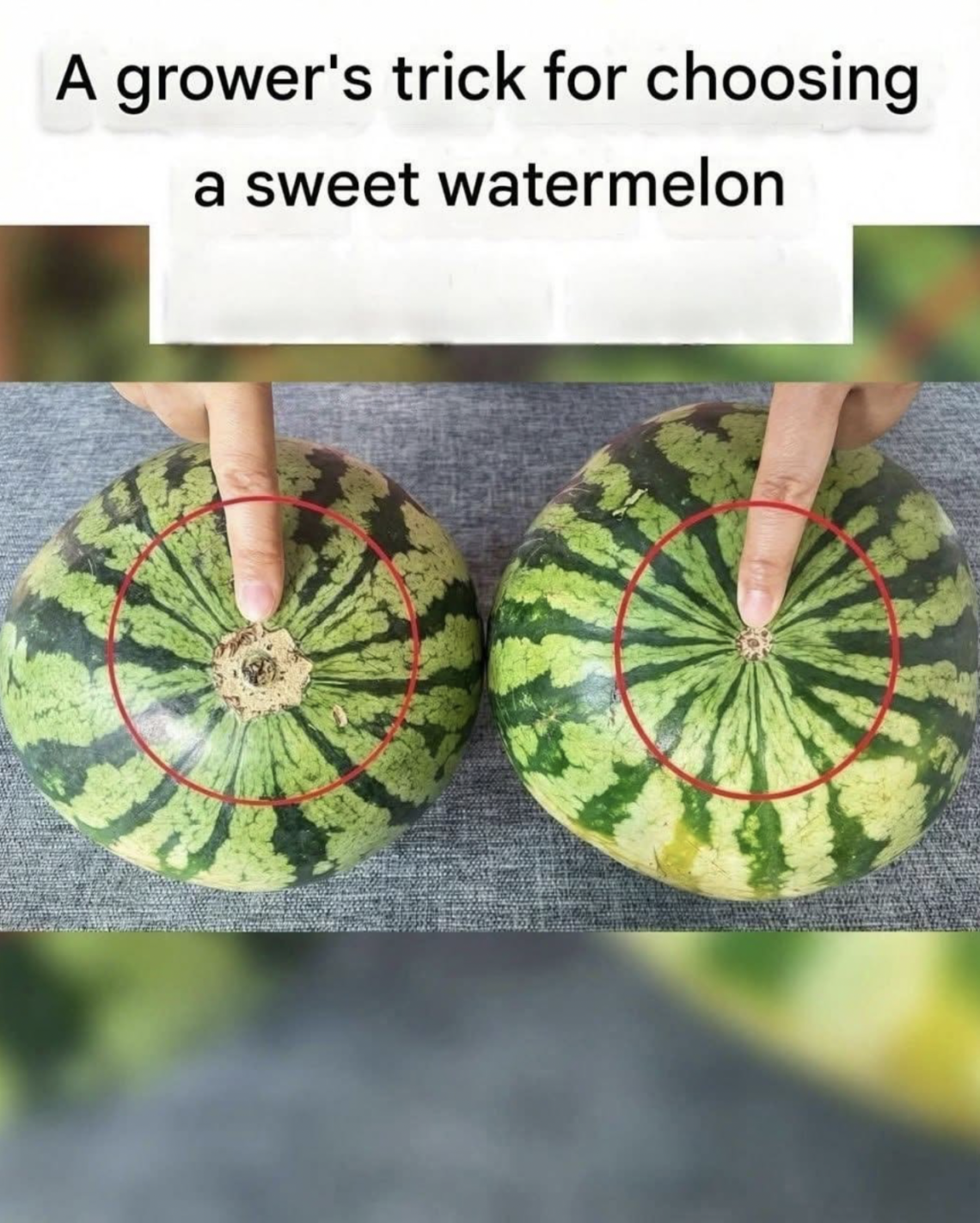
5. Examine the Stem Area
If the watermelon still has a visible stem or stem remnant, take a look at it.
A stem that appears dry and brownish can be associated with a fruit that has had more time to mature.
A very green stem may indicate that the fruit was harvested relatively recently, although this doesn’t automatically mean the watermelon is underripe.
This is another reason not to judge the fruit based on one characteristic.
The stem, field spot, weight, shape, and overall appearance should all be considered together.
6. Choose a Symmetrical, Well-Formed Watermelon
Take a moment to look at the overall shape.
A good watermelon is often relatively symmetrical and evenly developed.
It shouldn’t necessarily be perfectly round. Some varieties are naturally oval or elongated.
What you want to avoid is a fruit with obvious irregularities that suggest it may have experienced uneven growing conditions.
Large dents, deep bruises, soft areas, cracks, or significant damage are more important warning signs.
A few superficial marks aren’t necessarily a problem, but major damage can affect quality.
7. Check the Surface for Soft Spots or Damage
Before putting a watermelon in your cart, gently inspect the rind.
You don’t need to squeeze it aggressively.
Instead, look for obvious signs of deterioration.
Avoid watermelons with:
- large soft spots,
- leaking areas,
- deep cracks,
- extensive bruising,
- mold,
- or damaged sections that appear to be breaking down.
A small scratch or superficial mark isn’t necessarily concerning.
Watermelons are agricultural products, so minor imperfections are normal.
What matters more is whether the damage appears deep, wet, soft, or associated with spoilage.
8. Listen to the Sound When You Tap It
You’ve probably seen people tapping watermelons at the grocery store.
There is some logic behind the tradition, although it shouldn’t be treated as a magic test.
A ripe watermelon may produce a relatively deep, full sound when tapped, while an underripe or overripe melon can sound different.
The problem is that interpreting these sounds takes experience, and there isn’t a universally reliable “perfect watermelon sound.”
So if tapping works for you, use it as an additional clue—but don’t let it override the other signs.
If one watermelon has a good field spot, feels heavy, looks healthy, and has a well-developed appearance, those clues are more useful collectively than a single tap.
What Does Size Have to Do With Sweetness?
Bigger isn’t automatically sweeter.
Watermelon sweetness depends on the variety, growing conditions, maturity, and other factors.
A huge watermelon can be delicious, while a smaller one can also be exceptionally sweet.
Rather than searching for the biggest fruit, choose one that feels heavy for its size and appears healthy and mature.
That gives you a better starting point than simply choosing the largest watermelon in the display.
Can You Tell If a Watermelon Is Sweet From the Outside?
Not with complete certainty.
That’s the important reality.
The rind can provide clues about maturity and quality, but you cannot reliably determine the exact sweetness of the flesh without cutting the watermelon open.
Even experienced shoppers can occasionally choose a disappointing melon.
Weather, growing conditions, variety, harvesting time, storage, and handling all influence the final quality.
The goal is therefore to improve your odds—not to find a foolproof secret.
What About the Sugar Spot?
You may hear people mention small brown or dark speckled marks on the watermelon.
Some shoppers call these “sugar spots” and believe they indicate sweetness.
These markings can sometimes be associated with natural processes occurring on the rind, but they shouldn’t be treated as a guaranteed sweetness indicator.
Again, the safest approach is to consider several characteristics rather than relying on a single supposed trick.
What If the Watermelon Has a Huge Field Spot?
A large field spot isn’t necessarily bad.
The important thing is the color and overall condition of the spot.
A creamy or yellowish area can be a positive sign.
If the area looks rotten, excessively soft, wet, or damaged, that’s a different story.
Don’t confuse a naturally colored field spot with spoilage.
Should You Buy Pre-Cut Watermelon Instead?
Whole watermelon has one major disadvantage: you can’t see the flesh.
Pre-cut watermelon gives you an opportunity to inspect the color and texture before buying.
The flesh should generally look vibrant and juicy, depending on the variety.
Avoid pieces that appear excessively dry, slimy, fermented, or discolored.
Because cut fruit is more exposed to the environment, proper refrigeration and food-handling practices are especially important.
If you’re buying pre-cut watermelon, choose products that have been properly refrigerated and follow the storage instructions on the package.
How to Store a Whole Watermelon
Once you’ve found a good watermelon, storing it properly matters.
An intact watermelon can generally be kept at room temperature for a limited period, but refrigeration can help keep it cool and refreshing, particularly once it has been cut.
Once you slice the watermelon, refrigerate the cut pieces promptly and keep them covered.
Use clean utensils and containers, and avoid leaving cut fruit sitting out for extended periods.
Don’t Wash It Too Early
It can be tempting to wash a whole watermelon immediately after bringing it home.
However, it’s generally better to wash the exterior shortly before cutting rather than washing it and then leaving it stored for a long time.
When you’re ready to cut it, rinse the outside under clean running water and scrub the surface gently with a clean produce brush if needed.
Then dry it with a clean towel before cutting.
This helps reduce the chance of transferring dirt or microorganisms from the rind to the flesh while you’re slicing.
The Best Strategy: Use Several Clues Together
If you remember only one thing from this guide, make it this:
Don’t rely on one watermelon-picking trick.
Instead, combine several clues.
Look for a healthy, well-formed watermelon.
Check for a creamy-yellow field spot.
Compare its weight with similarly sized melons.
Inspect the rind for damage or soft spots.
Look at the stem area when visible.
Consider the overall appearance.
And, if you like, use the tapping sound as one additional clue.
When several of these signs point in the same direction, you’ve probably improved your chances of taking home a good melon.
A Quick Watermelon Shopping Checklist
Before choosing your watermelon, ask yourself:
Is it heavy for its size?
Does it have a creamy-yellow field spot?
Is the shape reasonably symmetrical?
Does the rind look healthy and intact?
Are there any soft or rotten areas?
Does the stem area look mature rather than obviously fresh and green?
Does the overall watermelon look naturally developed rather than damaged?
You don’t need every single sign to be perfect.
Think of the checklist as a way to make a more informed choice.