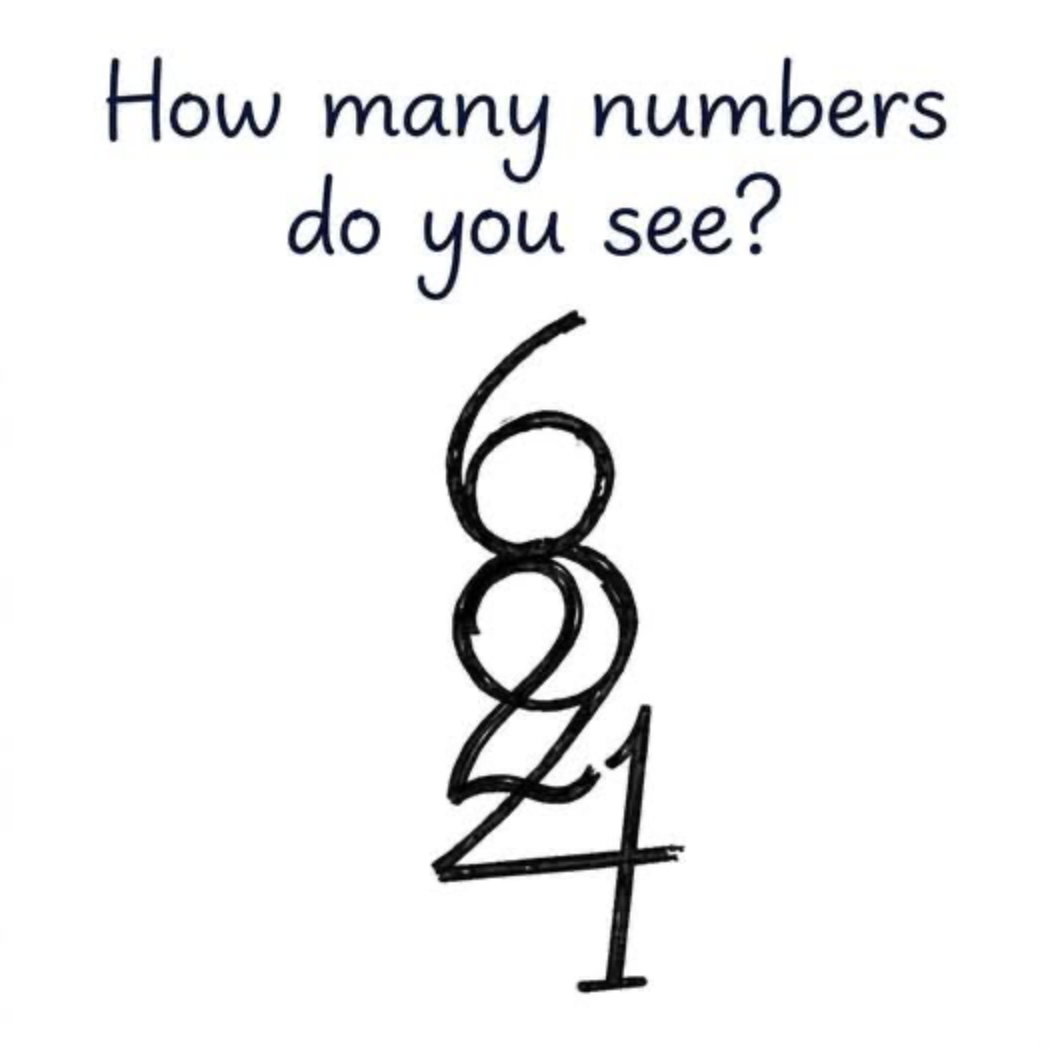
At first glance, it seems like a simple challenge. An image appears on your screen filled with overlapping shapes, lines, shadows, and partially hidden digits. The question sounds easy enough:
“How many numbers do you see?”
Some people immediately spot a few digits and confidently announce their answer. Others stare at the image for several minutes, gradually discovering more numbers hidden within the design. Before long, a simple visual puzzle turns into a fascinating demonstration of how differently people observe the world around them.
While puzzles like this are often presented as personality tests, the truth is a little more complex—and much more interesting. Your answer may not reveal your destiny or provide a scientific diagnosis of your personality. However, it can offer clues about how your brain processes visual information, handles ambiguity, pays attention to details, and approaches problem-solving.
The real magic of these puzzles lies not in the final answer but in the journey your mind takes to find it.
Why Visual Puzzles Fascinate Us
Human beings are natural pattern seekers.
From the earliest days of civilization, our survival depended on recognizing shapes, identifying movement, and spotting hidden dangers in our environment. Long before written language existed, our ancestors relied heavily on visual perception to understand the world.
Today, those same mental systems remain active.
Every second, your brain processes:
- colors
- shapes
- movement
- depth
- contrast
- patterns
Most of this happens automatically.
When you look at a visual puzzle filled with hidden numbers, your brain immediately begins searching for order within apparent chaos.
That process is what makes these puzzles so engaging.
Why Different People See Different Numbers
One of the most surprising things about number illusions is that two intelligent people can look at exactly the same image and see completely different things.
This happens because perception is not simply about eyesight.
Your eyes gather information, but your brain decides what that information means.
Several factors influence what you notice:
- experience
- attention
- expectations
- visual sensitivity
- mental focus
- cognitive style
In other words, seeing is not merely an optical process. It is also a psychological process.
The Difference Between Seeing and Observing
Many people assume seeing and observing are the same thing.
They are not.
Seeing is automatic.
Observing is intentional.
For example:
Most people can see a room.
But an observer notices:
- the arrangement of furniture
- the lighting
- small decorative details
- changes from previous visits
The same principle applies to number puzzles.
Some people stop after identifying the obvious digits.
Others continue searching for hidden patterns.
What Happens Inside the Brain During These Puzzles
When you encounter a hidden-number image, multiple brain systems begin working simultaneously.
Your visual cortex processes:
- shapes
- edges
- contrast
Your attention networks decide:
- where to focus
- what to ignore
Your memory systems compare what you see to familiar number shapes.
Meanwhile, your problem-solving centers evaluate possibilities.
This complex cooperation happens in fractions of a second.
The result feels effortless, even though your brain is performing extraordinary computations.
People Who See Only a Few Numbers
Some viewers immediately identify only the most obvious digits.
This does not mean they are less intelligent.
In fact, it often reflects a practical style of thinking.
These individuals frequently:
- focus on primary information
- avoid overcomplicating situations
- prefer efficiency
- make decisions quickly
They tend to prioritize what appears most relevant.
In everyday life, this can be a valuable skill.
Rather than becoming overwhelmed by details, they concentrate on what matters most.
Strengths of This Thinking Style
People who focus on major patterns often:
- act decisively
- avoid analysis paralysis
- simplify complex situations
- maintain perspective
They are often effective leaders because they can quickly identify priorities.
Potential Challenges
However, they may occasionally:
- overlook subtle details
- miss hidden opportunities
- underestimate complexity
Balancing efficiency with deeper observation can strengthen their decision-making.
People Who See Many Numbers
Some individuals continue discovering digits long after others have stopped looking.
They notice:
- faint outlines
- overlapping shapes
- hidden forms
- unusual angles
This often reflects a detail-oriented mindset.
Strengths of Detail-Oriented Thinkers
These individuals frequently excel at:
- analysis
- research
- quality control
- troubleshooting
They enjoy investigating problems thoroughly and rarely accept surface-level explanations.
Their attention to detail can be extremely valuable in professional and personal settings.
Potential Challenges
The same strengths can sometimes create difficulties.
Detail-focused people may:
- overanalyze situations
- struggle to make quick decisions
- spend excessive time seeking perfection
Learning when “good enough” is truly enough can be important.
The Role of Expectation
One fascinating aspect of visual perception is expectation.
Your brain constantly predicts what it expects to see.
These predictions influence what becomes visible.
Imagine being told:
“Look for hidden numbers.”
Immediately, your brain begins searching for numerical shapes.
Without that instruction, you might simply see random lines.
This phenomenon demonstrates how strongly expectations influence perception.
Why Ambiguous Images Are So Powerful
Visual puzzles often contain ambiguous information.
Ambiguity means there is more than one possible interpretation.
Your brain dislikes uncertainty.
It naturally attempts to organize incomplete information into recognizable patterns.
This tendency explains why people:
- see faces in clouds
- recognize shapes in shadows
- identify animals in rock formations
The same pattern-recognition mechanisms help reveal hidden numbers.
What These Puzzles Really Measure
Despite dramatic claims online, hidden-number puzzles do not scientifically measure intelligence.
However, they can reveal interesting differences in:
- observation style
- persistence
- attention allocation
- visual processing preferences
They encourage us to think about how we approach challenges.
Do we stop at the first answer?
Do we keep searching?
Do we trust our initial impression?
Do we question what we see?
These habits often extend beyond puzzles into daily life.
The Psychology of Persistence
One of the most interesting aspects of hidden-number challenges is persistence.
Some people:
- glance briefly
- choose an answer
- move on
Others continue examining every corner of the image.
Persistence often reflects curiosity and determination.
People who keep searching frequently enjoy:
- learning
- discovery
- solving mysteries
- intellectual challenges
Their motivation comes from the process itself.
Why Friends Often Disagree
Have you ever shown a visual puzzle to a group of people?
The results can be surprising.
Different answers appear almost immediately.
This happens because perception is influenced by:
- past experiences
- visual habits
- attention patterns
- cognitive preferences
Everyone’s brain filters information slightly differently.
That diversity is one reason these puzzles create such lively discussions.
The Connection Between Perception and Personality
Although visual puzzles cannot accurately define personality, certain tendencies may emerge.
For example:
People who quickly identify large patterns often value efficiency.
People who search for every hidden detail may enjoy analysis and exploration.
People who question whether the puzzle contains additional numbers often demonstrate curiosity and skepticism.
These tendencies are not rigid personality traits, but they can provide interesting insights into how someone approaches information.
Why We Love Discovering Hidden Things
Humans are naturally rewarded by discovery.
When you suddenly spot a hidden number, your brain experiences a small burst of satisfaction.
Psychologists sometimes refer to this as an “aha moment.”
These moments activate reward systems in the brain and create feelings of:
- excitement
- accomplishment
- curiosity
This is one reason hidden-number puzzles remain popular across generations.
The Importance of Looking Beyond the Obvious
Many visual puzzles contain a broader lesson.
The first thing we notice is not always the complete picture.
In life, as in puzzles:
- first impressions can be incomplete
- assumptions can be misleading
- deeper observation often reveals new information
The ability to pause, observe, and reconsider can be incredibly valuable.
What Your Answer Might Really Reveal
The most meaningful insight may not come from the number itself.
Instead, ask yourself:
- How quickly did I answer?
- Did I keep searching?
- Was I confident?
- Did I doubt my conclusion?
- Did I enjoy the challenge?
Your response to these questions may reveal more about your thinking style than the puzzle ever could.
The Bigger Lesson Hidden in the Puzzle
At its heart, the challenge is not really about numbers.
It is about perception.
It reminds us that people can look at the same information and arrive at different conclusions.
It demonstrates that observation requires effort.
And it shows that our minds are constantly interpreting, filtering, and organizing the world around us.

Welcome to my kitchen!
I’m a passionate home cook and recipe creator who loves turning simple ingredients into delicious, comforting meals that everyone can enjoy. Through this website, I share carefully prepared recipes, practical cooking tips, and easy-to-understand food education to help you feel more confident in the kitchen.
My goal is to make cooking simple, enjoyable, and accessible. Whether you are looking for a quick family dinner, a delicious dessert, healthy meal ideas, or traditional recipes with a modern touch, you’ll find inspiration here.
More Than Just Recipes
I believe that cooking is also a way to learn. That’s why this website is not only about recipes. I also create educational articles about ingredients, cooking techniques, kitchen tips, food preparation, and the stories behind different dishes.
Each article is designed to give you useful knowledge that you can apply in your own kitchen. From understanding how ingredients work together to learning better cooking methods, my aim is to help you become a more confident and creative cook.
My Philosophy
Good food doesn’t always require complicated ingredients or professional equipment. With a little knowledge, patience, and creativity, simple ingredients can become something truly special.
I believe in sharing recipes that are practical, clearly explained, and enjoyable to make. I also love exploring new flavors while appreciating traditional cooking and the recipes passed down through generations.
Thank you for visiting my kitchen and being part of this food-loving community. I hope my recipes and articles inspire you to cook, learn, experiment, and most importantly, enjoy every bite!
Happy cooking!