There are desserts that feel heavy, dense, and indulgent in a straightforward way.
And then there are desserts that feel almost… impossible.
Cream puffs belong to the second category.
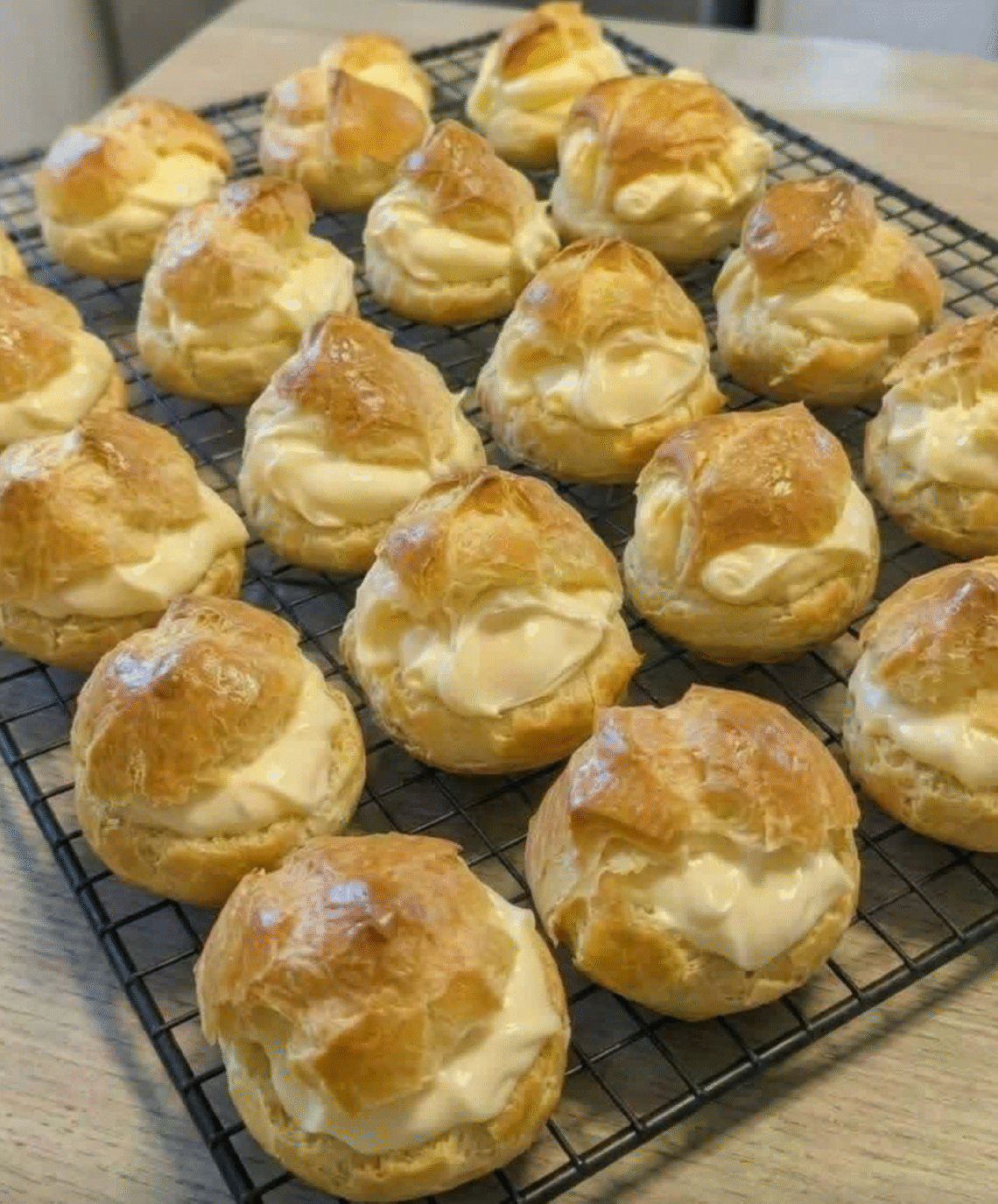
They look delicate enough to crumble under pressure, yet when you bite into them, they reveal something extraordinary: a hollow, airy shell filled with smooth custard that feels like it was crafted in a professional pastry kitchen.
But what makes them truly fascinating is not just how they taste—it’s how they are created.
Because cream puffs are not just baked.
They are engineered by heat, steam, and structure.
The Science Behind the Magic
Cream puffs are made from a classic pastry dough called choux pastry, one of the most unique doughs in baking.
Unlike most baked goods that rely on:
- Baking powder
- Yeast
- Chemical leaveners
choux pastry rises through a completely different mechanism.
It relies on one thing:
steam expansion.
When the dough enters a hot oven:
- The water inside the dough rapidly turns into steam
- The steam expands and pushes the dough outward
- The structure sets while expanded
This creates a hollow interior naturally—no artificial leavening required.
That hollow center is what makes it perfect for filling.
Ingredients: Simple, but Precise
Even though the ingredient list is short, each element plays a critical role.
For the choux pastry:
- Water (creates steam and structure)
- Butter (adds richness and flavor)
- Flour (builds structure)
- Eggs (provide elasticity and lift)
- Salt (enhances flavor balance)
For the custard:
- Milk (creamy base)
- Sugar (sweetness and texture)
- Egg yolks (richness and thickening power)
- Cornstarch (stabilizer)
- Vanilla (aroma and depth of flavor)
Each ingredient has a functional role, not just a taste role.
Step 1: Building the Choux Base (The Foundation Stage)
The process begins in a saucepan.
You combine:
- Water
- Butter
- Salt
As heat is applied, something important happens:
- The butter melts completely
- The mixture begins to boil gently
- The water becomes infused with fat
This step is essential because it ensures even moisture distribution in the dough.
The Flour Transformation Moment
Once the mixture is boiling, flour is added all at once.
This is not like normal baking where flour is gently folded.
Here, it is:
- Dumped in fully
- Stirred vigorously
- Cooked on heat
The dough begins to:
- Thicken instantly
- Pull away from the pan
- Form a cohesive mass
At this stage, something crucial happens: the flour is pre-gelatinized.
That means:
- The starches absorb liquid
- The structure becomes stable
- The dough is ready to trap steam later
This step is what gives cream puffs their ability to rise dramatically.
Step 2: Cooling and Egg Incorporation
After cooking the dough, it must cool slightly.
Why?
Because eggs are sensitive to heat. If added too early:
- They will scramble
- The dough will break
Once cooled, eggs are added gradually.
This stage is where transformation happens again.
At first:
- The dough looks broken
- It appears slippery or separated
But as mixing continues:
- It becomes smooth
- Glossy
- Elastic
- Pipeable
This texture is critical. It must be thick enough to hold shape, but soft enough to expand in the oven.
Step 3: Piping the Perfect Shape
The dough is transferred into a piping bag.
Small rounds are piped onto a tray.
What matters here is:
- Consistency of size
- Spacing between puffs
- Smooth surface shape
If they are uneven:
- Some may bake faster
- Some may collapse
- Some may not hollow properly
This is where precision matters more than speed.
Step 4: The Baking Transformation
Inside the oven, something dramatic happens.
The process unfolds in stages:
Stage 1: Rapid Expansion
Water inside the dough turns into steam instantly.
The dough expands outward like a balloon.
Stage 2: Structure Formation
The outer layer begins to dry and harden.
This creates a shell strong enough to hold shape.
Stage 3: Hollow Creation
As steam escapes:
- A cavity forms inside
- The structure stabilizes
- The puff becomes light and hollow
This is why opening the oven too early is dangerous—the structure is still fragile.
Step 5: Creating the Custard Filling
Now comes the heart of the dessert.
The custard is not just a filling—it is a contrast to the airy shell.
In a saucepan:
- Milk is gently heated
- Egg yolks are whisked with sugar
- Cornstarch is added for thickness
When combined:
- The mixture thickens slowly
- Becomes smooth and silky
- Gains a rich, velvety texture
At the end, vanilla is added for aroma and warmth.
The result is a custard that is:
- Soft
- Creamy
- Stable enough to hold inside pastry
- Yet delicate on the palate
Step 6: Filling the Cream Puffs
Once the shells are fully cooled:
They are either:
- Cut open slightly
OR - Injected with custard using a piping bag
As the custard enters:
- The shell becomes heavier
- The center fills completely
- The texture contrast becomes clear
This is the moment where the dessert comes to life.
Texture Experience: What Makes It Unforgettable
When you bite into a cream puff, you experience layers of sensation:
- A light crack of the outer shell
- A soft, airy interior collapse
- A smooth wave of custard
It is:
- Crisp + soft
- Airy + creamy
- Light + rich
This contrast is what makes it feel luxurious.
Why Cream Puffs Feel “Professional”
Cream puffs have a reputation for being bakery-level desserts because:
- They require timing
- They rely on technique
- They depend on understanding heat and structure
Yet once understood, they become repeatable and reliable.
Common Mistakes (and Why They Happen)
1. Flat Cream Puffs
Usually caused by:
- Opening the oven too early
- Underbaked dough
2. Dense Texture
Caused by:
- Too much egg
- Improper flour cooking
3. Soggy Shells
Caused by:
- Filling too early
- Not fully drying in the oven
Variations for Creativity
Once mastered, cream puffs become a canvas:
Chocolate Version
- Cocoa in custard
- Chocolate glaze on top
Coffee Cream Puffs
- Espresso-infused custard
Fruit Cream Puffs
- Strawberry or mango filling
Whipped Cream Version
- Lighter, airy alternative
Storage and Serving
- Best eaten fresh
- Refrigerate if filled
- Shells can be frozen unfilled
- Fill just before serving for best texture
Welcome to my kitchen!
I’m a passionate home cook and recipe creator who loves turning simple ingredients into delicious, comforting meals that everyone can enjoy. Through this website, I share carefully prepared recipes, practical cooking tips, and easy-to-understand food education to help you feel more confident in the kitchen.
My goal is to make cooking simple, enjoyable, and accessible. Whether you are looking for a quick family dinner, a delicious dessert, healthy meal ideas, or traditional recipes with a modern touch, you’ll find inspiration here.
More Than Just Recipes
I believe that cooking is also a way to learn. That’s why this website is not only about recipes. I also create educational articles about ingredients, cooking techniques, kitchen tips, food preparation, and the stories behind different dishes.
Each article is designed to give you useful knowledge that you can apply in your own kitchen. From understanding how ingredients work together to learning better cooking methods, my aim is to help you become a more confident and creative cook.
My Philosophy
Good food doesn’t always require complicated ingredients or professional equipment. With a little knowledge, patience, and creativity, simple ingredients can become something truly special.
I believe in sharing recipes that are practical, clearly explained, and enjoyable to make. I also love exploring new flavors while appreciating traditional cooking and the recipes passed down through generations.
Thank you for visiting my kitchen and being part of this food-loving community. I hope my recipes and articles inspire you to cook, learn, experiment, and most importantly, enjoy every bite!
Happy cooking!