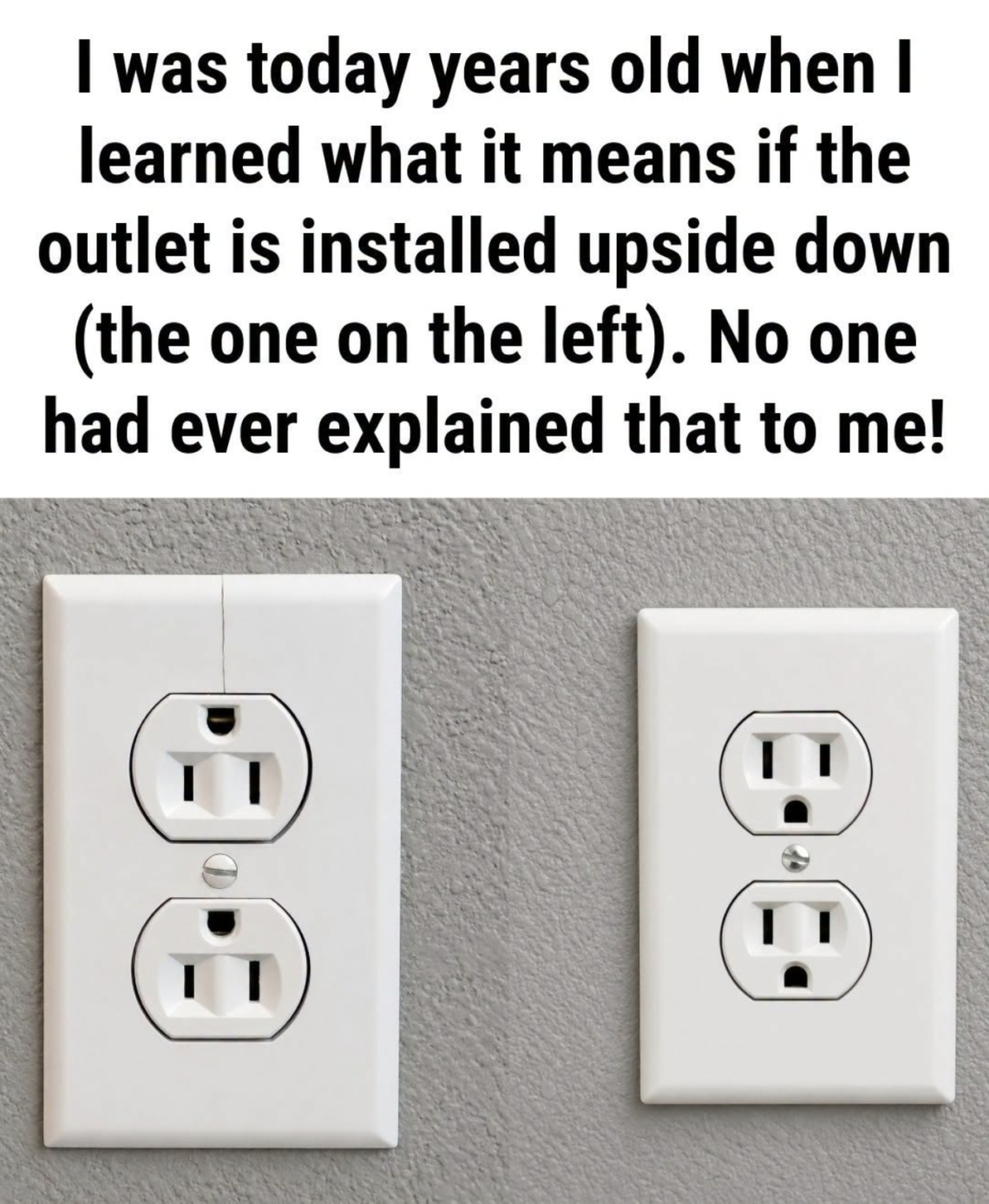
“No One Had Ever Explained That to Me!” The Surprising Reason Some Electrical Outlets Are Installed Upside Down (And Why It Can Actually Be a Smart Design Choice)
Most people rarely think about the electrical outlets in their homes. They are such a familiar part of everyday life that we simply plug in our lamps, televisions, phone chargers, kitchen appliances, and countless other devices without paying much attention to their orientation. However, every so often, you may notice something unusual: an outlet installed “upside down,” with the grounding hole located at the top instead of the bottom.
For many homeowners, this can be surprising. It is easy to assume that the outlet was installed incorrectly or that a previous homeowner made a mistake during a do-it-yourself renovation. In reality, an upside-down outlet is often installed intentionally, and depending on the building, electrical code requirements, or the preferences of the electrician, it may actually provide practical safety and identification benefits.
Although there is no universal rule requiring all electrical outlets to be installed in one specific orientation, understanding why some are installed with the grounding slot on top reveals interesting aspects of electrical safety, construction practices, and building design.
Is an Upside-Down Outlet Actually Incorrect?
In most situations, no.
Standard electrical outlets are generally designed to function properly regardless of whether they are installed:
- Ground up.
- Ground down.
- Horizontally.
As long as the wiring has been completed correctly and complies with applicable electrical codes, the outlet’s orientation does not affect its normal operation.
The electrical contacts inside the receptacle function the same way regardless of which direction the outlet faces.
Why Do Some Electricians Install Them Ground-Up?
One of the most common reasons involves safety.
Imagine a plug that is only partially inserted into an outlet.
If a metal object, such as:
- A picture frame.
- A butter knife.
- A metal ruler.
- A tool.
- A loose screw.
were to fall between the plug and the outlet, it could accidentally contact the exposed metal prongs.
With a traditional ground-down outlet, the energized prongs are often positioned above the grounding pin.
If the metal object bridges the energized prongs, it may create a short circuit.
When the outlet is installed with the grounding hole on top, the grounding pin is typically the first point of contact.
Because the grounding pin is connected to the building’s grounding system rather than carrying normal electrical current, this arrangement may reduce the likelihood of certain accidental electrical shorts if a conductive object falls behind a partially inserted plug.
Although such incidents are relatively uncommon, some electricians and facilities prefer this orientation because it offers an additional layer of protection in specific situations.
Hospital and Medical Facilities
Many hospitals intentionally install outlets with the grounding slot facing upward.
This practice allows maintenance personnel and healthcare workers to quickly recognize outlets that follow the facility’s electrical standards.
Hospitals often have strict electrical safety requirements because they operate:
- Medical equipment.
- Life-support systems.
- Monitoring devices.
- Diagnostic instruments.
In some facilities, outlet orientation also helps distinguish certain types of electrical circuits.
Identifying Switched Outlets
In some homes, one receptacle is controlled by a wall switch.
Electricians occasionally install these outlets upside down to indicate that they serve a different function.
For example:
- The upper outlet may always provide power.
- The lower outlet may be controlled by a wall switch.
Although orientation alone is not a universal indicator, some electricians use it as a visual reminder.
Commercial Buildings
Many commercial buildings also use ground-up outlets.
Reasons may include:
- Company installation standards.
- Safety preferences.
- Maintenance consistency.
- Local building practices.
Large facilities often prioritize standardized installations throughout the building.
Does Outlet Orientation Affect Performance?
No.
Regardless of orientation, a properly wired outlet delivers electricity in exactly the same manner.
Appliances, lamps, chargers, and other electrical devices function normally whether the grounding slot is positioned:
- Up.
- Down.
- Sideways.
Performance depends on correct wiring—not outlet orientation.
Understanding the Parts of an Outlet
A standard three-prong outlet consists of:
Hot Slot
Usually the narrower vertical opening.
It supplies electrical current.
Neutral Slot
Typically the wider vertical opening.
It completes the electrical circuit.
Ground Slot
The round or U-shaped opening.
It provides an important safety path that helps direct fault current safely to ground in the event of certain electrical faults.
Why Grounding Is Important
The grounding conductor plays a critical role in electrical safety.
It helps:
- Reduce shock hazards.
- Improve appliance safety.
- Provide a path for fault current.
- Support circuit breaker operation during certain faults.
Proper grounding is one of the most important features of modern electrical systems.
Why Homeowners Notice Upside-Down Outlets
People often assume something is wrong because most residential outlets have traditionally been installed with the ground facing downward.
When one outlet appears different, it naturally attracts attention.
However, a different orientation alone does not indicate poor workmanship.
Can Homeowners Flip an Outlet?
Although physically rotating an outlet may seem simple, electrical work should only be performed after the circuit has been safely de-energized and in accordance with applicable electrical requirements.
If you are uncertain about any electrical installation, it is safest to consult a qualified electrician rather than attempting modifications yourself.
Other Reasons an Outlet May Look Different
Not every unusual outlet indicates a problem.
Some outlets may include:
- USB charging ports.
- Tamper-resistant shutters.
- Weather-resistant construction.
- Ground-fault protection (GFCI).
- Arc-fault protection.
- Smart outlet features.
Modern electrical devices continue to evolve as safety standards improve.
Common Myths About Upside-Down Outlets
Myth 1: The Electrician Installed It Incorrectly
Not necessarily.
Many upside-down outlets are installed intentionally.
Myth 2: The Outlet Is Dangerous
No.
A properly installed outlet functions safely regardless of orientation.
Myth 3: Upside-Down Outlets Are Only Found in Hospitals
Although common in healthcare facilities, they are also found in homes, offices, schools, and commercial buildings.
Myth 4: Electricity Flows Differently
False.
Electricity flows the same way regardless of the outlet’s orientation.
Safety Tips for Using Electrical Outlets
Regardless of orientation:
- Never overload outlets.
- Replace damaged receptacles promptly.
- Keep outlets dry.
- Use child safety covers where appropriate.
- Avoid using damaged plugs.
- Inspect cords regularly.
- Do not force plugs into outlets.
Good electrical habits contribute significantly to household safety.
Frequently Asked Questions
Is it safe to use an upside-down outlet?
Yes, provided it has been installed correctly and complies with applicable electrical standards.
Why do hospitals often install outlets this way?
Ground-up orientation may support facility safety practices and help identify outlets used within standardized electrical systems.
Does outlet orientation affect my appliances?
No.
Your appliances will operate normally regardless of whether the outlet is installed ground-up or ground-down.
Should I rotate my outlets to match each other?
Not necessarily.
Orientation is largely a matter of installation preference or building standards rather than functionality.
Does every electrician prefer the same orientation?
No.
Practices vary depending on local customs, company standards, client preferences, and project requirements.
Small Design Choices Can Have Practical Reasons
Many features in modern homes appear insignificant until we understand the reasoning behind them. Electrical outlet orientation is one example of how a simple installation choice can reflect practical considerations related to safety, maintenance, identification, or building standards. While most people never notice the difference during daily life, electricians and facility managers often make these decisions deliberately based on the specific needs of the building.

Welcome to my kitchen!
I’m a passionate home cook and recipe creator who loves turning simple ingredients into delicious, comforting meals that everyone can enjoy. Through this website, I share carefully prepared recipes, practical cooking tips, and easy-to-understand food education to help you feel more confident in the kitchen.
My goal is to make cooking simple, enjoyable, and accessible. Whether you are looking for a quick family dinner, a delicious dessert, healthy meal ideas, or traditional recipes with a modern touch, you’ll find inspiration here.
More Than Just Recipes
I believe that cooking is also a way to learn. That’s why this website is not only about recipes. I also create educational articles about ingredients, cooking techniques, kitchen tips, food preparation, and the stories behind different dishes.
Each article is designed to give you useful knowledge that you can apply in your own kitchen. From understanding how ingredients work together to learning better cooking methods, my aim is to help you become a more confident and creative cook.
My Philosophy
Good food doesn’t always require complicated ingredients or professional equipment. With a little knowledge, patience, and creativity, simple ingredients can become something truly special.
I believe in sharing recipes that are practical, clearly explained, and enjoyable to make. I also love exploring new flavors while appreciating traditional cooking and the recipes passed down through generations.
Thank you for visiting my kitchen and being part of this food-loving community. I hope my recipes and articles inspire you to cook, learn, experiment, and most importantly, enjoy every bite!
Happy cooking!