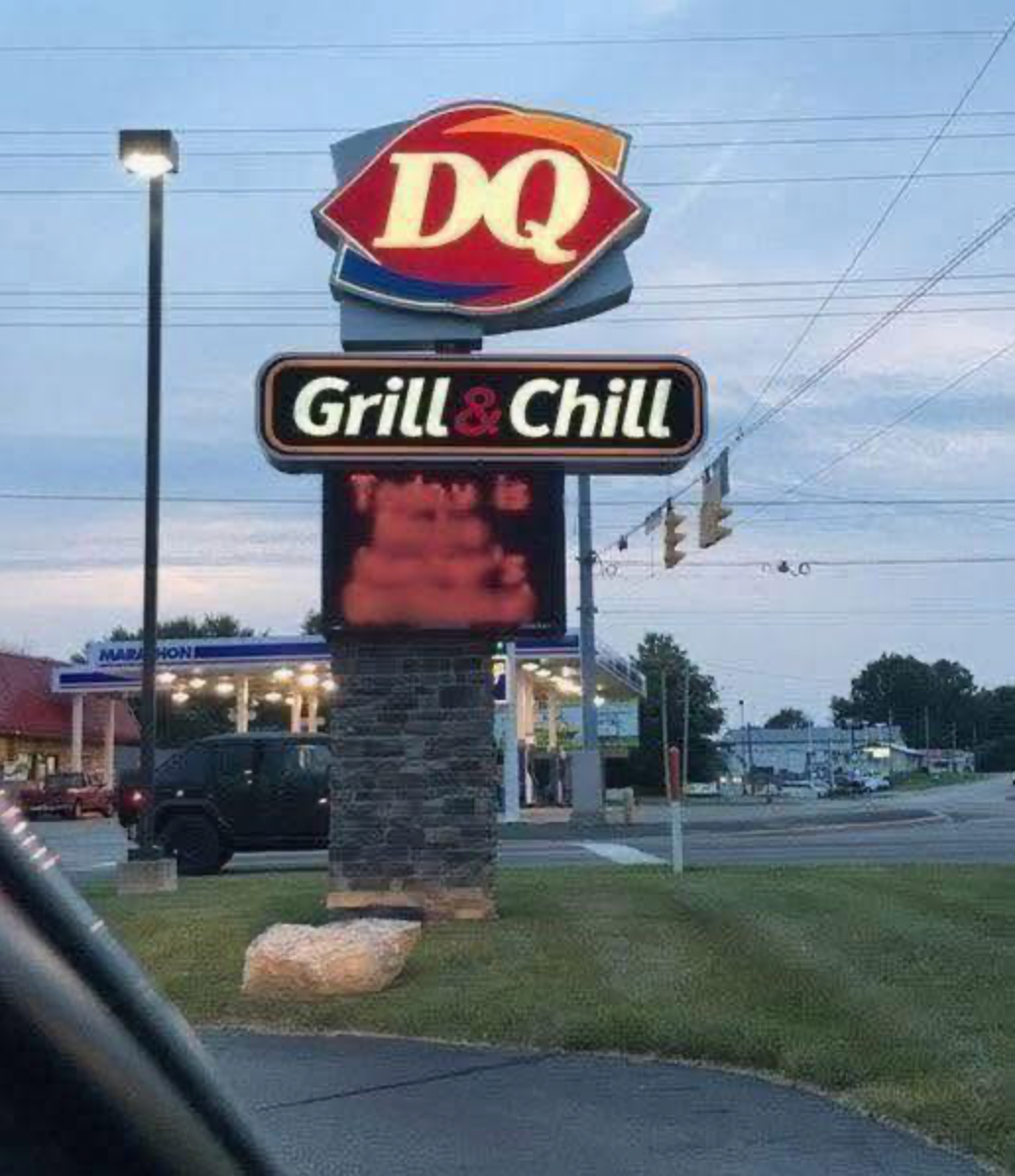
In the quiet town of Kewaskum, Wisconsin, a small-town Dairy Queen has unexpectedly become a focal point for a nationwide debate. What could have been just another seasonal display or routine business signage turned into a viral discussion about free speech, personal conviction, and the role of tradition in public spaces. The controversy centers on a hand-painted sign outside the restaurant, which the franchise owner describes as “politically incorrect,” and which has sparked both admiration and criticism from people across the United States.
The story demonstrates how a seemingly simple message, meant for a local community, can quickly resonate—or clash—with a broader audience in the digital age, where social media amplifies every opinion, often with far-reaching consequences.
The Sign That Started It All
The sign, prominently displayed at the entrance of the Dairy Queen, immediately captures attention with its bold declaration: “This restaurant is politically incorrect.” Beneath this statement, the sign lists specific greetings, values, and offers that the owner chooses to uphold. It reads greetings such as “Merry Christmas,” “Happy Easter,” and “God Bless America.” It also includes a nod to patriotism and civic service, offering free sundaes to veterans on Veterans Day and prominently displaying the national motto, “In God We Trust.”
According to the franchise owner, Kevin Scheunemann, the sign was originally placed nearly a decade ago following a dispute with a customer who objected to Christian music being played inside the store. Scheunemann explained that the sign was intended not as a provocation, but as a transparent reflection of his personal beliefs and the type of environment he wanted to maintain within his business. It was meant to communicate his appreciation for veterans, his embrace of traditional holiday celebrations, and his support for faith-based values.
Scheunemann has emphasized that the sign is not intended to discourage anyone from entering his restaurant. On the contrary, he has said he welcomes all customers and is open to discussion with anyone who may feel uncomfortable with the wording, reflecting a nuanced approach to balancing personal beliefs with public hospitality.
Local Community Reaction
Within Kewaskum, reactions to the sign have been largely supportive or indifferent. Many longtime residents describe the Dairy Queen as a comfortable, familiar place where families gather, students grab ice cream after school, and local veterans are recognized and celebrated. In this context, the sign was seen as an extension of the store’s personality rather than an exclusionary message.
Local business owners have echoed this perspective, suggesting that patrons who are uncomfortable with the sign are free to make their own choices about where to shop, a reflection of community norms around personal freedom and expression. For many locals, the sign reinforces a sense of hometown identity and continuity, connecting small-town business practices with long-standing cultural traditions.
The Viral Spread
The story shifted dramatically from a local matter to a national conversation when a visitor shared a photo of the sign on social media. The post quickly went viral, attracting thousands of comments from people all over the country. The online discussion was highly polarized:
- Supporters praised the Dairy Queen and its owner for courageously upholding personal convictions, traditional values, and expressions of gratitude toward veterans. Many described the sign as a refreshing act of honesty and a stand against what they perceive as excessive political correctness.
- Critics, in contrast, argued that while free speech is important, blending personal religious or political views with public-facing business messaging can create an unwelcoming atmosphere for customers who do not share those beliefs. Some described the phrase “politically incorrect” as deliberately provocative and potentially alienating in a public business setting.
This debate quickly evolved from a discussion about a single sign into a broader cultural conversation about freedom of expression, inclusivity, and how businesses navigate personal beliefs in spaces that serve the public.
Corporate Response and Policy
Dairy Queen’s corporate office weighed in following the national attention. The company clarified that individual franchisees have autonomy over signage and in-store policies, and that the sign represents the personal views of the local owner rather than the brand as a whole. At the same time, the company reaffirmed its commitment to treating all customers with respect and dignity, signaling its intent to remain neutral while acknowledging franchise independence.
This response highlighted the unique challenges faced by national brands operating through independently owned franchises, where local autonomy can sometimes spark national attention or controversy.
Broader Cultural Implications
The incident demonstrates how a local, personal expression can become a national talking point in today’s hyper-connected digital landscape. A sign intended to communicate the owner’s values to his immediate community became a flashpoint for debates over free speech, political correctness, religious expression, and the limits of public messaging in private businesses.
Psychologists and sociologists note that such controversies often touch on deeply held cultural beliefs and identity. For supporters, the sign represents authenticity, courage, and adherence to tradition. For critics, it symbolizes potential exclusion or the tension between personal conviction and public accommodation. The polarization reflects broader societal questions about how communities navigate cultural differences in public and commercial spaces.
The Human Side of the Debate
Beyond politics and social commentary, the controversy has also underscored the human dimension. Many local veterans expressed appreciation for the store’s recognition and free sundaes, while employees described the attention as both exhausting and fascinating. Scheunemann himself has been candid about the emotional toll of having a local tradition scrutinized nationwide, noting that what began as a simple gesture of personal expression unexpectedly sparked a conversation much larger than he anticipated.
Takeaways
The Kewaskum Dairy Queen sign illustrates how small, personal actions can carry outsized cultural weight. It reminds us that:
- Free speech in a public business context is complex: While individuals have the right to express personal beliefs, doing so in a customer-facing environment carries both supportive and critical attention.
- Local traditions can collide with national sensibilities: What feels normal or comforting in a small town may provoke strong reactions online.
- Social media amplifies small gestures: A simple hand-painted sign intended for a local audience can become a national flashpoint, prompting widespread debate.
Whether interpreted as a stand for personal authenticity or criticized as potentially exclusionary, the sign serves as a reminder that even seemingly ordinary actions can spark reflection, conversation, and debate far beyond their original context.
In the end, this small-town Dairy Queen has become a symbol of larger societal questions: How do we balance personal conviction with inclusivity? How do businesses navigate the line between free expression and public accommodation? And what does it mean for a message to be “politically incorrect” in today’s interconnected world?