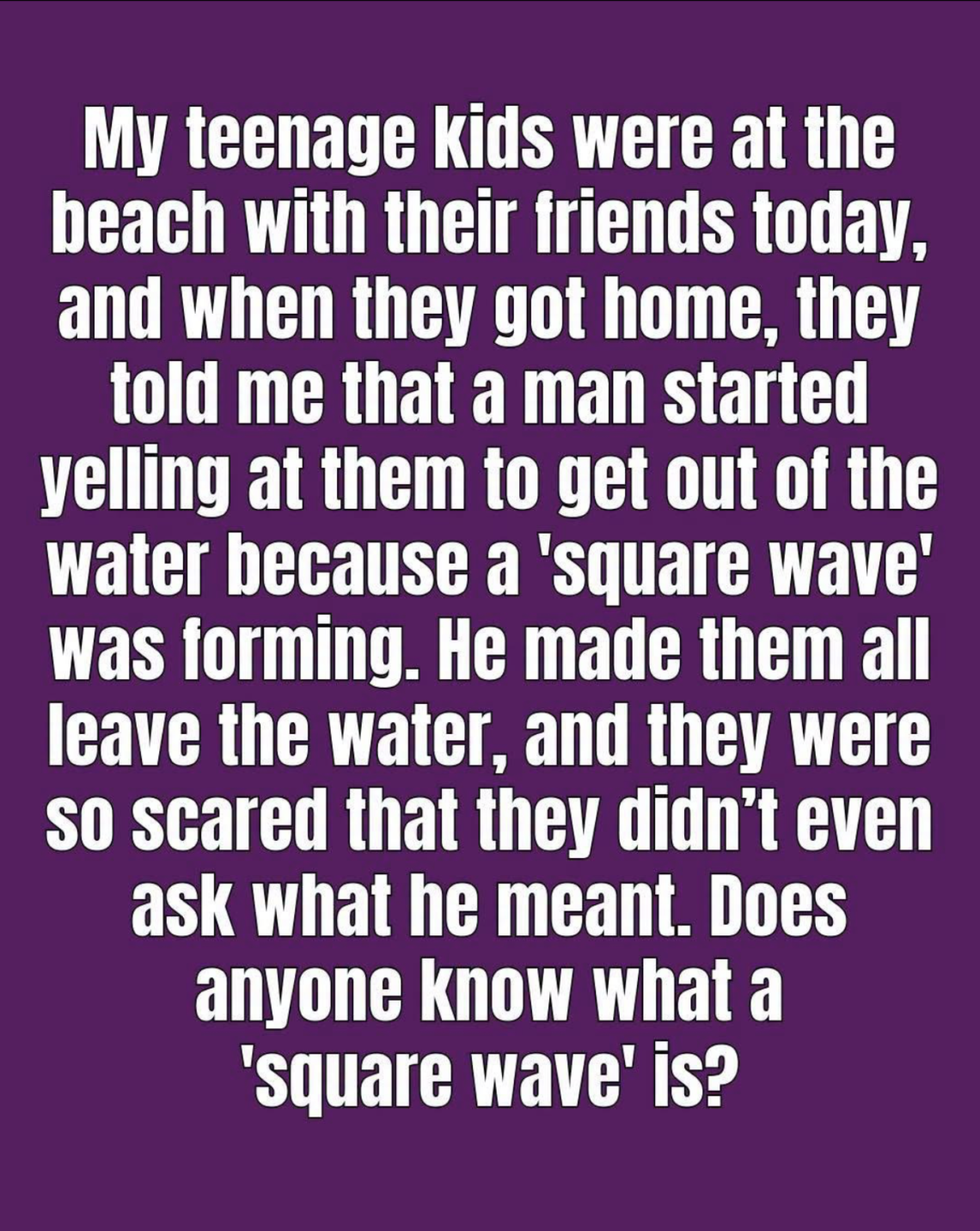
From the shore, you may suddenly notice something strange happening on the surface of the water. Instead of waves arriving in one consistent direction, long lines of waves appear to cross one another. Viewed from above—or from a high enough viewpoint—the pattern can resemble a giant checkerboard or a series of squares spread across the sea.
These formations are often called “square waves.”
The name is memorable, but it can also be misleading. The waves aren’t actually square, and the ocean isn’t suddenly forming perfect geometric shapes. What you’re seeing is generally the result of two different wave systems traveling in different directions and interacting with each other.
It is a fascinating demonstration of how complicated ocean movement can become.
But if you ever encounter this phenomenon in person, the most important thing to remember is this:
Admire unusual wave patterns from a safe location rather than entering the water to investigate them.
The appearance of crossing waves can indicate complicated sea conditions, and the water may be much more difficult to navigate than it looks from shore.
What Exactly Are “Square Waves”?
The term “square waves” is commonly used online to describe a sea state in which waves cross one another at noticeable angles.
Rather than seeing a simple sequence of waves moving toward the beach, you may see one set of waves moving in one direction while another set approaches from a different direction.
The overlapping wave crests can create a distinctive grid-like pattern.
From a distance, the effect can look remarkably organized.
The ocean appears to have been divided into squares.
But the pattern is actually produced by moving water, not by any rigid structure underneath the surface.
The geometry is temporary.
As the wind, swell, tides, currents, and other conditions change, the pattern can weaken, shift, or disappear.
How Can Two Sets of Waves Exist at the Same Time?
This is one of the most interesting parts of the phenomenon.
The ocean isn’t always controlled by a single weather system.
A storm hundreds or even thousands of kilometers away can generate swell that travels across the ocean.
Meanwhile, local winds can create a different set of waves closer to the coast.
Those two wave systems may have different directions.
When they meet, their surfaces overlap.
This is known as wave interference.
The resulting pattern can become visually striking, especially when the two wave systems travel at significantly different angles.
What Is a Swell?
To understand the phenomenon, it helps to understand the difference between locally generated waves and swell.
Wind blowing across the surface of the ocean transfers energy to the water.
Depending on the wind’s strength, duration, and the distance over which it blows, it can create waves of different sizes and characteristics.
Once waves move away from the area where they were generated, they can travel long distances as swell.
That means the weather directly above you isn’t necessarily responsible for every wave reaching your coastline.
You could have relatively calm conditions overhead while long-period swell from a distant storm arrives from another direction.
This is one reason ocean conditions can sometimes seem surprising.
Why Do the Waves Form a Grid?
Imagine drawing a series of parallel lines across a piece of paper.
Now draw another group of parallel lines crossing the first group at an angle.
Where the two sets intersect, you get a pattern that resembles a grid.
Something similar can happen on the ocean.
One wave system creates a series of ridges.
Another wave system creates another series of ridges.
Where they overlap, the surface takes on a crosshatched appearance.
The exact pattern depends on the direction, height, wavelength, and timing of the different waves.
That’s why not every instance looks identical.
Some may look like neat squares.
Others may look more like diamonds, rectangles, or irregular crisscrossing lines.
Does Seeing Square Waves Automatically Mean the Ocean Is Dangerous?
Not necessarily.
This is an important distinction.
The presence of a crosshatch pattern does not mean that everyone looking at it is automatically in immediate danger.
Ocean safety depends on many factors.
These include:
- wave height,
- wave period,
- wind strength,
- current direction,
- distance from shore,
- shoreline shape,
- water temperature,
- weather conditions,
- visibility,
- and the presence of lifeguards.
However, complicated crossing wave systems can make the water more difficult to read and navigate.
For that reason, unusual sea conditions should be treated cautiously.
Why Can Crossing Waves Be Difficult for Swimmers?
A swimmer is not simply floating on a flat surface.
The body is being moved by the water.
When waves arrive from a relatively consistent direction, an experienced swimmer can often anticipate their movement more easily.
When multiple wave systems intersect, the movement can become less predictable.
A swimmer may be lifted by one wave while another wave moves across it from a different direction.
The surface may also become more irregular.
This can make swimming more tiring and make it harder to maintain a comfortable position in the water.
For someone who is inexperienced, tired, or already struggling, those additional challenges can matter considerably.
What Should You Do If You See Them From the Beach?
The safest first step is simple:
Stay on shore.
There is no reason to enter the water just to get a closer look.
If you’re at a supervised beach, check the signs and ask a lifeguard about current conditions.
Pay attention to:
- warning flags,
- posted swimming restrictions,
- announcements,
- beach closures,
- weather warnings,
- and instructions from lifeguards.
If authorities have closed the water, don’t enter simply because the waves appear manageable from the beach.
The people monitoring the beach have access to information you may not have.
Don’t Confuse a Beautiful Pattern With Safe Conditions
This is perhaps the most important lesson.
Humans naturally associate beauty with harmlessness.
A colorful sunset is harmless.
A rainbow is harmless.
A fascinating pattern on the ocean can look equally inviting.
But natural beauty doesn’t tell you whether something is safe.
The ocean can look spectacular while powerful currents are moving beneath the surface.
It can also look relatively calm while conditions offshore are changing.
So don’t use appearance alone as your safety test.
What If You’re Already in the Water?
If you are already swimming and notice that the conditions have become much rougher or more complicated than expected, don’t panic.
Your first priority should be staying afloat and conserving your energy.
If lifeguards are present, attract their attention and follow their instructions.
Avoid exhausting yourself by making frantic movements.
If you are being moved by a current, trying to fight directly against it can rapidly drain your energy.
The exact response depends on the type of current and the local conditions, which is why instructions from trained lifeguards should take priority.
If you are unable to return safely to shore, signal for help rather than continuing until you become exhausted.
What About Rip Currents?
Another reason not to rely solely on the visual appearance of the sea is that rip currents can occur without an obvious “square wave” pattern.
A rip current is a localized flow of water moving away from the shoreline.
They can occur on many beaches and can be difficult to identify if you don’t know what you’re looking for.
Signs can include:
- a narrow channel of unusually disturbed water,
- differences in wave breaking,
- foam or debris moving away from shore,
- or a section where waves appear noticeably different from the surrounding water.
Not every rip current looks exactly the same.
If you’re unsure about the conditions, ask a lifeguard.
What If You Are Caught in a Rip Current?
If you realize that you’re being carried away from shore, the first thing to remember is don’t panic.
Try to stay afloat and conserve your energy.
Don’t attempt to overpower the current by swimming directly against it until you’re exhausted.
If possible, signal for help.
At a supervised beach, lifeguards are trained to recognize and respond to these situations.
Once you’re no longer being carried away from shore, appropriate escape techniques can depend on the specific current and local guidance.
This is one reason learning basic water-safety skills before swimming in the ocean is so valuable.
Why Children Should Be Especially Careful
Children can be particularly vulnerable to changing water conditions because even relatively modest waves can affect them differently from adults.
If a beach has warnings or lifeguards advise against swimming, children should stay out of the water.
Even confident young swimmers shouldn’t be expected to handle unfamiliar ocean conditions on their own.
Adults supervising children should remain attentive rather than relying solely on flotation devices or assuming the water is safe because other people are swimming.
Why Photos Can Make the Phenomenon Look More Extreme
Many of the most famous images of square waves are taken from elevated locations.
A drone, cliff, building, or high shoreline viewpoint can reveal the geometry of the waves much more clearly than standing at water level.
That perspective can make the pattern appear enormous.
But a photograph captures only one moment.
It doesn’t tell you:
- how strong the currents are,
- how deep the water is,
- how rapidly the conditions are changing,
- or whether swimming is permitted.
Never use a viral photograph as a guide to whether a particular beach is safe.
Don’t Assume the Water Is Safe Because Other People Are Swimming
This is another common mistake.
You might see several people in the water and assume everything is fine.
But individual swimmers have different abilities, and conditions can change.
People can also make poor decisions.
If lifeguards are warning people to leave the water, follow the warning even if others are ignoring it.
Your safety shouldn’t depend on whether someone else is taking a risk.
What Causes the Pattern to Disappear?
The pattern isn’t permanent.
The two wave systems may change direction.
One swell may become weaker.
Wind conditions can shift.
Tides and currents can alter the interaction.
As the different wave trains change, the distinctive grid-like appearance can disappear.
That temporary nature is part of what makes the phenomenon so fascinating.
You’re essentially seeing different sources of ocean energy intersect at one particular moment.
Are Square Waves the Same as Rogue Waves?
No.
These terms describe very different phenomena.
A cross sea or visually “square” pattern refers to wave systems traveling in different directions and interacting.
A rogue wave generally refers to an unusually large and unexpected individual wave relative to the surrounding sea state.
They should not be treated as interchangeable terms.
Seeing a crosshatched ocean surface does not mean that a rogue wave is about to appear.
Are Square Waves a Tsunami Warning?
No.
A grid-like wave pattern should not automatically be interpreted as a tsunami warning.
Tsunamis have different physical causes and characteristics.
If an official tsunami warning is issued, follow the instructions of local authorities immediately.
Do not attempt to diagnose tsunami risk from an unusual-looking wave pattern.
What Should Boaters Do?
If you’re on a small boat and encounter complicated crossing seas, conditions deserve particular attention.
Boat operators should follow local marine forecasts and warnings and should not rely solely on what the water looks like at the moment.
Crossing seas can produce uncomfortable and challenging conditions for smaller vessels.
If conditions deteriorate, the safest response depends on the vessel, location, weather, and official marine guidance.
Recreational boaters should have appropriate safety equipment and should know how to communicate for assistance before heading onto the water.
The Best Rule for Beachgoers
You don’t have to understand every detail of oceanography to make a safe decision.
If the sea suddenly looks dramatically different from normal, pause.
Look at the warning signs.
Check the flags.
Listen to the lifeguards.
Consider the weather.
And if you aren’t sure whether it is safe, stay out of the water.
There is no prize for being the person who gets closest to an unusual wave pattern.