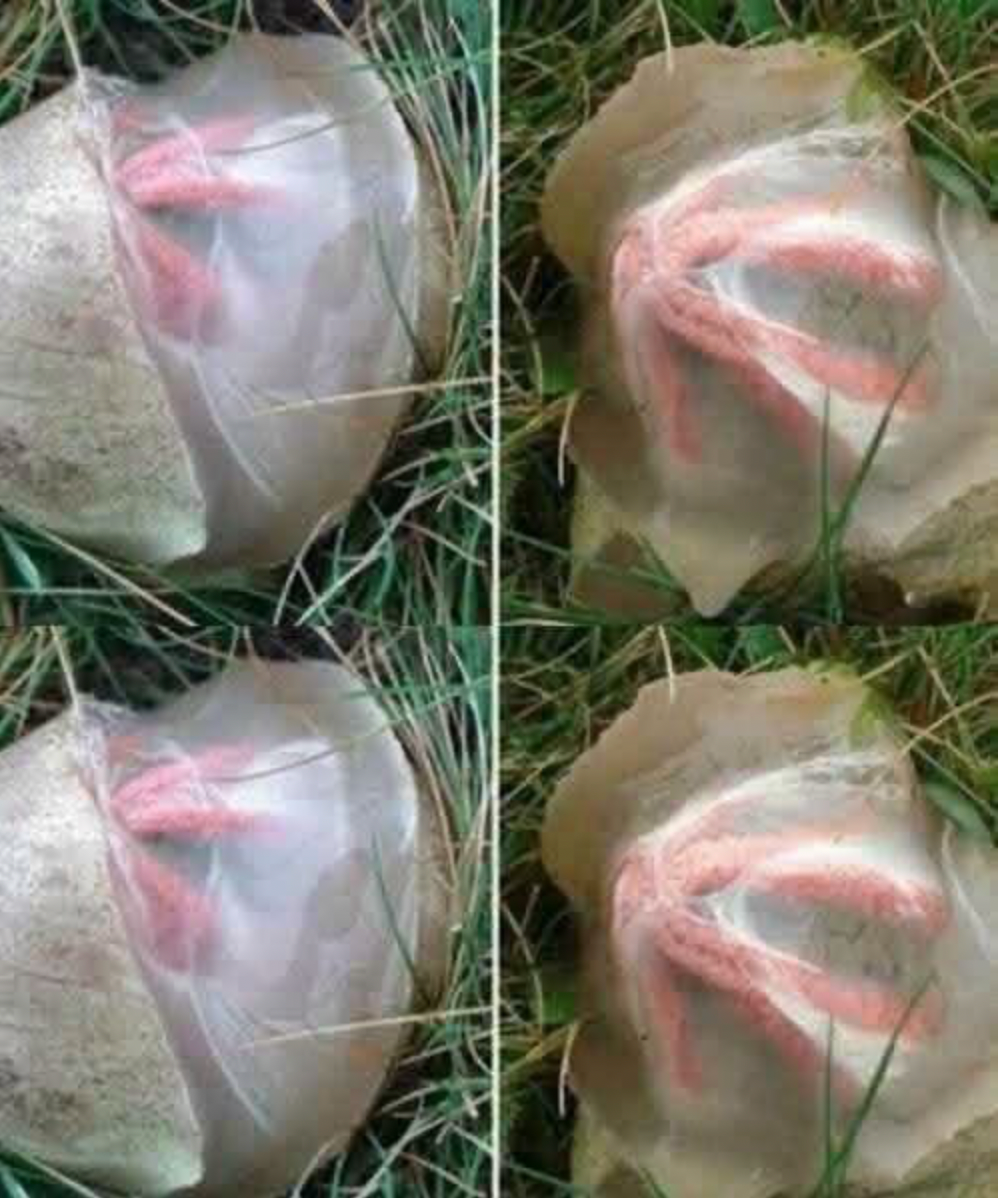
An ordinary walk through the garden can sometimes turn into a surprisingly memorable experience.
Most mornings, there is nothing particularly mysterious about checking the plants. You look for new leaves, pull a few weeds, move a fallen branch, and perhaps notice which flowers have opened overnight. The garden slowly becomes familiar, almost predictable.
That is exactly why one strange discovery can catch your attention so quickly.
One morning, while walking along the edge of a shaded area of soil, I noticed something that immediately made me stop.
There, among the leaves and damp earth, was a vivid red growth.
It was unlike the mushrooms I was accustomed to seeing.
It wasn’t the familiar rounded cap that most people picture when they hear the word “mushroom.” Instead, it had an unusual folded, irregular appearance. Parts of the surface looked almost glossy, while other areas appeared textured and uneven.
For a moment, I couldn’t even decide what I was looking at.
Was it a fungus?
A strange plant?
Something left behind by an animal?
Or perhaps some unusual growth that had appeared almost overnight?
The more closely I looked, the more fascinating it became.
Why Bright Red Fungi Get So Much Attention
Fungi come in an astonishing variety of shapes, colors, and textures.
Although many familiar mushrooms are shades of brown, white, gray, or beige, some species can be remarkably colorful.
Red, orange, yellow, purple, and even blueish fungi occur in nature.
Color can make a fungus particularly noticeable because it contrasts sharply with the muted greens and browns of a garden.
A bright red growth against dark soil and fallen leaves can look almost artificial.
That doesn’t mean it is dangerous.
It simply means that nature has produced something that catches the human eye.
The First Clue Was the Location
The strange growth appeared in a shaded part of the garden where the soil tended to stay moist.
That detail turned out to be important.
Fungi generally don’t behave like ordinary flowering plants.
They don’t depend on sunlight in the same way plants do because fungi obtain nutrients by breaking down organic material or interacting with living organisms.
A shaded garden containing damp soil, decaying leaves, old roots, mulch, compost, or buried pieces of wood can provide excellent conditions for many types of fungi.
So a sudden-looking mushroom growth isn’t necessarily evidence that something unusual has happened to the garden.
It may simply mean that the conditions were right.
Fungi Can Appear Very Quickly
One of the most surprising things about mushrooms is how rapidly their visible structures can develop.
For much of their lives, fungi exist primarily as networks of microscopic threads called hyphae.
Together, these threads form a larger structure known as mycelium.
Much of this fungal network can remain hidden in soil, wood, mulch, or other organic material.
Then, when temperature and moisture conditions become favorable, the fungus may produce a visible reproductive structure—the mushroom or other fruiting body.
That’s why it can seem as though a mushroom appeared out of nowhere.
The fungus itself may have been present for much longer.
Only the visible portion is new.
The Garden Wasn’t Necessarily “Infected”
Seeing an unfamiliar fungus can make a gardener wonder whether something is wrong with the soil.
Usually, the presence of a mushroom by itself isn’t evidence that the garden has a serious disease problem.
In many cases, fungi are simply participating in the natural decomposition process.
Leaves fall.
Branches decay.
Roots break down.
Mulch decomposes.
And fungi help recycle those materials into nutrients that eventually become part of the soil.
In that sense, a mushroom can be a visible reminder that an enormous biological process is happening beneath our feet.
Why Did It Look So Strange?
Mushrooms don’t all follow the classic “stem and cap” design.
Some fungi form cups.
Others develop shelves, brackets, coral-like structures, balls, spikes, wrinkles, folds, or irregular blobs.
Some appear smooth and polished.
Others are covered with tiny pores or textured surfaces.
The red growth in the garden could therefore belong to any number of very different fungal groups.
Without a clear photograph, location, microscopic examination, and sometimes expert identification, it would be irresponsible to confidently name a particular species from color and shape alone.
And that’s an important lesson when identifying wild fungi.
Color Alone Isn’t Enough
Bright red does not automatically mean poisonous.
Likewise, a bland-looking brown mushroom isn’t automatically safe.
There is no reliable rule saying that colorful mushrooms are dangerous while plain mushrooms are harmless.
Fungal identification depends on multiple characteristics, including:
- shape,
- size,
- texture,
- surface features,
- how the fungus grows,
- the substrate on which it appears,
- habitat,
- spore characteristics,
- and sometimes microscopic traits.
Two completely unrelated fungi can look surprisingly similar.
That’s why eating an unidentified wild mushroom is never a good idea.
What Should You Do If You Find One?
If an unfamiliar fungus appears in your garden, the simplest approach is usually to leave it alone while you determine what it is.
Don’t taste it.
Don’t let children or pets investigate it by putting it in their mouths.
If you want to identify it, take several clear photographs from different angles.
Photograph the entire growth.
Then photograph the top, side, and surrounding soil or wood.
A close-up of the surface can also be useful.
If possible, note where it was growing.
Was it directly in soil?
Was it growing from mulch?
Was it attached to a tree?
Was there buried wood underneath?
These details can make identification much easier.
What If You Have Pets or Young Children?
Extra caution is sensible when unfamiliar fungi are growing where children or pets play.
You don’t necessarily need to panic or treat the garden as dangerous.
Instead, prevent them from eating or handling unknown fungi.
If a child or pet may have ingested an unidentified mushroom, contact an appropriate medical or veterinary professional promptly rather than waiting for symptoms.
Don’t rely on internet photographs to determine whether a mushroom is safe to eat.
Should You Remove It?
That depends on the situation.
If the fungus is harmless and growing somewhere out of the way, you may simply choose to leave it.
It will often disappear naturally as it completes its life cycle.
If it is growing in an area where children or pets could easily reach it, removal may be reasonable.
Wear gloves, avoid unnecessary contact, and place the material in an appropriate waste container.
If you’re dealing with a fungus growing directly from a tree or wooden structure, however, the situation is different.
Repeated fungal growth on wood can sometimes indicate underlying decay or excess moisture.
In that case, the important question isn’t simply “How do I remove the mushroom?”
It’s:
Why is the fungus growing there in the first place?
A Mushroom Can Be a Clue About Moisture
Garden fungi often appear after periods of rain or unusually humid weather.
That makes them useful indicators of environmental conditions.
If a mushroom appears in a shaded patch of mulch after several wet days, there may be nothing unusual about it.
But if fungal growth repeatedly appears beside a leaking irrigation line, near a poorly draining area, or around rotting timber, it may be worth investigating the underlying moisture conditions.
The mushroom isn’t necessarily causing the problem.
It may simply be revealing it.
The Mystery Became More Interesting Than the Answer
At first, the strange red growth seemed almost unsettling.
It was unfamiliar, unexpected, and oddly beautiful.
But after learning more about fungi, the mystery began to feel less frightening.
What had looked like something bizarre was actually part of a much larger natural system.
The visible mushroom was only a small piece of a hidden network beneath the soil.
That realization changed the way I looked at the garden.
The soil wasn’t simply dirt.
It was alive with microscopic activity.
Fallen leaves weren’t merely garden waste.
They were resources being broken down and recycled.
And the strange red fungus wasn’t necessarily an intruder.
It could simply be nature making itself visible for a brief moment.
Nature Is Full of Things We Don’t Immediately Recognize
One of the most interesting things about gardening is that familiarity doesn’t eliminate mystery.
Quite the opposite.
The longer you spend observing a garden, the more you begin to notice things that were always there but previously escaped your attention.
A tiny mushroom after rainfall.
A cluster of insects beneath a leaf.
A web glistening in the morning.
A new growth emerging from old wood.
A patch of moss appearing where the soil stays damp.
These discoveries remind us that a garden is not a static decoration.
It is a living ecosystem.
The Lesson Behind the Strange Red Fungus
The discovery taught me something surprisingly simple:
Not everything unfamiliar is dangerous.
Sometimes the first reaction to something strange is fear.
We see something we cannot immediately identify, and our minds naturally try to fill the gap with possibilities.
But uncertainty isn’t the same thing as danger.
The better response is curiosity combined with caution.
Observe it.
Don’t touch or consume it unnecessarily.
Keep children and pets from eating it.
Take photographs.
Research carefully.
And if identification really matters, ask someone qualified to help.
That approach turns an alarming discovery into an opportunity to learn.