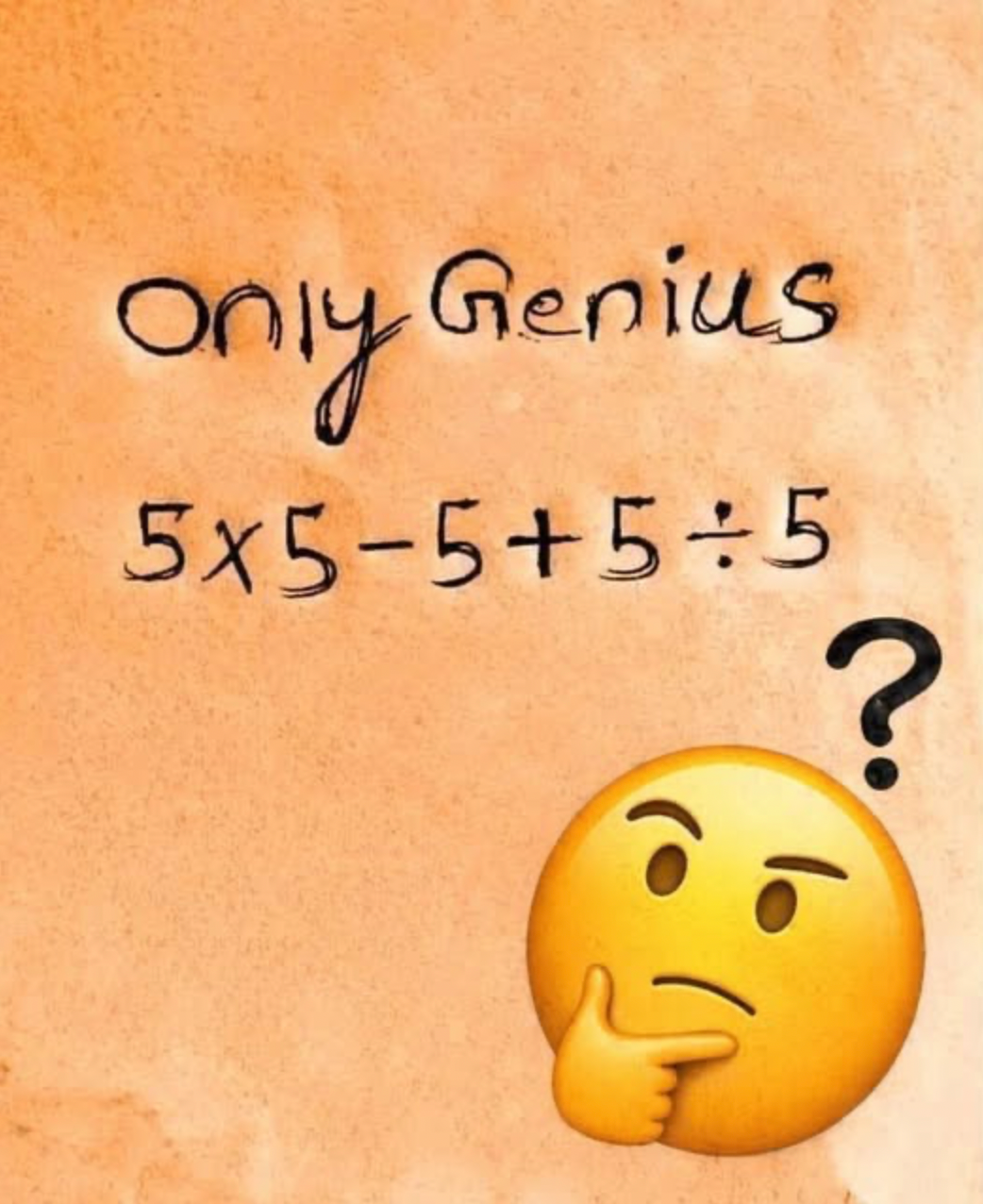
The internet is filled with puzzles that promise to reveal whether you’re a genius, a mathematical wizard, or someone with an exceptionally sharp mind. Among the most popular are short arithmetic challenges that appear incredibly simple at first glance but somehow manage to confuse millions of people. These puzzles spread rapidly across social media platforms because they encourage people to answer quickly, compare results with friends, and debate the “correct” solution in the comments.
One such puzzle has captured the attention of countless internet users:
5 × 5 − 5 + 5 ÷ 5 = ?
At first glance, it seems like elementary school mathematics. The numbers are small, there are only four operations, and most people feel confident they can solve it in just a few seconds. Yet the comment sections under these puzzles often explode with disagreement. Some people confidently answer 5, others insist the correct answer is 21, while a few arrive at entirely different numbers.
So why does such a simple-looking equation create so much confusion?
The answer lies not in advanced mathematics but in the way our brains process information. Psychologists often describe two different styles of thinking: one that is quick and automatic, and another that is slower and more analytical. Viral math puzzles are carefully designed to encourage the first style while punishing anyone who ignores the second.
Rather than testing intelligence, these puzzles usually test whether you remember one of the most fundamental principles of arithmetic: the order of operations.
Let’s examine why so many people fall into the trap and how to solve the puzzle correctly every single time.
Why These Puzzles Go Viral
Mathematical brain teasers spread quickly online because they satisfy several psychological triggers.
People enjoy them because they:
- Look deceptively easy.
- Can be solved in under a minute.
- Encourage friendly competition.
- Spark debates in comment sections.
- Give people a sense of accomplishment.
- Make surprising mistakes feel memorable.
Many viral creators intentionally choose equations that tempt readers into making predictable errors.
Fast Thinking vs. Slow Thinking
Psychologists often describe two general approaches to thinking.
Although these systems work together continuously, they operate differently.
Fast Thinking
Fast thinking is:
- Automatic
- Intuitive
- Quick
- Efficient
- Habit-based
It helps us:
- Read familiar words
- Recognize faces
- Drive familiar routes
- Make rapid decisions
Most of the time, fast thinking serves us extremely well.
However, it can sometimes lead us to overlook important details.
Slow Thinking
Slow thinking is:
- Deliberate
- Analytical
- Careful
- Logical
- Methodical
We use it when:
- Solving math problems
- Planning finances
- Learning new skills
- Evaluating evidence
- Making complex decisions
Unlike fast thinking, slow thinking requires conscious effort.
Why the Puzzle Tricks So Many People
Consider this equation:
5 × 5 − 5 + 5 ÷ 5
Many people instinctively begin reading it exactly as they would read a sentence:
From left to right.
That leads to this sequence:
5 × 5 = 25
25 − 5 = 20
20 + 5 = 25
25 ÷ 5 = 5
Final answer:
5
It feels perfectly reasonable.
Unfortunately, it ignores one of the most important rules in arithmetic.
The Order of Operations
Mathematics follows internationally accepted rules that determine which operations are performed first.
Without these rules, the same equation could produce many different answers.
The standard order is often remembered using acronyms such as:
- PEMDAS
- BODMAS
- BIDMAS
Although the acronyms differ slightly around the world, they all express the same idea.
The general order is:
- Parentheses (or Brackets)
- Exponents (Orders or Indices)
- Multiplication and Division (from left to right)
- Addition and Subtraction (from left to right)
The crucial point is that multiplication and division have equal priority, while addition and subtraction also share equal priority.
Solving the Puzzle Correctly
Let’s solve it carefully.
The equation is:
5 × 5 − 5 + 5 ÷ 5
Step 1:
Perform multiplication.
5 × 5 = 25
Now the equation becomes:
25 − 5 + 5 ÷ 5
Step 2:
Perform division.
5 ÷ 5 = 1
Now the equation becomes:
25 − 5 + 1
Step 3:
Work from left to right.
25 − 5 = 20
20 + 1 = 21
Final answer:
21
This is the correct solution according to the standard order of operations.
Why Reading Left to Right Doesn’t Work
Reading from left to right works well for language.
It does not work for mathematical operations.
Mathematics is a structured language with its own grammar.
Ignoring that grammar changes the meaning of the equation.
Why So Many Different Answers Appear
Online comment sections often contain answers like:
- 5
- 21
- 1
- 25
- 20
Most incorrect answers result from:
- Ignoring multiplication precedence
- Forgetting division precedence
- Misreading the equation
- Performing operations in the wrong order
Very few incorrect answers are due to difficult mathematics.
Does Solving It Quickly Mean You’re a Genius?
Not necessarily.
Headlines often claim:
“Only geniuses can solve this.”
“Only 1% get it right.”
“Only people with IQs above 140 succeed.”
There is usually no scientific evidence supporting these claims.
Success depends largely on:
- Remembering arithmetic rules
- Reading carefully
- Avoiding impulsive answers
Someone who recently studied basic algebra may solve it faster than someone with years of professional experience who simply answered too quickly.
The Psychology Behind the Trap
The puzzle creates what psychologists call a cognitive shortcut.
Your brain notices familiar numbers.
It assumes:
“I know how this works.”
Then it rushes toward an answer.
Only after slowing down do many people realize they skipped an important rule.
This is exactly why the puzzle is entertaining.
Why Schools Teach the Order of Operations
Imagine three students solving the same equation.
Without agreed rules, one student might answer:
5
Another:
21
Another:
25
All would believe they were correct.
Mathematics avoids this confusion by establishing universal conventions.
These conventions allow scientists, engineers, accountants, programmers, architects, and students worldwide to communicate using the same mathematical language.
Real-Life Importance
The order of operations is not just a classroom exercise.
It appears in:
- Engineering calculations
- Financial planning
- Computer programming
- Scientific research
- Architecture
- Physics
- Chemistry
- Statistics
Small mistakes in calculation can produce very different outcomes.
Developing the habit of working carefully is valuable far beyond school mathematics.
Common Mistakes
Mistake 1
Reading strictly left to right.
Mistake 2
Forgetting division before addition.
Mistake 3
Treating multiplication as optional.
Mistake 4
Rushing because the equation looks easy.
Mistake 5
Assuming viral puzzles use unusual rules.
Most legitimate puzzles simply rely on standard arithmetic.
Tips for Solving Similar Puzzles
Whenever you encounter a viral math puzzle:
- Read the entire equation first.
- Look for parentheses.
- Identify multiplication and division.
- Perform operations in the correct order.
- Only then complete addition and subtraction.
- Double-check your work.
Taking just a few extra seconds often prevents mistakes.
Frequently Asked Questions
Is the correct answer really 21?
Yes. According to the standard order of operations, multiplication and division are completed before addition and subtraction, giving a final answer of 21.
Why do some people insist the answer is 5?
They usually evaluate the expression from left to right without following the order of operations.
Does getting it wrong mean I’m bad at math?
Not at all. These puzzles are designed to encourage quick, intuitive responses. Many people simply answer before slowing down to apply the arithmetic rules.
Why do social media puzzles often cause arguments?
Many people confidently use different solving methods, while misleading headlines encourage debate to increase engagement and comments.
Are these puzzles good for the brain?
They can be enjoyable mental exercises that encourage careful reading, logical thinking, and attention to detail. However, they are not scientific measures of intelligence or IQ.

Welcome to my kitchen!
I’m a passionate home cook and recipe creator who loves turning simple ingredients into delicious, comforting meals that everyone can enjoy. Through this website, I share carefully prepared recipes, practical cooking tips, and easy-to-understand food education to help you feel more confident in the kitchen.
My goal is to make cooking simple, enjoyable, and accessible. Whether you are looking for a quick family dinner, a delicious dessert, healthy meal ideas, or traditional recipes with a modern touch, you’ll find inspiration here.
More Than Just Recipes
I believe that cooking is also a way to learn. That’s why this website is not only about recipes. I also create educational articles about ingredients, cooking techniques, kitchen tips, food preparation, and the stories behind different dishes.
Each article is designed to give you useful knowledge that you can apply in your own kitchen. From understanding how ingredients work together to learning better cooking methods, my aim is to help you become a more confident and creative cook.
My Philosophy
Good food doesn’t always require complicated ingredients or professional equipment. With a little knowledge, patience, and creativity, simple ingredients can become something truly special.
I believe in sharing recipes that are practical, clearly explained, and enjoyable to make. I also love exploring new flavors while appreciating traditional cooking and the recipes passed down through generations.
Thank you for visiting my kitchen and being part of this food-loving community. I hope my recipes and articles inspire you to cook, learn, experiment, and most importantly, enjoy every bite!
Happy cooking!