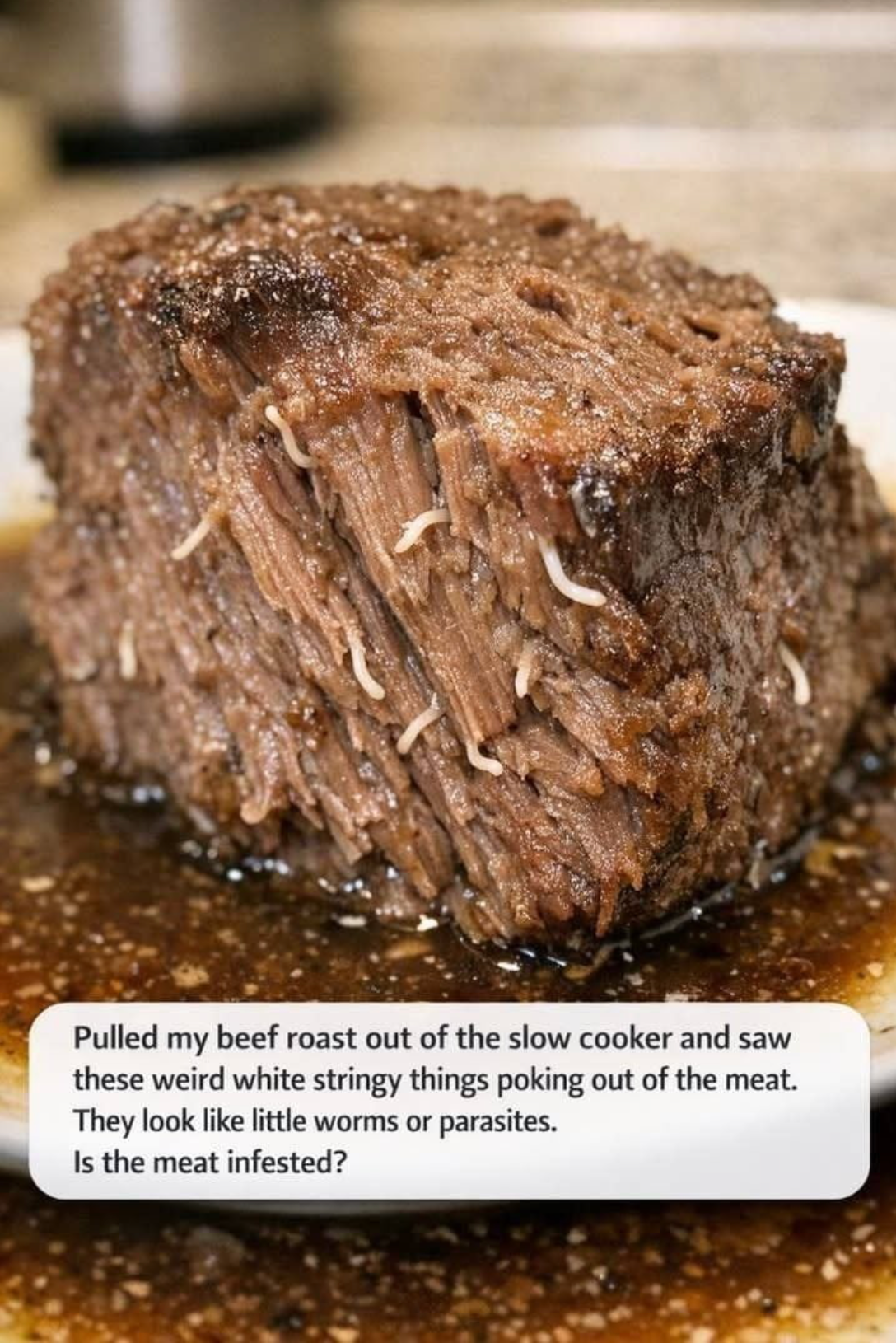
If you’ve ever opened a slow cooker and pulled out a perfectly cooked beef roast only to see strange white, stringy, worm-like fibers poking out of the meat, your reaction is completely normal. It can look alarming at first glance, especially because the shape and color can remind people of parasites or something unsafe.
But here is the important truth right away:
In almost all home-cooked beef roasts, especially slow-cooked ones, these white stringy structures are NOT parasites, NOT worms, and NOT contamination.
Instead, they are part of the natural structure of meat that becomes more visible after long, slow cooking.
Let’s go very deep into what is actually happening inside your roast.
1. What You Are Actually Seeing Inside the Meat
Beef is not a smooth, uniform material. It is made of several internal components that hold muscle together and give it structure:
Main components inside beef:
- Muscle fibers (the main structure of meat)
- Collagen (connective tissue that holds fibers together)
- Elastin (stretchy connective tissue)
- Fat layers and micro fat deposits
When meat is raw, all of this is tightly packed together, so you don’t notice individual parts.
But slow cooking completely changes that structure.
2. What Slow Cooking Does to Beef
A slow cooker uses low temperature over a long time. This is very important because it does not just “cook” meat—it transforms it.
Inside the slow cooker, three major processes happen:
A. Collagen breaks down into gelatin
Collagen is the tough, white connective tissue that holds muscle together.
When heated slowly:
- It dissolves gradually
- It turns into soft gelatin
- It lubricates the meat, making it tender
But during this breakdown process, collagen doesn’t just disappear instantly—it often becomes visible first as thin, white, string-like strands.
This is one of the main reasons you see “worm-like” fibers.
B. Muscle fibers separate and shred naturally
Beef muscle is made of long fibers bundled tightly together.
Slow cooking causes:
- Fibers to loosen
- Bundles to break apart
- The roast to fall apart easily
As they separate, they can look like:
- White threads
- Stringy strands
- Thin, irregular lines sticking out of the meat
This is especially visible when you pull the roast apart with forks.
C. Fat renders and shifts inside the meat
Beef contains small layers of fat between muscle fibers.
During cooking:
- Fat melts slowly
- It spreads through the meat
- It sometimes leaves behind pale streaks or soft white lines
These can mix with collagen strands, making the “stringy” appearance even more noticeable.
3. Why It Looks Like Worms or Parasites
The human brain is very sensitive to shape patterns.
So when you see:
- Thin white strands
- Curved or stretched fibers
- Movement-like shapes when the meat is pulled apart
Your brain may interpret it as something “alive” or “foreign.”
But in reality:
These structures do not move, do not grow, and are fully part of the cooked meat itself.
Parasites would not appear suddenly only after cooking and would not form consistent fiber-like structures embedded throughout the roast.
4. Why This Happens More in Slow Cookers Specifically
This is very important: you are much more likely to see this in a slow cooker than in other cooking methods.
That’s because slow cookers:
- Use low heat (not high searing temperatures)
- Cook for many hours (6–10+ hours)
- Focus on breaking down tough cuts of meat
Cuts commonly used for slow cooking, like:
- Chuck roast
- Brisket
- Shoulder roast
contain a LOT of connective tissue. That is exactly what makes them perfect for slow cooking—but also what creates these visible strands.
5. The Key Idea: Tough Meat Becomes Soft by Breaking Down Structure
This is the most important concept:
The “weird white strings” are literally the structure of the meat breaking down into something edible.
Before cooking:
- Tough
- Tight
- Connected
After cooking:
- Soft
- Separated
- Stringy or shredded
So what looks strange is actually the process of transformation.
6. What It Means for Safety
Let’s be very clear:
This is SAFE if:
- The meat was fresh before cooking
- It smells normal (savory, roasted, not sour or rotten)
- It reached proper cooking time and heat
- There is no sliminess or mold before cooking
This is NOT safe if:
- It smelled bad before cooking
- It had a slimy texture before cooking
- It shows signs of spoilage (green/gray discoloration, mold, foul odor)
But the white stringy appearance alone is NOT a safety issue.
7. Why Slow Cooked Beef Is Supposed to Look Like This
Ironically, what you are seeing is actually a sign of successful slow cooking.
Good slow-cooked beef should:
- Fall apart easily
- Shred into fibers
- Look stringy when pulled
- Be very tender
If it stayed solid and firm, that would actually mean it was undercooked or not properly broken down.
8. How to Make It Look Less “Stringy” (If You Prefer)
If the appearance bothers you, there are ways to reduce how visible the fibers look:
Choose different cuts
- Leaner cuts = less connective tissue
- Ribeye-style roasts = more uniform texture
Cook slightly shorter
- Less time = less fiber breakdown
Slice instead of shred
- Cutting against the grain keeps structure intact
Trim connective tissue before cooking
- Reduces visible strands later
But keep in mind: tenderness and shredding naturally go together in slow cooking.
9. The Simple Truth
What you saw is not:
- ❌ worms
- ❌ parasites
- ❌ contamination
- ❌ anything harmful
It is:
- ✔ collagen breaking down
- ✔ muscle fibers separating
- ✔ fat melting and redistributing
- ✔ normal slow-cooking transformation
Final Summary
When beef roast comes out of a slow cooker with white stringy fibers, it can look strange—but it is simply the natural breakdown of meat structure during slow cooking.
It is one of those moments where appearance is misleading. What looks alarming is actually exactly what makes the meat tender, juicy, and easy to eat.

Welcome to my kitchen!
I’m a passionate home cook and recipe creator who loves turning simple ingredients into delicious, comforting meals that everyone can enjoy. Through this website, I share carefully prepared recipes, practical cooking tips, and easy-to-understand food education to help you feel more confident in the kitchen.
My goal is to make cooking simple, enjoyable, and accessible. Whether you are looking for a quick family dinner, a delicious dessert, healthy meal ideas, or traditional recipes with a modern touch, you’ll find inspiration here.
More Than Just Recipes
I believe that cooking is also a way to learn. That’s why this website is not only about recipes. I also create educational articles about ingredients, cooking techniques, kitchen tips, food preparation, and the stories behind different dishes.
Each article is designed to give you useful knowledge that you can apply in your own kitchen. From understanding how ingredients work together to learning better cooking methods, my aim is to help you become a more confident and creative cook.
My Philosophy
Good food doesn’t always require complicated ingredients or professional equipment. With a little knowledge, patience, and creativity, simple ingredients can become something truly special.
I believe in sharing recipes that are practical, clearly explained, and enjoyable to make. I also love exploring new flavors while appreciating traditional cooking and the recipes passed down through generations.
Thank you for visiting my kitchen and being part of this food-loving community. I hope my recipes and articles inspire you to cook, learn, experiment, and most importantly, enjoy every bite!
Happy cooking!