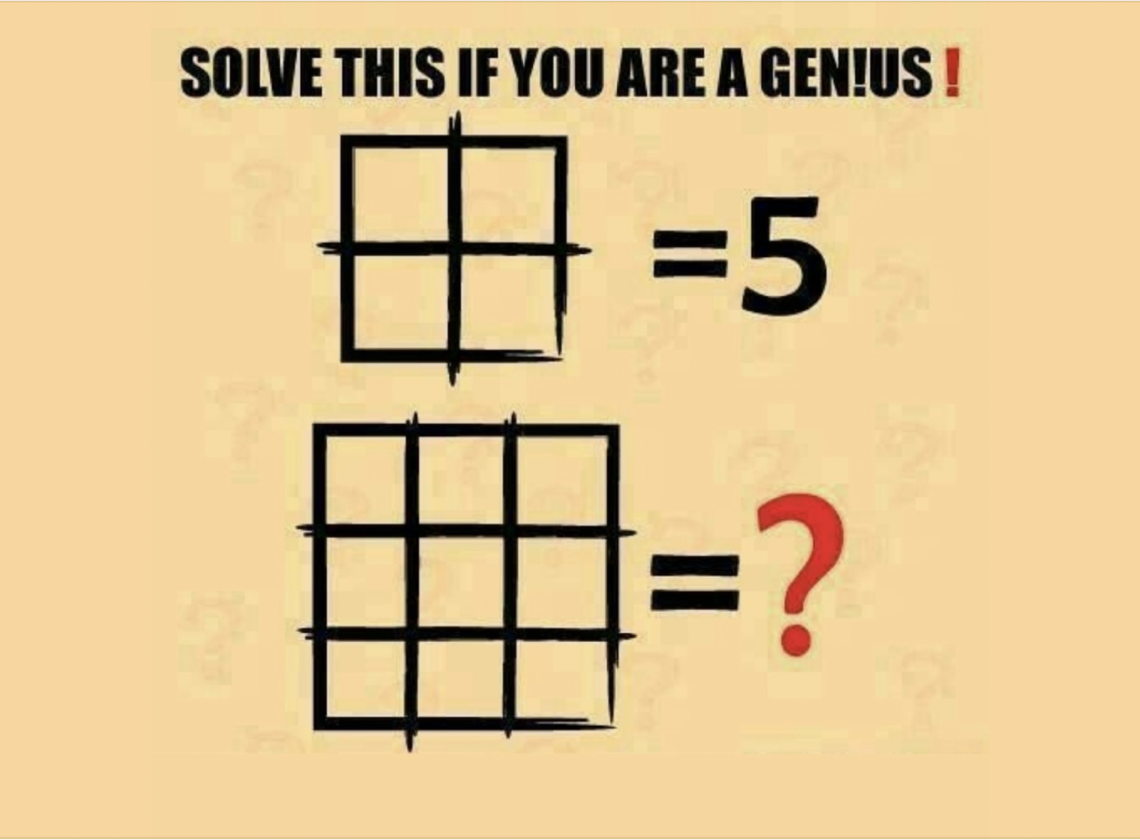
At first glance, this type of puzzle looks extremely simple: you are shown a grid made of smaller squares, and you are asked a seemingly easy question—how many squares are there in total?
Most people immediately start counting the smallest visible squares and quickly arrive at an answer like 16 or 25, depending on the grid size. But then comes the twist: that answer is wrong.
The real challenge is that the puzzle is not asking you to count only the small squares. It is asking you to count all possible squares of every size, including hidden ones formed by combining smaller units.
This is where most people get confused, and why the correct answer often surprises everyone.
Why People Get the Wrong Answer
The most common mistake is assuming the puzzle is only about 1×1 squares (the smallest visible units).
For example, in a 4×4 grid:
- People count 16 small squares
- They stop there
- They miss larger squares completely
This happens because our brain naturally focuses on what is visually obvious instead of what is mathematically possible.
But in reality, a grid contains multiple layers of square structures.
Understanding What You Must Count
To solve the puzzle correctly, you must count every square formed in the grid, including:
- 1×1 squares (smallest units)
- 2×2 squares
- 3×3 squares
- 4×4 squares (the whole grid itself)
Each size contributes additional squares that are easy to miss if you are not systematic.
Step-by-Step Method (The Correct Way)
Let’s use a standard 4×4 grid as the example where many people say the answer is 16 or 30.
Step 1: Count 1×1 squares
A 4×4 grid has:
- 4 rows × 4 columns = 16 small squares
So:
1×1 squares = 16
Step 2: Count 2×2 squares
Now look for squares made of 4 small squares grouped together.
In a 4×4 grid:
- You can slide a 2×2 block across rows and columns
- There are 3 positions horizontally and 3 vertically
So:
3 × 3 = 9
2×2 squares = 9
Step 3: Count 3×3 squares
Now we count larger blocks made of 9 small squares.
In a 4×4 grid:
- A 3×3 square can only fit in 2 positions horizontally
- And 2 positions vertically
So:
2 × 2 = 4
3×3 squares = 4
Step 4: Count the 4×4 square
There is only one full square that covers the entire grid.
4×4 squares = 1
Final Calculation
Now add everything together:
- 1×1 squares = 16
- 2×2 squares = 9
- 3×3 squares = 4
- 4×4 squares = 1
Total:
16 + 9 + 4 + 1 = 30 squares
Why Some People Say 40+ Squares
In some versions of the puzzle, the grid is more complex or includes:
- Subdivided patterns
- Overlapping grids
- Diagonal or hidden square formations
In those cases, the total number of squares increases beyond 30.
For example:
- 5×5 grids
- Grids with internal markings
- Puzzle overlays
This is why the answer is sometimes 30, 40, or even more, depending on the structure.
The General Formula (Important Insight)
For any square grid of size n×n, the total number of squares is:
1² + 2² + 3² + … + n²
For a 4×4 grid:
1² + 2² + 3² + 4²
= 1 + 4 + 9 + 16
= 30
This formula explains everything clearly and avoids confusion.
Why This Puzzle Tricks So Many People
This puzzle is designed to test:
- Observation skills
- Logical thinking
- Pattern recognition
- Attention to detail
Most people fail because they:
- Only see the smallest units
- Do not consider combinations
- Stop too early in counting
It is a classic example of how visual puzzles can mislead intuition.
Mental Shortcut to Solve Faster
Instead of counting manually, you can:
- Identify grid size (n×n)
- Square each level (1², 2², 3²…)
- Add them together
This guarantees the correct answer every time.
Real-Life Importance of This Logic
This type of thinking is not just for puzzles. It is used in:
- Computer graphics (pixel grids)
- Engineering design
- Architecture planning
- Data modeling
- Game development
Understanding layered structures helps in solving complex real-world problems.
Welcome to my kitchen!
I’m a passionate home cook and recipe creator who loves turning simple ingredients into delicious, comforting meals that everyone can enjoy. Through this website, I share carefully prepared recipes, practical cooking tips, and easy-to-understand food education to help you feel more confident in the kitchen.
My goal is to make cooking simple, enjoyable, and accessible. Whether you are looking for a quick family dinner, a delicious dessert, healthy meal ideas, or traditional recipes with a modern touch, you’ll find inspiration here.
More Than Just Recipes
I believe that cooking is also a way to learn. That’s why this website is not only about recipes. I also create educational articles about ingredients, cooking techniques, kitchen tips, food preparation, and the stories behind different dishes.
Each article is designed to give you useful knowledge that you can apply in your own kitchen. From understanding how ingredients work together to learning better cooking methods, my aim is to help you become a more confident and creative cook.
My Philosophy
Good food doesn’t always require complicated ingredients or professional equipment. With a little knowledge, patience, and creativity, simple ingredients can become something truly special.
I believe in sharing recipes that are practical, clearly explained, and enjoyable to make. I also love exploring new flavors while appreciating traditional cooking and the recipes passed down through generations.
Thank you for visiting my kitchen and being part of this food-loving community. I hope my recipes and articles inspire you to cook, learn, experiment, and most importantly, enjoy every bite!
Happy cooking!