Eggs are one of the most useful ingredients in the kitchen. They can become breakfast, cakes, cookies, sauces, casseroles, sandwiches, and countless other dishes.
But there is one question almost every home cook eventually asks:
“Is this egg still good?”
Sometimes an egg has been sitting in the refrigerator longer than expected. Perhaps the carton has lost its label, you aren’t sure when you bought it, or you’re simply wondering whether an egg that looks perfectly normal on the outside is still safe to use.
Fortunately, there are several practical ways to assess an egg.
Some methods help you understand how old an egg is, while others can help you identify obvious signs of spoilage.
It’s important to understand the difference: a freshness test is not the same thing as a food-safety test.
When in doubt, the safest choice is to discard an egg rather than risk eating a spoiled or improperly stored one.
1. Check the Date and Storage History First
Before performing any kitchen trick, start with the simplest information available: the carton and the way the eggs have been stored.
Look for the date printed on the package and consider how long the eggs have been refrigerated.
Dates on egg cartons can have different meanings depending on where you live and the labeling system being used. A date approaching or passing does not automatically prove that an egg is rotten.
Storage conditions matter, too.
Eggs that have been consistently refrigerated are very different from eggs that have been left at room temperature for an extended period.
The most important questions are:
- Have the eggs been kept refrigerated?
- Has the shell been cracked?
- Has the egg been exposed to unusual temperatures?
- Is the carton still intact?
- Is there any visible contamination?
- How long has the egg been stored?
If you are uncertain about the storage history, don’t rely solely on a freshness trick.
2. Try the Water Test — But Understand What It Actually Tells You
The famous water test is one of the oldest household methods for estimating egg freshness.
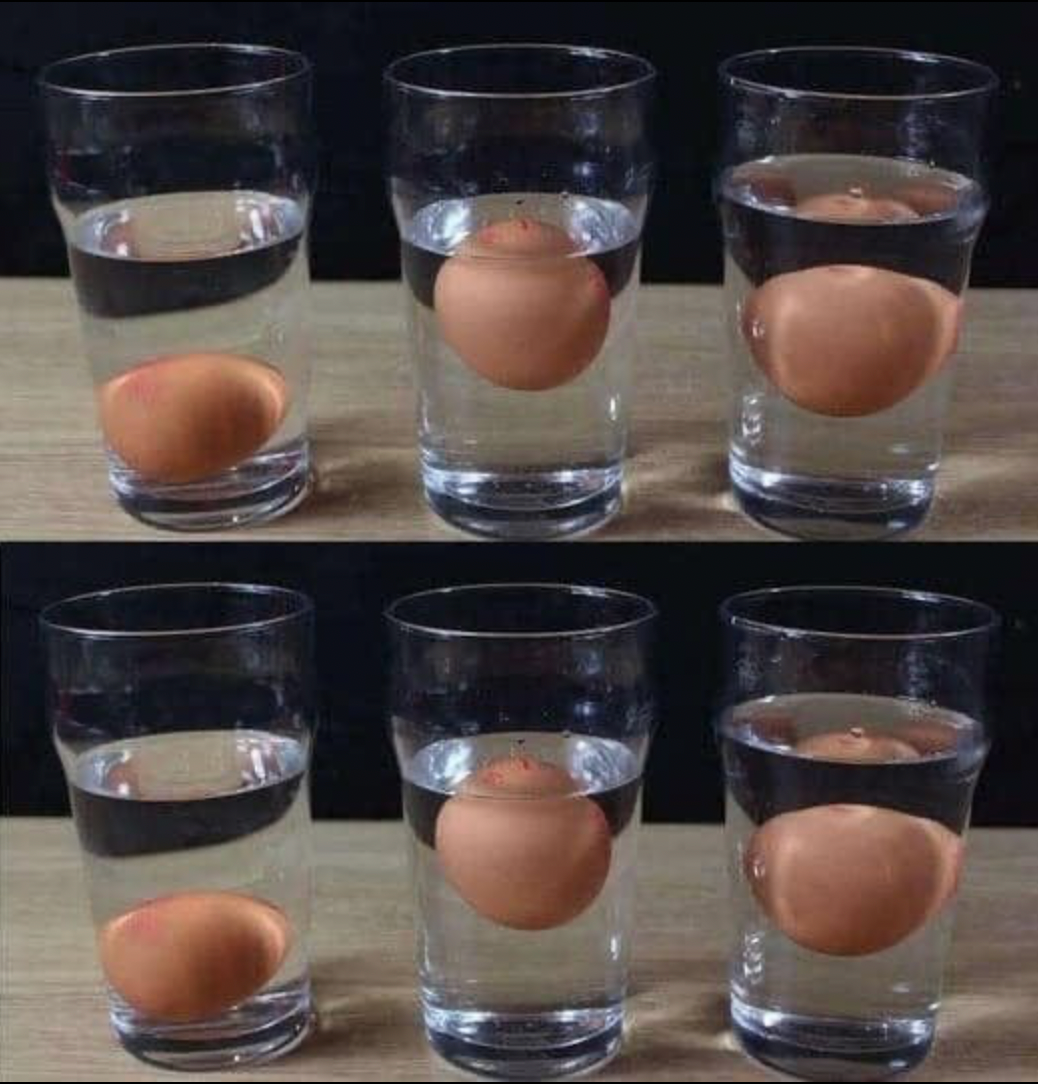
Place the egg gently into a bowl or glass of cool water.
An egg that lies flat on the bottom is generally fresher.
An egg that stands upright on the bottom is older.
An egg that floats is considerably older.
But here’s the important part:
The water test primarily tells you about the age of an egg, not whether it is definitely safe to eat.
Why does this happen?
Eggshells contain tiny pores.
Over time, moisture and gases gradually move through those pores, and the air space inside the egg becomes larger.
As that internal air pocket increases, the egg becomes more buoyant.
That’s why older eggs tend to stand upright or float.
So the water test is interesting and useful as a rough freshness indicator, but it shouldn’t be treated as a guarantee of safety.
3. Crack the Egg Into a Separate Bowl
This is one of the most useful habits when you’re uncertain about an egg.
Instead of cracking a questionable egg directly into a bowl containing several other ingredients, crack it into a small separate container first.
Then inspect it.
Look for anything unusual about the egg’s appearance.
A fresh egg typically has a distinct yolk surrounded by egg white.
As eggs age, the white can become thinner and the yolk may become flatter or easier to break.
That’s not necessarily evidence of spoilage.
It’s often simply a sign that the egg is older.
However, if you see something that looks genuinely abnormal, don’t take chances.
Separating the egg before adding it to your recipe prevents one questionable egg from contaminating an entire bowl of ingredients.
4. Use Your Nose — But Don’t Taste It
One of the clearest signs of a spoiled egg is an unpleasant odor.
If an egg smells strongly sulfurous, rotten, or otherwise abnormal after being cracked open, discard it.
You don’t need to taste it to find out whether it’s bad.
In fact, never taste an egg simply to determine whether it has spoiled.
Your sense of smell is enough to identify an obvious rotten-egg odor.
The characteristic smell associated with spoiled eggs comes from compounds produced as the egg’s components break down.
A fresh egg should not have a powerful rotten smell.
If you crack one open and immediately think, “Something is seriously wrong with this,” trust that warning.
Dispose of it.
5. Examine the Shell Before You Crack It
Sometimes the first warning sign is visible before the egg even reaches the bowl.
Look carefully at the shell.
A normal shell can have small variations in color, texture, and shape.
However, avoid using eggs with shells that are:
- Cracked
- Leaking
- Severely damaged
- Covered with unusual contamination
A cracked shell can provide an opportunity for bacteria to enter the egg.
If an egg has been cracked for an unknown amount of time, it is safer not to use it.
It’s also a good idea to wash your hands after handling raw eggs and to clean surfaces that have come into contact with them.
Fresh Doesn’t Always Mean Safe
This distinction is worth emphasizing.
An egg can be relatively fresh and still carry harmful bacteria.
Likewise, an older egg isn’t automatically rotten.
That’s why you shouldn’t depend on one trick alone.
The water test, appearance, smell, shell condition, and storage history all provide different pieces of information.
Food safety depends heavily on proper refrigeration, handling, and cooking.
What About a Slightly Cloudy Egg White?
Don’t panic if you crack open an egg and notice that the white looks somewhat cloudy.
A cloudy egg white can actually be associated with a very fresh egg.
The cloudiness is related to carbon dioxide that remains dissolved in the egg white.
As the egg ages, that gas gradually escapes and the white becomes clearer and thinner.
So cloudiness by itself isn’t a sign that an egg has spoiled.
What About a Blood Spot?
You may occasionally crack open an egg and see a tiny red or brown spot.
This can look alarming, but a small blood spot does not automatically mean the egg is spoiled.
These spots can occur when a small blood vessel breaks during the formation of the egg.
They are generally considered a normal occurrence.
If the egg otherwise looks and smells normal and has been properly stored, a small blood spot isn’t the same thing as spoilage.
What About a Green Ring Around a Hard-Boiled Yolk?
A greenish ring around the yolk of a hard-boiled egg can sometimes appear.
This is generally caused by a reaction involving sulfur and iron when the egg is cooked for too long or at an excessively high temperature.
It may affect appearance, but it doesn’t necessarily mean the egg has spoiled.
The best way to avoid the ring is to cook eggs appropriately and cool them promptly after cooking.
The Safest Way to Handle Eggs
Good kitchen habits make a big difference.
Keep eggs refrigerated according to local food-safety guidance.
Store them in their original carton when practical.
The carton provides protection and helps you keep track of dates.
Avoid leaving raw eggs sitting out unnecessarily.
Wash your hands after handling raw eggs.
Clean countertops, utensils, and cutting boards that come into contact with raw egg.
And don’t use the same utensil for raw and cooked food without washing it first.
Don’t Wash Eggs Right Before Storage
In places where eggs are sold unwashed, washing them at home can remove the natural protective coating on the shell.
If eggs are sold refrigerated and already washed, follow the storage instructions appropriate for that product.
The important principle is consistency: store eggs according to the food-safety practices used where you live and follow the instructions on the package.
What Should You Do With an Egg You’re Unsure About?
If an egg has an unusual smell, a damaged shell, suspicious appearance, or uncertain storage history, the safest decision is simple:
Throw it away.
An egg is inexpensive compared with the potential consequences of eating spoiled or contaminated food.
There is no need to take a gamble just to save one ingredient.
When you’re uncertain, it’s better to lose an egg than lose a day feeling sick.
A Quick Five-Step Egg Check
If you want a simple routine, remember:
1. Check the carton
Look at the date and consider how the eggs have been stored.
2. Inspect the shell
Avoid eggs with cracks, leaks, or serious contamination.
3. Use the water test
A floating egg is generally older, but the test doesn’t prove that an egg is unsafe.
4. Crack it separately
Don’t immediately mix a questionable egg with your other ingredients.
5. Smell and inspect it
A strong rotten odor or clearly abnormal appearance means it’s time to discard it.
The Biggest Mistake to Avoid
The biggest mistake is assuming that one household test can guarantee food safety.
The water test is not a magical freshness detector.
A normal-looking egg can still contain harmful bacteria.
Likewise, an older egg may still be usable if it has been properly stored and handled.
That’s why freshness and safety should be considered separately.