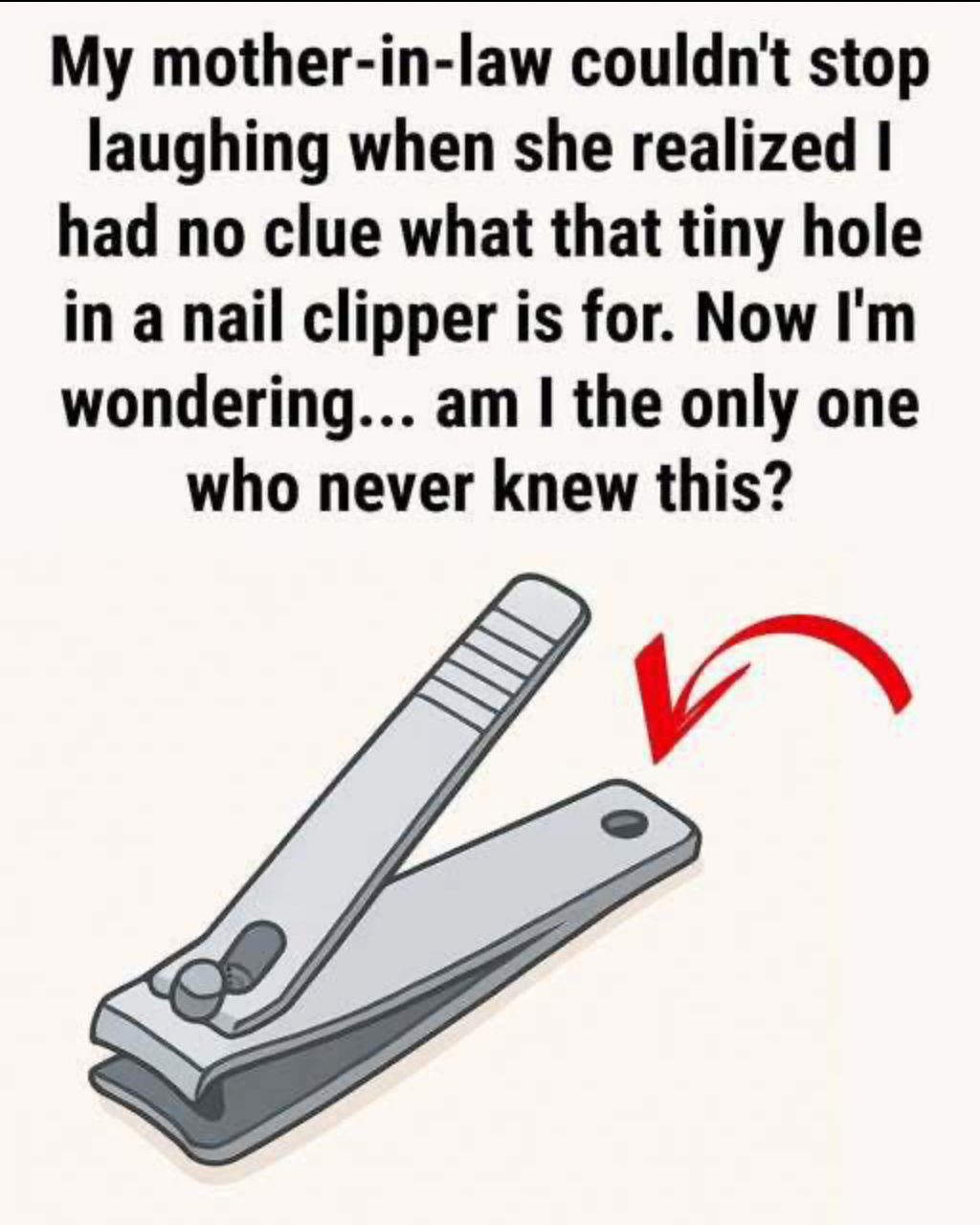
Most of us reach for a nail clipper without giving it a second thought. It rests quietly in a bathroom drawer, a travel pouch, or a bedside table, performing a simple task with quiet efficiency. Because it is such a familiar object, we rarely stop to examine its design. Yet embedded in its familiar metal form is a small, easily overlooked feature that many people notice but almost never question: the small round hole near the lever.
At first glance, this hole appears purely decorative or incidental, a minor detail with no obvious function. In reality, it is the result of careful, practical design—one that reflects both the history of the nail clipper and the thoughtful engineering behind everyday tools. Despite its simplicity, this tiny hole continues to serve important purposes even today.
A Design Rooted in Practical Engineering
The modern nail clipper evolved in the late 19th and early 20th centuries, when manufacturers sought to create grooming tools that were compact, durable, and easy to mass-produce. Every part of the clipper was designed with function in mind, and nothing was added without reason.
The small round hole near the lever is part of this philosophy. Its placement and size were carefully chosen to support multiple uses while preserving the clipper’s structural integrity. Rather than being an afterthought, the hole is an example of how efficient design can serve both manufacturing needs and everyday practicality.
A Simple Solution for Attachment and Portability
One of the most common and enduring purposes of the hole is attachment. The hole allows the nail clipper to be easily connected to keychains, rings, cords, or small chains. This made nail clippers far more portable, especially for travelers, soldiers, workers, and anyone who needed grooming tools on the go.
Even today, many people attach nail clippers to:
- Keychains
- Travel kits
- Emergency or hygiene kits
- Camping and outdoor gear
This small feature prevents the clipper from being lost and ensures it is always accessible when needed.
Improved Grip and Control During Use
Beyond portability, the hole also contributes subtly to usability. When trimming nails, especially thick or hard nails, control and stability matter. Some users instinctively place a finger through or near the hole while applying pressure, which can help improve grip and precision.
While not its primary function, this secondary benefit enhances the tool’s ergonomics without adding extra parts or complexity.
Manufacturing Efficiency and Material Savings
From a manufacturing standpoint, the hole serves another purpose: reducing material without sacrificing strength. Removing a small amount of metal lowers overall weight and cost while maintaining durability. Over millions of units, this small reduction adds up to significant savings in raw materials.
At the same time, the hole helps balance the clipper’s structure, distributing stress more evenly when pressure is applied. This contributes to the tool’s long lifespan, allowing it to withstand repeated use without bending or breaking.
Assistance in Assembly and Alignment
In the production process, the hole also plays a role in assembly and quality control. It can be used to:
- Align components during manufacturing
- Secure the clipper in place during polishing or finishing
- Assist with automated handling during mass production
These behind-the-scenes functions are invisible to users but essential to consistent quality.
A Legacy Feature That Endures
What makes the small round hole especially interesting is that it has survived decades of design changes. While nail clippers have evolved in size, shape, and finish, this feature remains largely unchanged. Its continued presence is a testament to its usefulness.
In an era where many products are redesigned frequently for aesthetics alone, the nail clipper’s hole represents a rare example of design that endures because it works.
A Reflection of Thoughtful Everyday Design
The small round hole in your nail clipper reminds us that even the most ordinary objects often carry layers of intention. It shows how good design is not always about adding more features, but about making simple tools do their job better.
Next time you pick up a nail clipper, that tiny hole may stand out a little more. It is a quiet detail, but one that tells a story of practicality, efficiency, and thoughtful engineering—proof that even the smallest design choices can have lasting value.