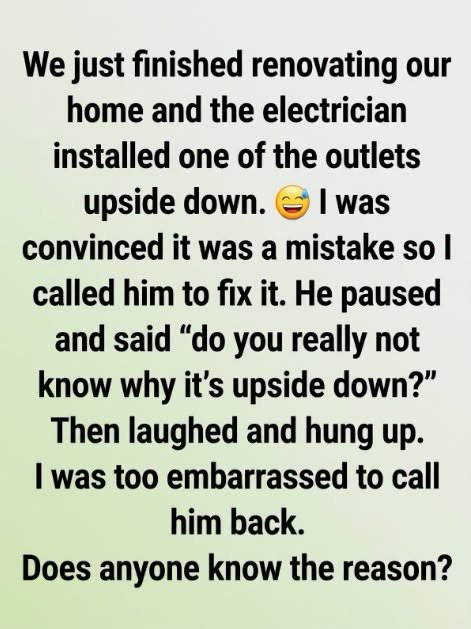
The Hidden Logic Behind Upside-Down Wall Outlets
Have you ever walked into a home, hotel room, office, or older building and noticed that one electrical outlet was installed upside down?
At first glance, it can look like an obvious mistake. After all, most wall outlets are installed in the same orientation, so seeing one rotated 180 degrees naturally makes you wonder whether the electrician simply installed it incorrectly.
But sometimes, there is a very practical reason.
An upside-down receptacle can be an intentional design choice, and in some installations it may provide a useful visual clue that the outlet is controlled by a nearby wall switch.
However, there is an important detail to understand: an upside-down outlet does not automatically mean that it is switched. Outlet orientation varies between electricians, homeowners, building practices, and local electrical requirements.
So what does that unusual orientation actually mean?
What Is a Switched Outlet?
A switched receptacle is an electrical outlet that is controlled, either completely or partially, by a wall switch.
Instead of plugging a lamp into the wall and turning the lamp on and off using its own switch, you can connect it to the switched outlet and control it from a nearby wall switch.
This arrangement can be especially useful for:
- Floor lamps
- Table lamps
- Holiday decorations
- Certain small appliances
- Decorative lighting
- Other devices that are intended to be switched from across the room
In many homes, especially those without dedicated ceiling lighting in a room, a switched receptacle provides a convenient way to control the primary light source.
Why Would an Outlet Be Installed Upside Down?
There is no universal rule that says an upside-down receptacle must be switched.
Nevertheless, some electricians and installers use orientation as a visual indication of a particular configuration.
For example, a receptacle may be installed with the grounding opening facing upward while standard nearby receptacles are installed in the opposite orientation.
In an installation where this convention is deliberately used, the unusual orientation can make it easier to identify the switched outlet at a glance.
Imagine walking into a dark room and trying to determine which outlet controls the lamp in the corner.
Rather than searching for tiny labels or remembering which receptacle is connected to the switch, the different orientation can serve as a simple visual clue.
It’s a small detail, but it can make the electrical layout easier to understand.
How to Tell Whether Your Outlet Is Controlled by a Switch
The easiest way to determine whether an outlet is switched is not to rely on its orientation.
Instead, look for a nearby wall switch and test the receptacle.
A simple method is:
Step 1: Find a Nearby Wall Switch
Look for a switch on the same wall or near the entrance to the room.
Step 2: Plug In a Lamp
Use a simple lamp or another suitable device that can clearly indicate whether power is present.
Step 3: Turn the Switch On and Off
Operate the wall switch and observe whether the lamp responds.
If the lamp turns on and off with the wall switch, that receptacle—or at least that portion of the receptacle—is switched.
Step 4: Check Both Plug Positions
Some duplex receptacles are wired so that only one half is controlled by the wall switch, while the other half remains powered continuously.
This is an especially important detail because you may plug something into one socket and see no response from the switch even though the other socket is switched.
A Switched Outlet Can Be Partially Controlled
One of the more interesting features of some receptacles is that only one outlet in the pair may be switched.
A typical duplex receptacle has two places where you can plug something in.
An electrician can configure the wiring so that:
- The upper receptacle is switched while the lower one remains continuously powered, or
- The lower receptacle is switched while the upper one remains continuously powered.
This allows homeowners to control a lamp with a wall switch while still having another outlet available for a device that needs continuous power.
Depending on the installation, the separation between the two receptacles involves the receptacle’s internal tab and the way the wiring is configured.
Because this involves electrical wiring, modifications should be performed by a qualified person familiar with the applicable electrical requirements.
Is an Upside-Down Outlet Safer?
This is where things become a little more complicated.
You may have heard that installing a receptacle with the grounding slot on top is safer because a falling metal object could theoretically contact the grounding pin first.
The idea is based on the design of a grounded electrical plug.
If a plug is only partially inserted and a conductive object falls across the exposed area, having the grounding contact positioned above the energized contacts may, in some circumstances, reduce the chance that the object will bridge the energized contacts.
However, this should not be presented as a universal safety requirement.
Electrical codes and professional practices vary by location, and there is not one universally required orientation for every ordinary receptacle.
The most important safety features are proper grounding, correct wiring, appropriate overcurrent protection, suitable receptacles, and compliance with the electrical requirements that apply to the installation.
In other words, orientation alone should not be treated as a guarantee of electrical safety.
Why Outlet Orientation Can Be Different From Room to Room
You may notice that some outlets in the same house face one direction while others face another.
There can be several explanations.
Different Electricians
Different electricians may have different installation preferences.
Different Construction Periods
A home that has undergone renovations may contain electrical work from different periods.
Switched Receptacles
An unusual orientation may be used as a visual distinction for a switched receptacle.
Special Equipment
Some installations may use a particular orientation because of the equipment or wiring arrangement.
Personal Preference
Some electricians or homeowners simply prefer one orientation over another.
Renovation or Replacement
An outlet may have been replaced without matching the orientation of the surrounding receptacles.
So while an upside-down outlet can have a purpose, you should not assume that every unusual outlet orientation has a hidden meaning.
What About Building Codes?
Electrical requirements vary considerably depending on where you live.
Local electrical codes may specify requirements for receptacle placement, grounding, tamper resistance, protection devices, accessibility, and other aspects of installation.
However, the physical orientation of a standard receptacle is not universally treated in the same way everywhere.
In some installations, electricians may use orientation as a convention to identify a switched receptacle. In others, the orientation may have no special significance at all.
This is why it is better to think of the upside-down outlet as a possible clue, rather than a universal electrical code.
If you are working on an electrical installation, always follow the applicable local requirements rather than relying on general advice found online.
Could an Upside-Down Outlet Simply Be an Installation Mistake?
Absolutely.
Sometimes an upside-down outlet really is just an upside-down outlet.
An electrician may have installed it differently from the surrounding receptacles without any special intention.
A previous homeowner may have replaced it.
A contractor may have used a different convention.
Or someone performing a repair may simply have rotated the receptacle during installation.
This is why orientation alone cannot tell you whether a receptacle is switched.
If you want to know why a particular outlet is installed that way, testing it or checking the electrical documentation is more reliable.
Why Some People Prefer the Grounding Pin on Top
The orientation debate has existed for years among electricians and homeowners.
One argument for ground-up installation is the theoretical safety advantage discussed earlier if a conductive object falls onto a partially inserted plug.
Another argument is that certain industrial or commercial installations may use a particular orientation as part of a consistent installation practice.
On the other hand, many residential installations use the opposite orientation, and properly installed receptacles can be safe in either configuration when the electrical system is correctly wired and protected.
The important lesson is that orientation is not the same thing as proper electrical safety.
What Should You Do If You Want to Rotate an Outlet?
If you simply prefer the appearance of an outlet in a different orientation, it may be physically possible to rotate the receptacle.
However, electrical work should not be treated like ordinary decorating.
A receptacle is connected to energized electrical wiring, and incorrect handling can result in electric shock, short circuits, equipment damage, or fire.
If you are not qualified to work on electrical systems, the safest approach is to have a licensed or otherwise appropriately qualified electrician inspect and modify the installation.
Even if the change appears simple, the electrician can also determine whether the receptacle is switched, partially switched, properly grounded, and compliant with local requirements.
A Simple Way to Investigate Your Own Outlet
If you’re curious about an unusual outlet in your home, you don’t necessarily need to remove the wall plate or touch the wiring.
Start with observation.
Look for:
A nearby wall switch:
Is there a switch positioned close to the receptacle?
An unusual orientation:
Does this outlet face a different direction from the others?
A lamp or simple device:
Can you safely plug in a lamp and determine whether the wall switch controls it?
A partially switched receptacle:
Does only one of the two sockets respond to the switch?
These simple observations can often tell you much more than the physical orientation alone.
If you need to inspect the wiring, however, leave that job to a qualified professional.
What Does It Mean If Only One Outlet Responds to the Switch?
This is a common source of confusion.
You may plug a lamp into the upper socket, flip the wall switch, and discover nothing happens.
That doesn’t necessarily mean the outlet isn’t switched.
Try the other socket.
Some duplex receptacles are configured so that one half is controlled by the wall switch while the other remains permanently energized.
This arrangement is useful because it gives you both options in the same location.
For example, you could connect a floor lamp to the switched portion while using the always-on portion to charge a device or power another appliance.
Why This Small Detail Can Be So Useful
Electrical systems are usually designed to make everyday life easier, but many of their most useful features are hidden behind walls.
A switched receptacle is a good example.
Instead of walking across a room to operate a lamp manually, you can control it from a convenient wall switch.
This can be particularly useful in bedrooms, living rooms, family rooms, and other spaces where floor or table lamps are used as the primary source of lighting.
An unusual outlet orientation may sometimes provide a quick visual reminder of that arrangement.
It’s a small design decision with a practical purpose.
Frequently Asked Questions
Does an upside-down outlet mean it is controlled by a switch?
Not necessarily.
Some electricians use an upside-down orientation to identify switched receptacles, but there is no universal rule that every upside-down outlet is switched.
The best way to determine whether it is switched is to test it with a lamp and nearby wall switch.
Is an upside-down outlet dangerous?
No. The orientation itself does not make a properly installed receptacle inherently dangerous.
Electrical safety depends much more on correct wiring, grounding, protection, the condition of the receptacle, and compliance with applicable electrical requirements.
Is it safer to have the ground pin on top?
Some electricians favor the ground-up orientation because of a theoretical advantage if a conductive object falls onto a partially inserted plug.
However, receptacle orientation practices vary, and the orientation itself should not be considered a substitute for proper electrical installation and protection.
Can only half of an outlet be switched?
Yes.
A duplex receptacle can be configured so that one socket is controlled by a wall switch while the other remains continuously powered.
Why do some outlets in my house face different directions?
There can be several reasons, including switched-receptacle conventions, electrician preference, renovations, replacements, or simple installation differences.
Can I turn my outlet upside down myself?
If you are not qualified to perform electrical work, it is safer to have an electrician make the change.
Even a seemingly simple receptacle adjustment involves electrical wiring and should be performed in accordance with local requirements.
How can I tell if my outlet is switched?
Plug a lamp into the receptacle and operate nearby wall switches. If the lamp responds, you have identified a switched circuit or receptacle.
If only one socket responds, the receptacle may be partially switched.
The Hidden Logic Behind an Ordinary Outlet
The next time you notice a wall outlet installed upside down, don’t immediately assume that someone made a mistake.
It might be a deliberate installation choice.
It could be a switched receptacle. It could reflect an electrician’s preferred orientation. It could relate to a particular installation practice—or it could simply be an outlet that was installed differently from the others.
The interesting part is that something as ordinary as the direction of a wall outlet can sometimes reveal information about how a home’s electrical system was designed.
And if there is a nearby wall switch, there is a good chance that the unusual orientation is worth investigating.
A quick test with a lamp may reveal that what looked like an installation mistake is actually a small but useful piece of electrical design.
Sometimes the strangest-looking details in our homes have a practical reason behind them.

Welcome to my kitchen!
I’m a passionate home cook and recipe creator who loves turning simple ingredients into delicious, comforting meals that everyone can enjoy. Through this website, I share carefully prepared recipes, practical cooking tips, and easy-to-understand food education to help you feel more confident in the kitchen.
My goal is to make cooking simple, enjoyable, and accessible. Whether you are looking for a quick family dinner, a delicious dessert, healthy meal ideas, or traditional recipes with a modern touch, you’ll find inspiration here.
More Than Just Recipes
I believe that cooking is also a way to learn. That’s why this website is not only about recipes. I also create educational articles about ingredients, cooking techniques, kitchen tips, food preparation, and the stories behind different dishes.
Each article is designed to give you useful knowledge that you can apply in your own kitchen. From understanding how ingredients work together to learning better cooking methods, my aim is to help you become a more confident and creative cook.
My Philosophy
Good food doesn’t always require complicated ingredients or professional equipment. With a little knowledge, patience, and creativity, simple ingredients can become something truly special.
I believe in sharing recipes that are practical, clearly explained, and enjoyable to make. I also love exploring new flavors while appreciating traditional cooking and the recipes passed down through generations.
Thank you for visiting my kitchen and being part of this food-loving community. I hope my recipes and articles inspire you to cook, learn, experiment, and most importantly, enjoy every bite!
Happy cooking!