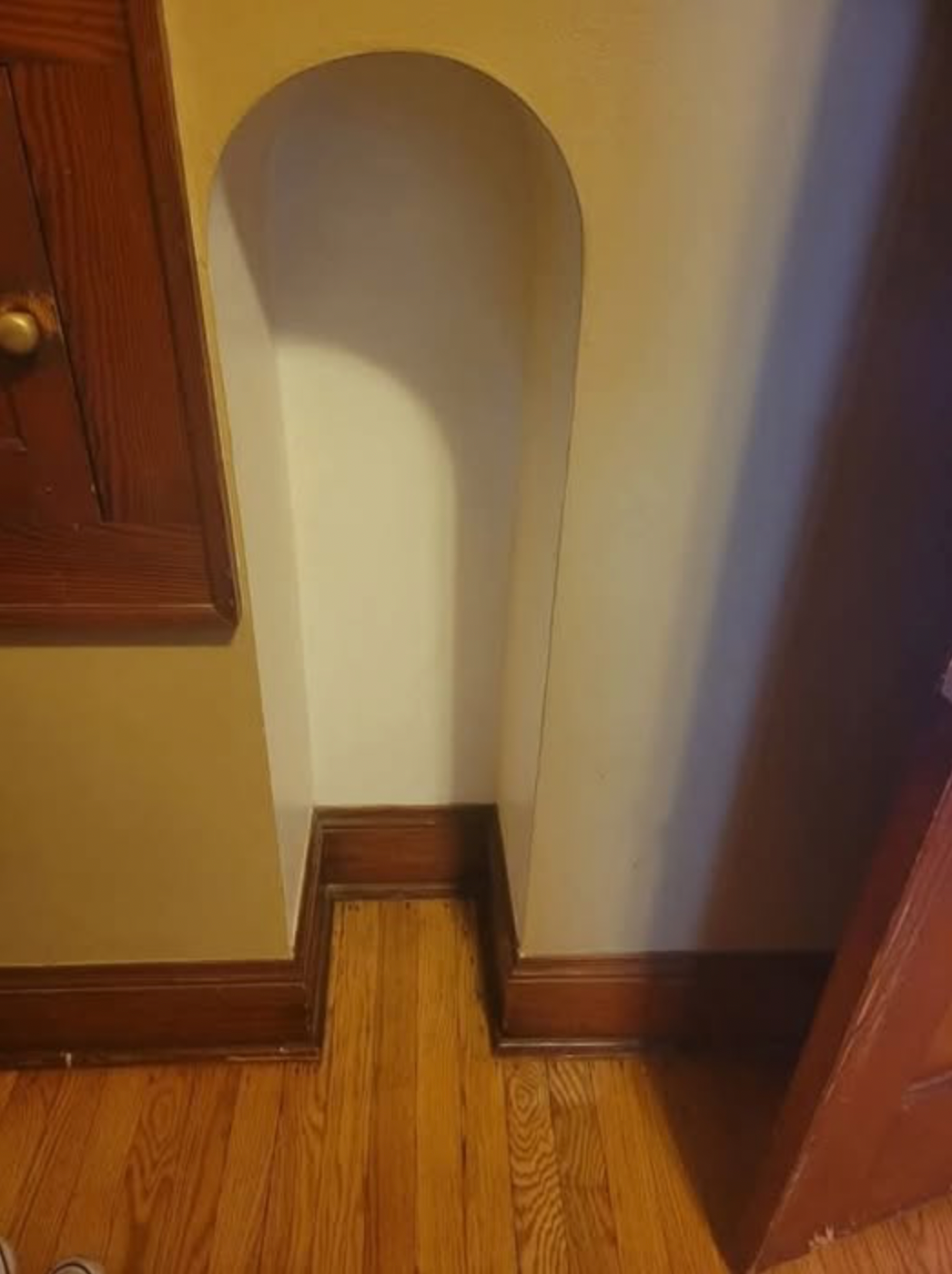
When I moved into my charming 1940s house a couple of years ago, I was immediately enchanted by its character. Hardwood floors that creaked just enough to remind you of their age, wide hallways that smelled faintly of cedar and old paint, and intricate crown molding that spoke to a level of craftsmanship rarely seen today. And then there was the nook.
A small, strange little nook tucked away in the hallway—a feature so subtle yet so peculiar that it seemed almost deliberate, as if the house itself had left me a tiny puzzle. The nook wasn’t very deep; in fact, it barely extended into the wall. Its shape was oddly triangular, tapering sharply toward the ceiling. At its highest point, it barely reached three feet, but somehow it dominated that section of the hallway, demanding attention without saying a word.
For the first five minutes, I just stood there, motionless, staring at it. I could feel the hallway shrinking slightly around me as I examined every angle. The edges were perfectly finished, the paint matched the rest of the trim, and yet it defied explanation. It was too shallow for a bookshelf, too narrow and awkward for a vase or sculpture, too small to hold anything practical, really. I even tried draping a scarf through it like a casual display, only to discover it looked ridiculous, as if the nook itself were quietly laughing at my attempts.
Months of Silence and Growing Fascination
The nook remained empty for months. Every day, I walked past it, each time feeling a mix of curiosity, mild frustration, and intrigue. It became a kind of silent companion, a miniature sentinel observing my comings and goings. Guests noticed it immediately, asking, “What is that?” And I had no answer.
It started to occupy my thoughts more than I expected. I began imagining all the possible original uses. Could it have been a tiny shelf for a telephone in the 1940s, when rotary phones were bulky and often mounted in hallways? Perhaps it held a small candle or a religious icon, a practice common in mid-century homes. Maybe it was just a design flourish—an expression of the builder’s whimsy, a quirk meant to make the home memorable. Each theory seemed plausible, yet none quite fit perfectly.
Playing with Ideas (and Failing)
I tried to “activate” the nook’s potential. My experiments included:
- A vase of dried flowers – looked suffocating, as if the nook itself rejected them.
- A small figurine or ceramic bird – disappeared against the angular backdrop.
- A catchall for keys, mail, or small gadgets – became messy, chaotic, and unsatisfying.
No arrangement worked. The nook refused to bend to modern expectations. It seemed almost sentient in its stubborn insistence on mystery, quietly reminding me that not all spaces in a house were designed with practicality in mind. Some were meant to intrigue, to inspire, or simply to exist.
Imagination and Storytelling
Over time, the nook became a source of daily inspiration and amusement. I started to imagine tiny narratives surrounding it:
- Perhaps a child in the 1940s used it as a secret treasure shelf.
- Maybe it held a small figurine or clock, meticulously cared for by a long-gone resident.
- Could it have been used to display a cherished photograph, catching the light just right during morning sunbeams?
Every time I imagined a new story, the nook seemed to come alive in my mind, like a character frozen in time, quietly preserving the memory of someone else’s life.
A Whisper from History
I began to research architectural styles of the 1940s. Hallways in houses from that era often included:
- Small alcoves and niches designed for decoration or utility.
- Curios like clocks, radios, or porcelain figures.
- Features that reflected personal taste rather than strict functionality.
This nook fits perfectly into that tradition. It may have served a purpose once, one that seems foreign to modern eyes, or perhaps it was simply an expression of craftsmanship, a way for the builder to add a subtle, unexpected detail to the home.
Learning to Love the Mystery
Eventually, I stopped trying to force it into a modern function. The nook doesn’t need to hold keys, flowers, or figurines. It is valuable for its presence alone—a tiny, enigmatic piece of architecture that:
- Sparks curiosity and conversation with anyone who notices it.
- Connects me tangibly to the history of the home.
- Invites imagination, creativity, and storytelling.
- Stands as a reminder that not every space needs a purpose; some exist simply to provoke wonder.
Sometimes, the beauty of older homes lies in these small quirks and mysteries. They remind us that life, like architecture, is not always about utility or efficiency. Sometimes it’s about pausing, observing, and letting curiosity guide us.
Reflections
- The hallway nook has become my favorite part of the house, a subtle character in daily life.
- It’s a lesson in patience, observation, and embracing imperfection.
- It’s a reminder that history is all around us, hidden in the small, overlooked corners of the world.
- And perhaps most importantly, it teaches that mystery is valuable, even when it resists explanation.
I no longer feel frustrated by the nook. Instead, I appreciate it for what it truly is: a tiny, silent storyteller, a bridge between past and present, and a quiet source of daily wonder in a busy, practical world.