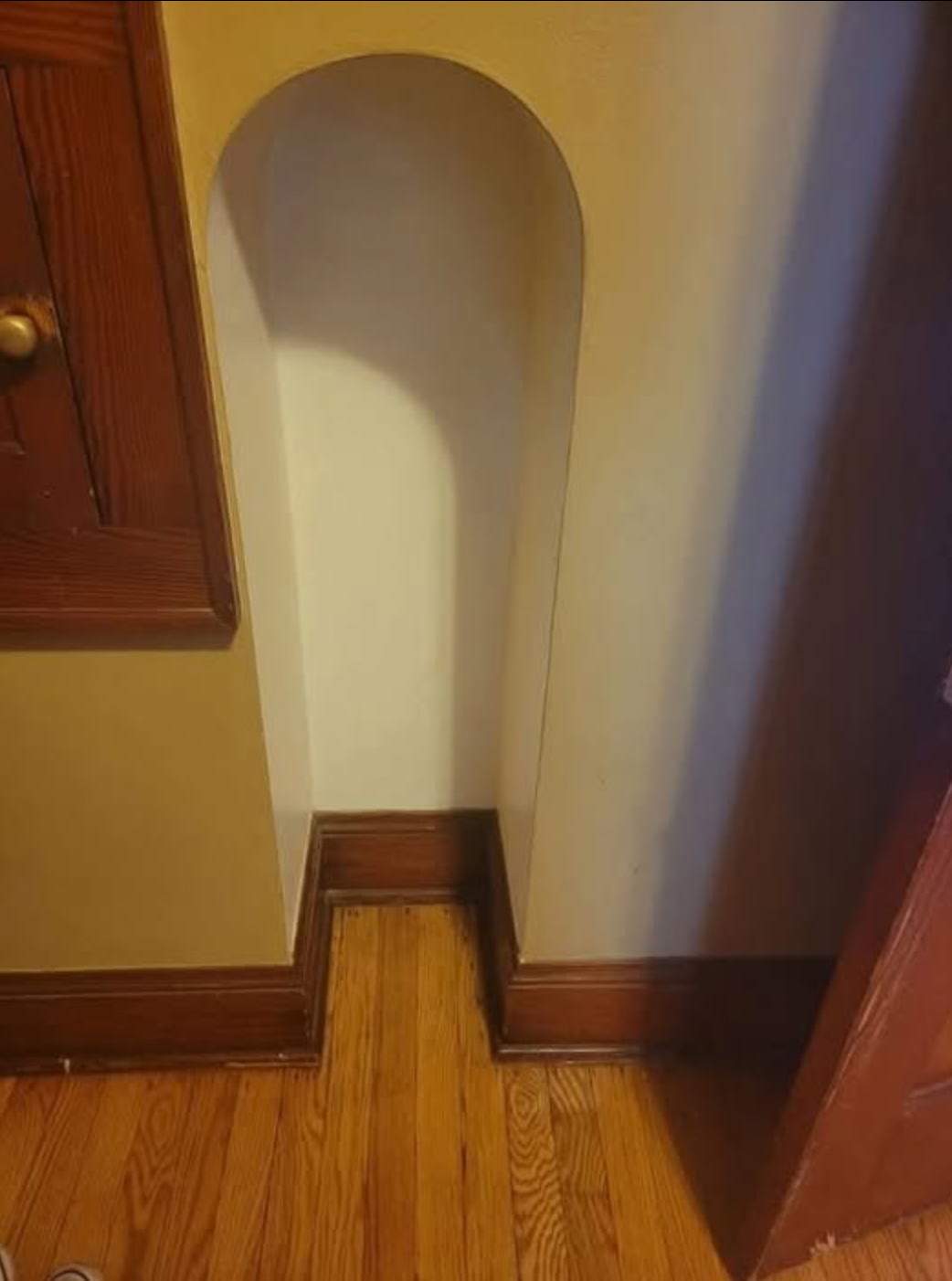
When I moved into my charming 1940-something house a couple of years ago, I expected the usual surprises that come with older homes: creaky floorboards that speak when you walk, odd little drafts in winter, doors that don’t quite close unless you give them a firm push, and that unmistakable smell of history—wood, plaster, and time.
What I didn’t expect was to be confronted by a feature so strange, so oddly specific, and so stubbornly confusing that it would become a running joke in my home for months.
It was the hallway nook.
Not a closet. Not a shelf. Not an alcove deep enough to be useful. Just… a weird little cut-out space in the wall.
And it was impossible to ignore.
The First Time I Saw It, I Just Stared
It happened on move-in day. I was walking boxes in and out, sweaty and tired, doing that classic new-home ritual of mentally rearranging furniture while simultaneously wondering why you own so many random cords.
And then I noticed it.
Right there in the hallway, carved into the wall like the builder had a sudden burst of creativity and then got interrupted halfway through.
It wasn’t particularly deep—definitely not deep enough for anything practical like storage. It was about three feet high at its peak, and the shape was… honestly hard to describe without gesturing wildly.
It was almost triangular.
Like a narrow wedge that started wider at the bottom and then tapered upward, getting tighter and tighter, as if the wall itself was slowly pinching it shut.
For a full five minutes I just stood there, staring, with my brain doing that confused buffering thing.
“What… is this?”
It Was Too Small for Everything I Tried
At first, I assumed it must have had a purpose that would become obvious once I settled in.
Maybe it was meant for a small decorative table.
Maybe it was for a tall plant.
Maybe it was for one of those vintage hallway telephone stations (you know, the little shelf and stool situation).
But no.
The more I looked, the less sense it made.
I tried ideas.
Attempt #1: The Bookshelf Plan
I grabbed a few books and tried stacking them in there.
It looked ridiculous.
Too shallow, too narrow, and the slanted upper edge made it feel like the nook was actively rejecting the concept of literature.
Attempt #2: The Vase Idea
I tried placing a vase inside it, thinking maybe it could be one of those charming architectural display niches.
The vase fit… kind of.
But it looked awkward. Like the nook was not designed for beauty, only for mystery.
Attempt #3: The “Maybe It’s for Shoes” Theory
Nope.
The opening was too narrow, and it felt strange to have shoes displayed like museum pieces in the hallway.
Attempt #4: The “Let’s Pretend It’s Art” Strategy
I even considered hanging something inside it—like turning it into a mini gallery.
But it didn’t feel like a display nook either.
It felt like something functional that had lost its instructions.
The Nook Became a Silent House Puzzle
Weeks turned into months.
And the nook stayed empty.
Not because I didn’t care, but because it felt like a question that refused to be answered.
Every time I walked past it, I’d glance over like it might suddenly reveal itself.
It became the hallway’s little secret.
Guests noticed it too.
And without fail, someone would ask:
“So… what is that?”
And I would shrug, laugh awkwardly, and say something like:
“I don’t know. It came with the house.”
But deep down, it bothered me more than I wanted to admit.
Because old houses don’t usually do random things.
Older homes—especially from the 1940s—tend to have features that made perfect sense at the time:
built-in ironing boards
milk doors
laundry chutes
transom windows
phone niches
coal doors
strange little cupboards for linens
So why would a builder carve out a weird triangle in the hallway wall just for fun?
I Started Noticing the Shape Was… Familiar
One day, while cleaning (or more accurately, pretending to clean while procrastinating), I looked at it again and thought:
“This shape reminds me of something.”
Not a shelf.
Not a cabinet.
Not a decorative niche.
It looked like the negative space left behind when something else is installed.
Like a missing piece.
Like a place something used to fit.
And that’s when the theories started.
The Theories (And They Got Weird Fast)
Once I became obsessed, my brain went full detective mode.
Theory 1: “It Used to Hold a Statue”
Maybe in the 1940s someone placed a religious statue there, like a Mary niche.
But it didn’t look elegant enough.
It looked more like… infrastructure.
Theory 2: “It Was for a Phone”
Some homes had built-in phone shelves.
But this wasn’t shaped right. Also, it wasn’t positioned in a way that would be convenient for someone standing and talking.
Theory 3: “A Secret Storage Spot”
Maybe it opened somehow?
Maybe there was a hidden panel?
I tapped the walls like a cartoon burglar.
Nothing.
Theory 4: “It Was a Vent or Duct Space”
Now this one felt closer.
Because the triangle shape looked like it was following the slope of something inside the wall.
Something angled.
Something structural.
The Breakthrough: I Finally Found the Answer
Eventually, I did what every modern homeowner does when faced with an ancient mystery:
I took a photo.
I posted it online.
And I waited for the internet to do its thing.
Within minutes, people started responding with confidence that was both comforting and mildly insulting.
Because apparently… this mystery is very common.
And the answer was:
It’s the space for a staircase.
More specifically:
It’s Likely a “Stair Nook” from a Previous Layout (or an Access/Return Space)
In many older homes, especially from the 1930s–1950s, the hallway layout was often built around:
staircases
heating ducts
chimney chases
angled framing supports
That triangular shape is a big clue.
Because when you have a staircase behind a wall, the underside of the stairs creates an angled empty space—exactly like a triangle tapering upward.
Sometimes builders:
leave it as a closed wall
turn it into a closet
install a small cabinet
or leave a shallow nook if the space isn’t deep enough for full storage
And in some houses, renovations over the decades change the interior structure—closing off an old stair access, re-routing hallways, moving doors—and you’re left with a strange leftover space like this.
So that nook isn’t random.
It’s architectural “leftovers.”
A fossil.
A clue.
Why It’s So Common in 1940s Homes
Homes built in that era often featured:
compact hallways
staircases tucked tightly
plaster walls over framing that doesn’t allow easy remodeling
heating systems retrofitted later (ducts, returns)
So instead of rebuilding the whole wall, builders would do what builders often do:
They’d make it “good enough.”
And decades later, a new homeowner (me) stands there confused with a vase in hand, wondering if the house is messing with them.
What You Can Do With It Now (Fun, Practical Ideas)
Now that you know it likely relates to a staircase/structural angle, you can still make it useful.
Here are genuinely good ideas:
1) Mini Built-In Shelves
Custom shallow shelves can turn it into:
a book nook
candle shelf
decor corner
2) A Charging Station
Since it’s in the hallway, you can add:
a small shelf
hooks
a basket
phone charging
3) Display Niche
Add:
LED strip lighting
a framed photo
a small sculpture
And suddenly it becomes intentional.
4) Pet Nook
If you have a cat:
small bed
tiny curtain
it becomes a “cat cave”
5) Seasonal Corner
Decorate by season:
winter greenery
spring flowers
fall pumpkins
People will assume it was designed for that.
The Best Part? It’s Not Just a Nook—It’s a Story
Once I learned the truth, I stopped seeing it as an annoying empty space.
It became something else.
It became a reminder that houses have layers.
That your home has lived multiple lives.
That people walked these halls long before you—carrying laundry baskets, holding kids by the hand, rushing to answer the phone, warming the house with old heating systems.
That weird nook?
It’s not just an awkward triangle.
It’s history you can touch.