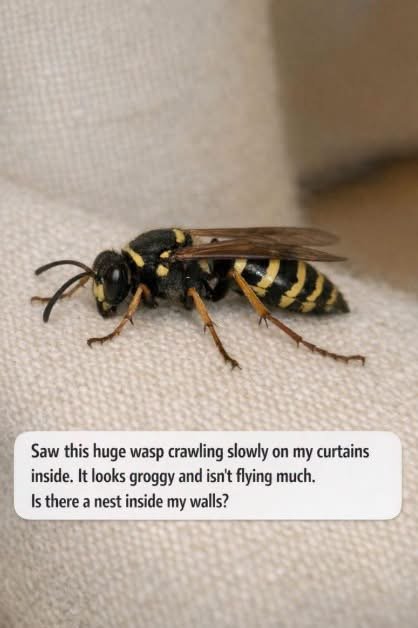
Saw This Huge Wasp Crawling Slowly on My Curtains? Here’s What It Could Mean
Have you ever walked into a room and suddenly noticed a large wasp crawling slowly across the curtains? It can be an unsettling sight, especially when the insect looks unusually sluggish, barely flies, or seems almost “groggy.”
The first question that often comes to mind is: Could there be a wasp nest hidden somewhere inside the walls?
The answer is not necessarily.
A single wasp inside the house does not automatically mean that a colony has established itself behind the walls. Wasps can enter through open windows and doors, small gaps, vents, damaged screens, or even arrive accidentally on clothing, plants, bags, or other objects brought indoors. The source article also notes that cooler temperatures can make wasps considerably less active, which may explain why an insect that normally flies rapidly is suddenly moving slowly.
However, repeated sightings are different. If you continue finding wasps inside your home, particularly around the same room, wall, window, or opening, it is worth investigating further.
Why Is the Wasp Moving So Slowly?
Wasps are usually associated with quick movements and active flying, so a large wasp crawling slowly across a curtain can look unusual.
One possible explanation is temperature.
Wasps are ectothermic insects, meaning their activity is strongly influenced by environmental temperature. When temperatures become cooler, their movements can slow considerably. A wasp that would normally fly quickly in warm outdoor conditions may instead crawl slowly or remain almost motionless when it becomes chilled.
The source article specifically explains that cooler conditions toward the end of the wasps’ active season can make them appear lethargic.
The Wasp May Simply Be Trapped
Another possibility is that the insect entered your home accidentally and is now trying to find its way out.
Windows are particularly important because wasps can be attracted to natural light. A wasp may crawl across curtains because it is attempting to reach the window.
If it cannot find an opening, it may continue crawling instead of flying normally.
This can make the insect appear sick or unusually weak when it may simply be cold, tired, disoriented, or trapped indoors.
Does One Wasp Mean There Is a Nest Inside the Wall?
No.
Finding a single wasp is not enough evidence to conclude that you have a nest inside your house.
A wasp can enter through:
- Open windows
- Open doors
- Damaged window screens
- Small cracks
- Gaps around windows
- Roof openings
- Vents
- Gaps around pipes or cables
- Exterior wall openings
- Other small structural spaces
The source article also points out that an insect can occasionally enter the home on clothing, bags, plants, or objects brought inside.
Therefore, seeing one wasp crawling across a curtain shouldn’t immediately lead to the conclusion that a colony is living inside your walls.
The pattern of activity is much more informative than one isolated encounter.
Why You Might See Wasps Indoors Toward the End of the Season
Paper wasps and other social wasps are generally more active during warmer periods.
During the warmer part of the year, colonies can be highly active, with workers moving around and searching for food and materials.
As temperatures begin to fall, their behavior can change.
You may notice individual wasps around buildings or occasionally inside homes as they search for sheltered areas. A chilled wasp may move slowly and spend more time crawling than flying.
This is one reason a slow-moving wasp shouldn’t automatically be interpreted as proof of a hidden nest.
The source article specifically notes that paper wasps can become less active as temperatures fall and that this can make them appear lethargic.
When Should You Actually Suspect a Wasp Nest?
While one wasp isn’t necessarily a reason to panic, repeated activity deserves attention.
Instead of concentrating on the size of the wasp or how slowly it is moving, look for a pattern.
1. Several Wasps Appear in the Same Area
If you start seeing multiple wasps around the same window, wall, ceiling, or room, pay closer attention.
One insect could be accidental.
Several insects repeatedly appearing in one location may indicate that there is a nearby entry point or nesting area.
2. Wasps Keep Entering the Same Opening
This is a particularly useful clue.
If you observe wasps repeatedly entering and leaving the same small gap, crack, vent, or opening, there may be a nest somewhere nearby.
The source article identifies repeated movement through one opening as a more meaningful sign of a nearby nest than simply finding one wasp indoors.
3. Activity Around the Eaves or Roof
Check the exterior of the house from a safe distance.
Pay attention to areas such as:
- Eaves
- Soffits
- Roof edges
- Vents
- Exterior wall gaps
- Window frames
- Cracks around the structure
Repeated wasp activity around one location can be a useful warning sign.
4. You Hear Buzzing
In some situations, insect activity may be noticeable through buzzing from a concealed area.
If you repeatedly hear buzzing coming from one wall, ceiling, or other enclosed space while also seeing wasps nearby, don’t ignore the combination of signs.
However, avoid hitting, drilling, or opening the wall to investigate.
Why Was the Wasp on the Curtain?
The location actually makes sense.
Curtains are usually next to windows, and windows provide natural light.
An indoor wasp that is trying to escape may naturally move toward the brightest area of the room.
If the window is closed, screened, or otherwise inaccessible, the wasp may crawl along the curtain while attempting to find a way outside.
So the fact that you discovered it on a curtain doesn’t mean the curtain or wall is where the insect came from.
It may simply have been looking for an exit.
What Should You Do If You Find One Wasp?
If you discover a single wasp inside, try not to panic.
If you are comfortable doing so and can maintain a safe distance, creating an obvious route outdoors may help.
For example, if appropriate, you can open a nearby exterior window and allow the insect an opportunity to leave.
However, don’t take unnecessary risks.
If you’re allergic to insect stings, uncomfortable around wasps, or the insect appears highly active or aggressive, keep your distance and have someone else handle the situation.
For a single insect, the safest approach depends on your circumstances and your ability to avoid being stung.
What If You Find Several Wasps?
This situation deserves more attention.
If several wasps begin appearing inside your home, particularly within a short period of time, don’t automatically assume that every insect is entering randomly.
There could be an entry point somewhere nearby.
There could also potentially be a nest in a sheltered area such as an attic, roof space, wall cavity, or another protected location.
The important thing is not to disturb a suspected nest.
Don’t start cutting into walls, removing ceiling panels, or aggressively investigating an inaccessible cavity yourself.
A disturbed colony may become defensive.
Should You Seal the Hole Where Wasps Are Entering?
This can be more complicated than it seems.
If you see wasps entering through a crack, your first instinct may be to immediately seal the opening.
But if an active nest is located inside the structure, closing the entrance without dealing with the colony can potentially cause problems.
The insects may search for another route.
That route could potentially lead toward the interior of your home.
For this reason, if you strongly suspect that an active nest is inside a wall or other inaccessible space, professional assessment is preferable before permanently sealing an opening.
How to Reduce the Chance of Wasps Entering Your Home
Once you’ve dealt with the immediate situation, prevention can help reduce future encounters.
Check Your Window Screens
Inspect screens for:
- Holes
- Tears
- Loose edges
- Gaps
- Poorly fitted corners
Even a relatively small opening can provide an entry route for insects.
Check Exterior Doors
Look around your exterior doors for gaps.
Weather stripping and door sweeps can help reduce unwanted openings around doors.
Inspect Exterior Gaps
Look around windows, vents, pipes, utility lines, siding, and other areas where there may be openings.
Appropriate exterior gaps can be sealed as part of normal home maintenance.
Keep Food and Drinks Covered Outdoors
Wasps may be attracted to food and sugary drinks.
When eating outside, keep beverages and food covered when possible.
Clean up spills and food scraps promptly, and keep garbage containers properly closed.
Don’t Confuse One Wasp With an Infestation
It’s easy to become alarmed after seeing one large insect inside the home.
But there is an important difference between:
“I found one wasp.”
and
“Wasps are repeatedly entering my house through the same location.”
The first situation may simply be an isolated indoor visitor.
The second deserves investigation.
This distinction is one of the main points of the original article.
When Should You Contact a Professional?
Consider professional help if:
- You repeatedly see wasps indoors.
- Several wasps appear in the house.
- Wasps repeatedly enter or leave one opening.
- You see substantial activity around a wall or roof area.
- You hear persistent buzzing from a concealed space.
- You can see a nest but cannot safely reach it.
- You suspect a nest inside a wall or attic.
- Someone in the household has a serious insect-sting allergy.
A professional can assess the situation without requiring you to disturb a potentially active colony.
What If the Wasp Is Extremely Large?
Size alone doesn’t tell you whether an insect has established a nest in your home.
There are numerous wasp species, and some naturally look much larger than the familiar yellow-and-black wasps people commonly encounter.
Therefore, don’t try to identify the situation solely from the insect’s size.
If identification matters, a clear photograph taken from a safe distance can help an insect expert determine what species you’re dealing with.
But if you are concerned about a possible nest, the more important question is usually not “How big is this wasp?” but rather:
“Are there repeated signs of wasp activity around my home?”
Frequently Asked Questions
Does one wasp inside mean there is a nest?
No. One wasp can enter accidentally through a window, door, gap, vent, or other opening.
Why is the wasp crawling instead of flying?
Cool temperatures, exhaustion, disorientation, or being trapped indoors can all contribute to reduced activity.
Why do wasps appear near curtains?
Curtains are often located beside windows. A wasp may be attracted toward the light while searching for an exit.
Should I open the window?
If you can do so safely, providing an exit may allow a lone indoor wasp to leave. Don’t approach or handle it if doing so would put you at risk.
How can I tell if there is a nest?
Look for repeated activity: multiple wasps, repeated entry and exit through the same opening, activity around eaves or vents, or persistent insect activity from a concealed location.
Should I open my wall to look for the nest?
No. If you suspect a nest inside a wall, avoid disturbing the structure and consider professional assistance.
Can a wasp become slow because it is cold?
Yes. Cooler conditions can substantially reduce wasp activity, causing them to crawl slowly or appear lethargic.
Final Thoughts
Finding a huge wasp crawling slowly across your curtains can certainly be frightening, especially when the insect looks too sluggish to fly.
But one slow-moving wasp doesn’t automatically mean that a hidden nest is living inside your walls.
It may have simply entered through an open window or another small opening, become disoriented, or slowed down because of cooler temperatures. The location near a curtain can also make sense because the insect may be trying to reach the light coming through a nearby window.
The thing to watch is repetition.
If you see one wasp and then nothing else, it may have been an isolated visitor. If you begin seeing several wasps, particularly around the same opening or part of your house, that’s when the situation deserves closer attention.
And if you suspect that a nest is inside a wall, attic, roof space, or another inaccessible location, avoid disturbing it yourself.
Sometimes a frightening-looking wasp really is just a lost insect that accidentally found its way indoors. But repeated activity is the clue that tells you it’s time to investigate further.

Welcome to my kitchen!
I’m a passionate home cook and recipe creator who loves turning simple ingredients into delicious, comforting meals that everyone can enjoy. Through this website, I share carefully prepared recipes, practical cooking tips, and easy-to-understand food education to help you feel more confident in the kitchen.
My goal is to make cooking simple, enjoyable, and accessible. Whether you are looking for a quick family dinner, a delicious dessert, healthy meal ideas, or traditional recipes with a modern touch, you’ll find inspiration here.
More Than Just Recipes
I believe that cooking is also a way to learn. That’s why this website is not only about recipes. I also create educational articles about ingredients, cooking techniques, kitchen tips, food preparation, and the stories behind different dishes.
Each article is designed to give you useful knowledge that you can apply in your own kitchen. From understanding how ingredients work together to learning better cooking methods, my aim is to help you become a more confident and creative cook.
My Philosophy
Good food doesn’t always require complicated ingredients or professional equipment. With a little knowledge, patience, and creativity, simple ingredients can become something truly special.
I believe in sharing recipes that are practical, clearly explained, and enjoyable to make. I also love exploring new flavors while appreciating traditional cooking and the recipes passed down through generations.
Thank you for visiting my kitchen and being part of this food-loving community. I hope my recipes and articles inspire you to cook, learn, experiment, and most importantly, enjoy every bite!
Happy cooking!