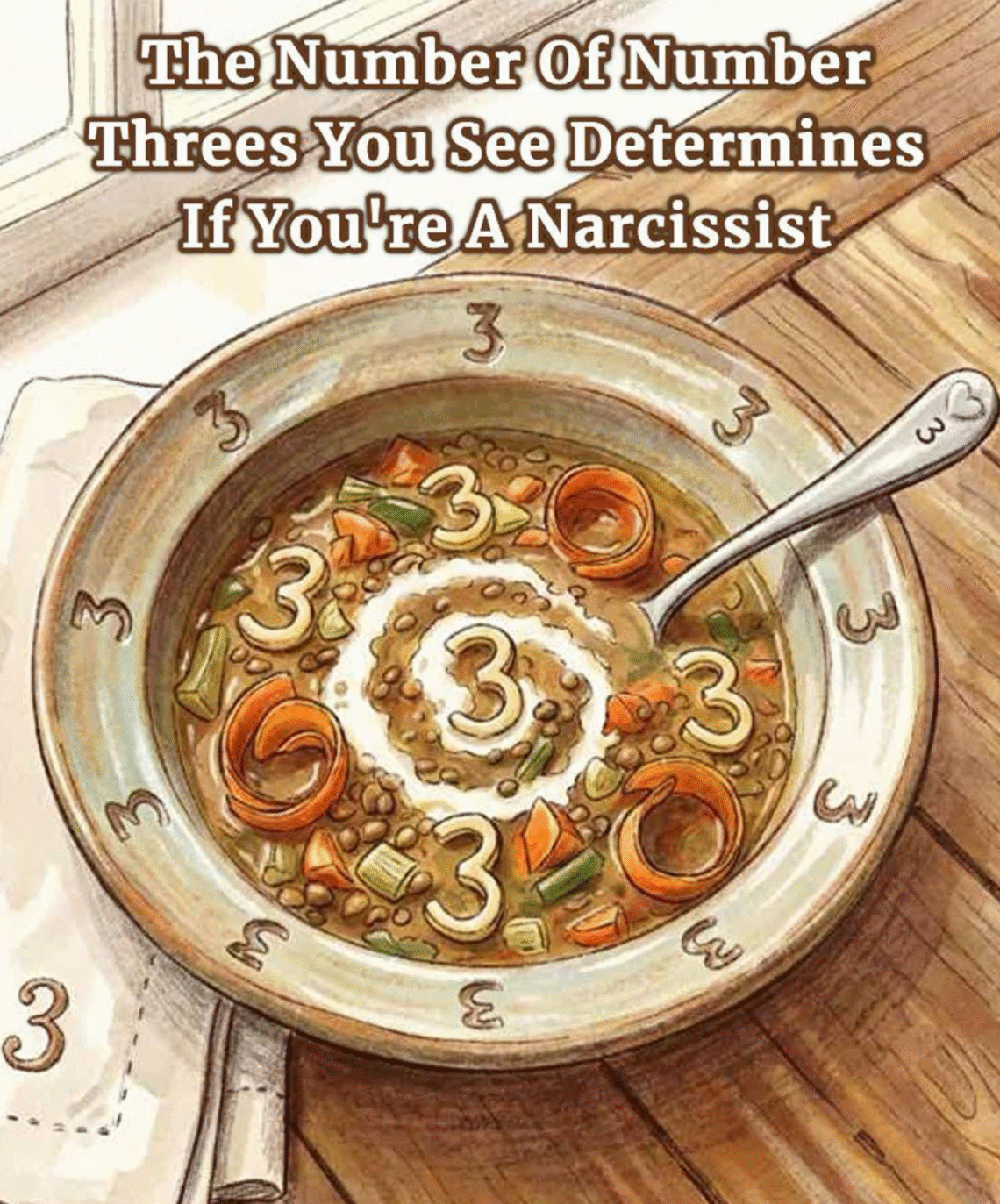
At first glance, the image appears simple, almost unremarkable.
A bowl of soup rests on a wooden table. Steam rises gently from its surface, curling into the air in soft, drifting lines. A spoon lies nearby, angled casually, as if just set down moments ago. The scene feels ordinary and familiar, the kind of everyday moment that barely registers as something worth examining. It suggests comfort, routine, and stillness—perhaps a quiet kitchen on a calm afternoon.
But then you look again.
And something subtle begins to change.
When the Ordinary Starts to Shift
The second glance lingers a little longer. Your eyes trace the curves of the bowl, then the circular rim, then the spiral of steam lifting upward. The spoon’s handle arcs gently, echoing the same rounded shapes. Shadows fall in soft bends rather than straight lines. What once felt like random design now begins to feel patterned.
Without consciously trying, your brain starts to connect these shapes.
And that is when something curious happens.
You begin to notice the number three.
Not explicitly written, not printed anywhere, but implied—suggested through form, repetition, and alignment. Three curves here. Three visible wisps of steam there. Perhaps three prominent shapes that seem to group themselves naturally. Once the idea takes hold, it becomes hard to ignore. The number appears again and again, as though it had been there all along, waiting for your attention to catch up.
Why the Brain Sees Patterns That Were Always There
Psychologists explain this phenomenon as a natural function of human perception. The brain is wired to seek patterns, especially in environments that are calm and visually coherent. When there is no immediate threat or task demanding urgency, the mind becomes more exploratory, more open to subtle details.
The number three holds particular power in perception. Humans naturally find groups of three satisfying and stable. It is the smallest number that forms a pattern rather than a pair, and it appears frequently in art, design, storytelling, and nature. Triangles are structurally strong. Three-part rhythms feel complete. Visually, three elements often create balance without monotony.
Once your brain becomes aware of the possibility of “three,” it begins scanning for it automatically.
Attention, Not Personality, Drives What You Notice
It may be tempting to believe that noticing more number threes reveals something deep about who you are as a person. But researchers caution against that interpretation. This kind of observation says far more about where your attention is directed in that moment than about fixed personality traits.
If you notice many instances of the number three, it likely means:
- You allowed your gaze to slow down
- You engaged in open-ended observation rather than goal-driven looking
- You became receptive to patterns instead of dismissing details as irrelevant
Someone else viewing the same image might notice texture, warmth, or mood instead. Another person might focus on function—what kind of soup it is, whether it is hot, or who might be about to eat it. None of these responses are more “correct” than the others. They simply reflect different modes of attention.
The Role of Priming and Mental Focus
Once the idea of the number three is introduced—either by suggestion or by your own discovery—it acts as a mental filter. Psychologists call this priming. Your mind becomes temporarily tuned to a specific concept, increasing the likelihood that you will notice it repeatedly.
This does not mean the number three suddenly appeared. It means your attention shifted.
In everyday life, this happens constantly. When you learn a new word, you start hearing it everywhere. When you consider buying a certain car, you suddenly see that model on every street. The brain highlights what it has been told matters.
Why This Moment Feels Strangely Meaningful
There is something quietly compelling about noticing patterns in an ordinary scene. It creates the feeling that there is more beneath the surface, that meaning is hidden in plain sight. This sensation can feel almost philosophical, even though it arises from basic cognitive processes.
The comfort of the image—the soup, the table, the stillness—makes it easier to sink into this mode of observation. Without distraction or urgency, attention becomes playful. The mind explores instead of evaluates.
That is why moments like this can feel oddly calming, even absorbing.
What It Ultimately Reveals
How many number threes you notice does not define your personality, intelligence, or emotional state. Instead, it reveals something quieter and more temporary: how present you were willing to be.
It reflects a moment when you slowed down enough to let your eyes wander, when you allowed an ordinary image to unfold gradually rather than rushing past it. The number three becomes less important than the act of noticing itself.