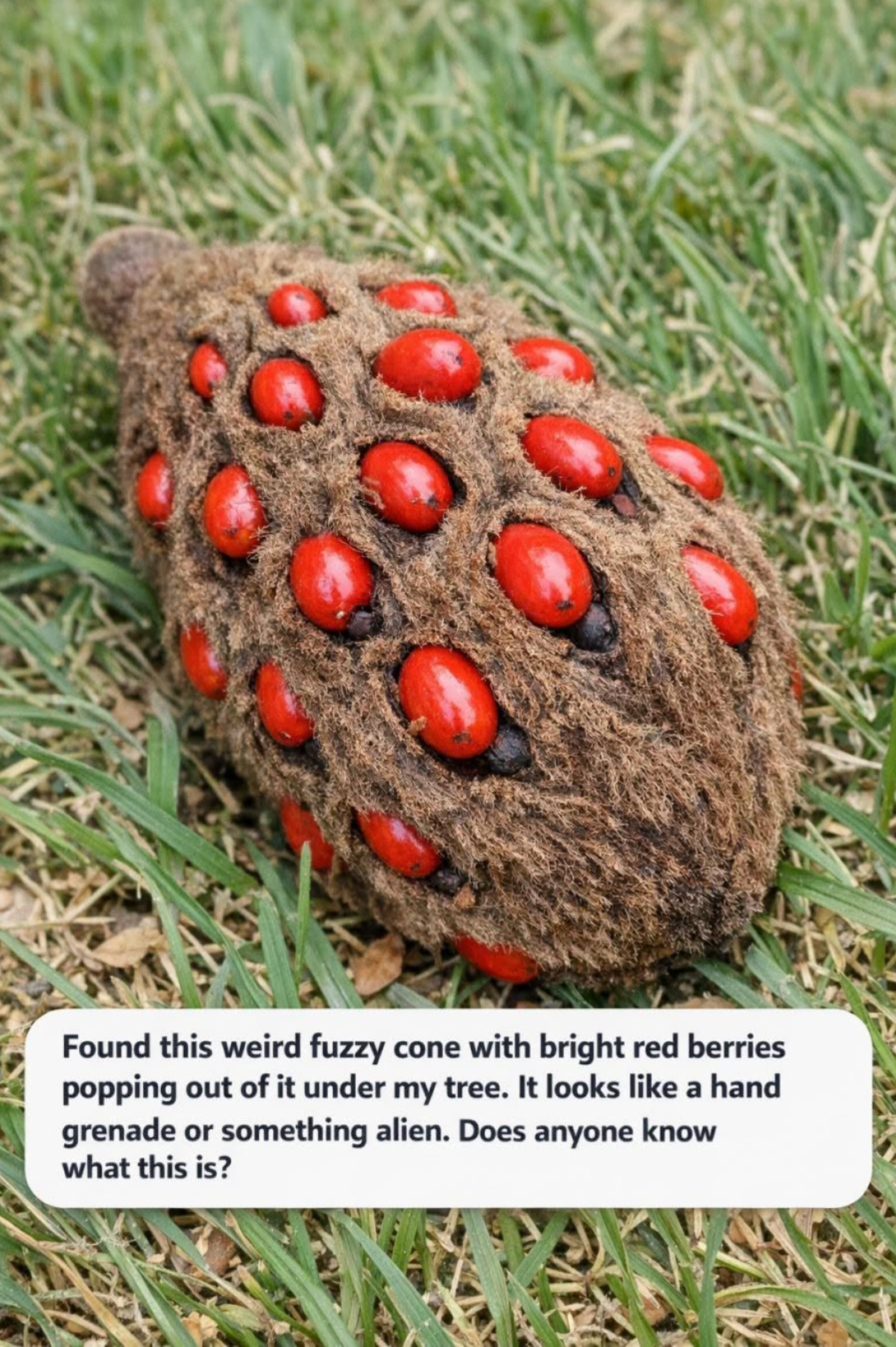
At first glance, it looks like something from another planet.
You’re walking beneath a tree, perhaps clearing away fallen leaves or checking the garden after a rainy morning, when you notice an unusual object lying on the ground.
It looks like a small, fuzzy cone.
The outside is covered in strange fibers or bristles, and the shape is unlike anything you normally expect to find beneath a tree.
Then you notice something even more surprising.
The object appears to have split open, revealing several brilliant red structures that look remarkably like tiny berries.
For a moment, you might wonder whether you’re looking at a strange fruit, an exotic flower, an insect nest, or even some kind of fungus.
It is exactly the sort of natural discovery that makes you stop what you’re doing and take a second look.
But the explanation is often much more ordinary—and much more fascinating—than it first appears.
It May Be a Galls or Fungal Growth Associated With a Tree
One important possibility for unusual fuzzy, cone-like growths beneath trees is a plant gall or another specialized growth associated with a particular tree species.
Plant galls are abnormal-looking structures produced when plants respond to organisms such as certain insects, mites, fungi, or bacteria.
They can be astonishingly diverse.
Some resemble balls.
Others look like tiny horns, fuzzy cushions, spikes, cones, or miniature pieces of fruit.
The plant isn’t necessarily “sick” in the ordinary sense.
Instead, the gall is the result of a complicated interaction between the plant and another organism.
Why Would a Tree Produce Something So Strange?
A gall can form when another organism interferes with the plant’s normal growth.
Certain insects, for example, can stimulate plant tissue to grow in unusual ways.
The resulting structure provides protection and, in some cases, food or shelter for the organism responsible for producing it.
In other words, what looks like a strange little ornament may actually be part of a biological relationship taking place between the tree and another species.
Nature has an extraordinary talent for turning ordinary plant tissue into something that looks completely alien.
And What About Those Bright Red “Berries”?
This is where identification becomes especially interesting.
The red structures may not actually be berries at all.
Depending on the species and what you’re looking at, red objects associated with a fuzzy or hairy structure could be reproductive structures, seeds, spores, fruiting structures, or parts of a gall.
That’s why it’s risky to identify an unfamiliar object simply by saying, “It looks like berries.”
Nature frequently produces structures that resemble familiar objects without actually being related to them.
A red, rounded shape isn’t necessarily a berry.
A fuzzy cone isn’t necessarily a seed pod.
And something growing from or beneath a tree isn’t necessarily a mushroom.
One Famous Possibility: Cedar-Apple Rust
If the object was found beneath or near a cedar or juniper, one particularly interesting possibility is cedar-apple rust.
This fungal disease has one of the strangest appearances in the plant world.
Under suitable conditions, the fungus can produce gelatinous orange or reddish structures on infected juniper tissues.
These structures can look remarkably unusual, especially after rain when they become swollen and conspicuous.
The fungus has a complicated life cycle involving different host plants, commonly junipers and various apple or crabapple relatives.
That means a strange growth on one tree can actually be connected biologically to plants growing elsewhere nearby.
It is a wonderful example of how interconnected an ecosystem can be.
Another Possibility: A Tree Fruit or Seed Structure
Sometimes the explanation is much simpler.
A fallen fruit, seed pod, or cone can change dramatically as it dries, splits, ages, or becomes exposed to moisture.
Something that looked completely ordinary when it was attached to a tree can look bizarre after falling to the ground.
The outer covering may crack open.
The interior may become visible.
Brightly colored seeds may emerge.
Fine hairs or fibers may catch on the surface.
After several days outdoors, decomposition can make the structure even more difficult to recognize.
This is why the location of the object matters so much.
Look Up at the Tree
If you discover a strange object beneath a tree, one of the best clues is often directly above you.
Look at the branches.
Are there similar structures still attached?
Do you see unusual leaves, cones, fruits, or growths?
Are there signs of insects?
Are there damaged branches?
Are there nearby trees of a different species?
Sometimes identifying the source is much easier than identifying the fallen object itself.
If dozens of similar objects are scattered beneath one particular tree, that’s an especially strong clue that they originated there.
Take a Photograph Before Touching It
If you want to identify an unusual natural object, photographs can be extremely useful.
Take a picture of the entire object from above.
Then photograph it from the side.
If it has opened, photograph the interior as well.
Take another picture showing the surrounding environment.
A close-up of the surface can reveal details that aren’t obvious to the naked eye.
Also record what kind of tree was nearby, if you know.
Was it an oak?
Pine?
Cedar or juniper?
Maple?
Fruit tree?
Different trees host very different organisms, so this information can dramatically narrow down the possibilities.
Don’t Assume That Bright Colors Mean Poison
A vivid red color can make an unfamiliar object look dangerous.
But color alone doesn’t tell you whether something is poisonous.
Plants, fungi, insects, and other organisms use bright colors for many different biological reasons.
Some colors help attract animals.
Others may protect reproductive structures.
Some are simply the result of pigments.
Therefore, don’t use color as a test of toxicity.
If you don’t know what the object is, don’t eat it and don’t allow children or pets to chew on it.
Why Does It Look Fuzzy?
The fuzzy appearance can have several explanations.
Fine hairs may be part of a plant structure.
Fungal growth can create delicate filaments.
Some galls have hairy or bristly surfaces.
Even dried plant fibers can give a fallen object a fuzzy appearance.
This is one of those situations where photographs and location are much more useful than appearance alone.
Two completely unrelated natural objects can both look like fuzzy little cones.
Rain Can Make Strange Things Even Stranger
Moisture can dramatically change the appearance of natural objects.
A dry structure may look hard and brown.
After rain, it can swell, soften, become more colorful, or reveal structures that were previously hidden.
Fungal reproductive structures are especially capable of changing appearance under different moisture conditions.
So if you discovered the object after a storm or several rainy days, that may be an important part of the explanation.
Is It Harmful to the Tree?
Not necessarily.
A single strange object beneath a tree doesn’t automatically indicate that the tree is unhealthy.
Some fungi and insects are natural parts of woodland ecosystems.
Others can cause plant diseases.
Still others simply use dead or decaying material.
If you repeatedly see unusual growths directly attached to living branches, widespread leaf damage, dying limbs, or other signs of decline, then the tree may deserve closer inspection.
For an important or valuable tree, an arborist or plant-disease specialist can provide a more reliable diagnosis.
Nature Loves Look-Alikes
One reason these discoveries are so fascinating is that nature repeatedly creates visual illusions.
A gall can look like fruit.
A fungus can resemble coral.
A seed pod can look like an insect nest.
A fungus can appear to be a piece of decaying wood.
And a group of seeds can look like tiny berries.
Our brains are constantly trying to classify unfamiliar objects by comparing them with things we already know.
Sometimes that first guess is completely wrong.
And that’s perfectly normal.
What Should You Do With It?
If you’re simply curious, the best first step is observation.
Leave it where it is and photograph it.
If it is in an area where children or pets could eat it, keep them away from it until you’ve identified it.
If you need to remove it, use reasonable precautions and avoid direct contact with anything unidentified.
Don’t taste it.
Don’t burn it.
Don’t use it as a food ingredient.
And don’t assume that an online photograph is enough to establish that an unfamiliar wild organism is edible.
The Fascinating Lesson Behind the Discovery
Perhaps the most interesting part of finding a strange fuzzy cone isn’t the object itself.
It’s the realization that the space beneath an ordinary tree can contain an entire miniature ecosystem.
Every fallen leaf, seed, cone, gall, fungus, insect, and fragment of bark can have a story.
What looks like a random piece of debris may actually represent part of an organism’s life cycle.
The bright red structures that appear to be tiny berries may have a completely different biological purpose.
The fuzzy exterior may be protecting something.
The tree overhead may be hosting an interaction that is almost invisible to us.
And all of it can be happening quietly beneath our feet.
Before You Decide What It Is
The next time you discover something strange beneath a tree, resist the temptation to immediately label it.
Instead, ask a few simple questions:
What tree is it beneath?
Is the object attached to the tree or merely lying underneath it?
Are similar objects still growing above?
Did the weather recently change?
Does the object contain seeds, spores, insects, or another structure?
Is there evidence of damage to the surrounding plant?
Those observations can turn a mystery into an identification.