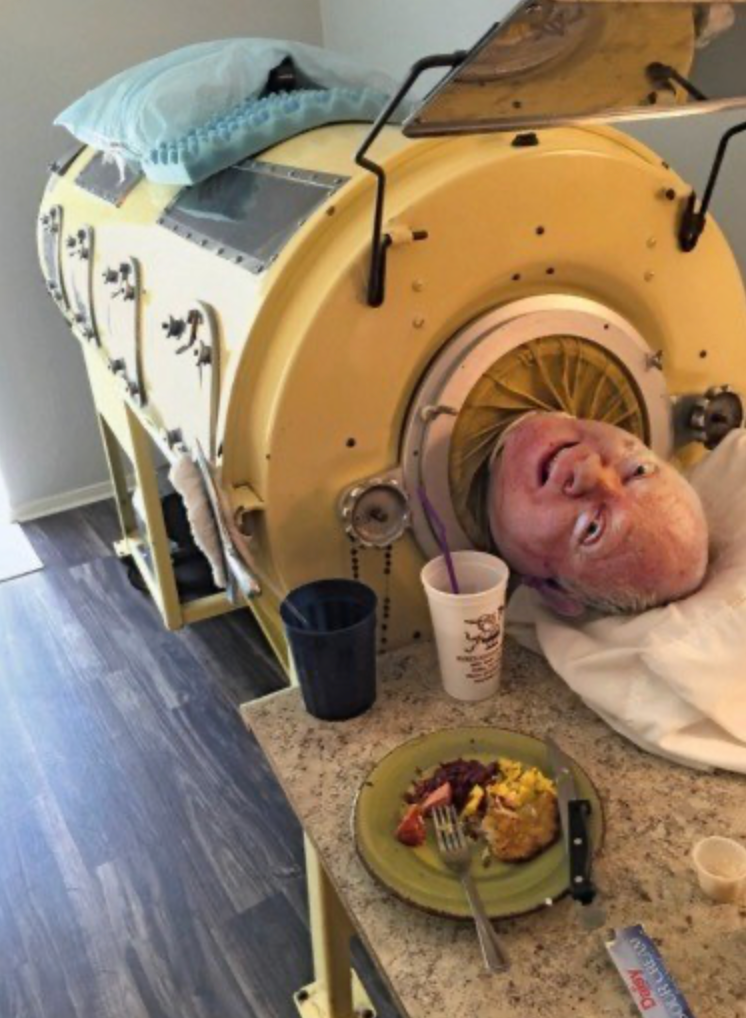
At first glance, an iron lung seems like something from another era — a massive steel cylinder, clanking and humming, a machine that kept countless children alive when the world was at war with polio. For most people, the iron lung is a historical artifact. But for one man, now 76 years old, it has remained a constant companion, a life-saving machine he has relied on for seven decades.
Paralyzed by polio at age six, he survived a nightmare that once terrified every parent in America. Doctors told his family that he would never live past childhood, that the disease had weakened his muscles so severely he would not be able to breathe on his own. But he refused to accept that prediction. With unwavering determination, he became one of the longest-living polio survivors in history — and one of the last people in the world still using an iron lung.
Today, he describes his life with a sense of gratitude that surprises many. “My life is incredible,” he says, not with cliché optimism, but with a depth of understanding only someone who has battled death since childhood can possess.
The Day Everything Changed
He was a lively, energetic six-year-old boy when the symptoms began: fever, stiffness, exhaustion. Within days, he could no longer move or breathe his own breath. His body had been struck by the poliovirus, an illness that in the 1940s and 1950s paralyzed thousands of children each year.
Doctors rushed him into an iron lung, a room-sized machine that worked like an artificial diaphragm, expanding and contracting to help him breathe. Families were separated by glass windows; children lay motionless in long metal tubes; nurses moved quickly between rows of machines that sounded like rhythmic waves, keeping their young patients alive.
For many, the iron lung was a short-term life support device. But for him, it became permanent. His diaphragm had been too severely damaged. Without the machine, his lungs simply could not draw air.
That was nearly seventy years ago.
Growing Up Inside a Machine
Life inside an iron lung meant adapting to realities most people cannot imagine. The machine held his entire body except for his head, which rested on a padded support. Reading required a specially positioned mirror; playing meant imagining worlds beyond the steel walls; learning required teachers who were willing to sit beside the machine for hours.
Yet he refused to let physical circumstances limit his curiosity or his dreams. He pursued education with fierce focus, eventually becoming a brilliant student. Many assumed he would spend life hidden away, but he insisted on participating in the world as fully as possible.
The iron lung did not stop him. He found ways to write, to study, to socialize, and eventually to build a life rich in relationships, learning, and accomplishment.
A Testament to Strength, Ingenuity, and Survival
As technology advanced, most people dependent on iron lungs transitioned into modern ventilators. But for him, the iron lung worked better for his body than newer machines. He continued maintaining it — changing leather seals, replacing parts, keeping the vintage bellows moving with his own hands or the help of friends, volunteers, and medical technicians.
People often ask why he still uses such an old device. His answer is simple and honest: “It’s kept me alive my whole life. It works. And I trust it.”
The machine is a living reminder of a past medical era, but it is also a symbol of his resilience. He acknowledges that living with such a device is challenging — but not tragic. His outlook has always been shaped by gratitude rather than resentment.
An Extraordinary Life Beyond Limits
Despite severe paralysis, he built a full, meaningful life. He earned his education. He developed talents that surprised those around him. Some polio survivors became authors, lawyers, teachers — and he followed a similar path of intellectual and creative achievement.
He formed friendships that lasted decades. He became a mentor to younger generations, teaching them about perseverance, self-worth, and the importance of adaptive thinking. His home became a place where resilience was not just spoken about but lived daily.
He lived independently for many years, adapting his environment to fit his needs. Every task required planning and innovation, but he approached each challenge not with despair but with ingenuity. Those who know him describe him as remarkably positive, sharp-witted, and determined.
One of the Last of His Kind
As vaccines eradicated polio in most countries, the need for iron lungs disappeared. Manufacturers stopped producing them. Hospitals discarded them. Today, fewer than a handful of people worldwide still depend on them.
He is one of them.
And he treats that fact not as a burden, but as part of his extraordinary story.
The machine that once filled hospital wards with noise and hope remains by his side, a relic of the past but a lifeline of the present. Keeping it functioning requires dedication and resourcefulness. Volunteers, collectors, and medical enthusiasts help him locate spare parts — sometimes through auctions, scrapyards, or old hospitals. His machine is not just metal and motors; it is a survivor, just like him.
Gratitude at the Heart of Everything
When asked how he manages to stay so positive while facing such immense physical limitations, he offers a simple but profound answer:
“I have lived a life filled with love, purpose, and passion. I’ve known more joy than many people who have never spent a day in an iron lung. Every breath I take, this machine helps me take — and every breath reminds me that I’m still here. That is incredible.”
His story is one of courage, adaptation, and emotional strength. It is a reminder that life’s value is not determined by physical ability, but by one’s capacity to find meaning, connection, and purpose.
A Life That Continues to Inspire
Thousands of people around the world have discovered his story through interviews, documentaries, and articles. Many call him a symbol of endurance, hope, and human spirit. He never set out to be an inspiration — he simply wanted to live. But the honesty of his journey, the contrast between his limitations and his achievements, has deeply moved everyone who has heard his voice.
In a world focused on speed, convenience, and perfection, his life stands as a testament to patience, resilience, and gratitude. He shows that meaning can be found even under the most challenging conditions — and that the human spirit is far stronger than circumstance.